


You’re the one people rely on.
You hit deadlines. You return calls. You show up early. You keep promises.
You also pour a drink most nights—and lately, it’s not really optional.
As a clinician, I work with executives, physicians, attorneys, founders, parents, and high-level professionals who all say some version of the same thing:
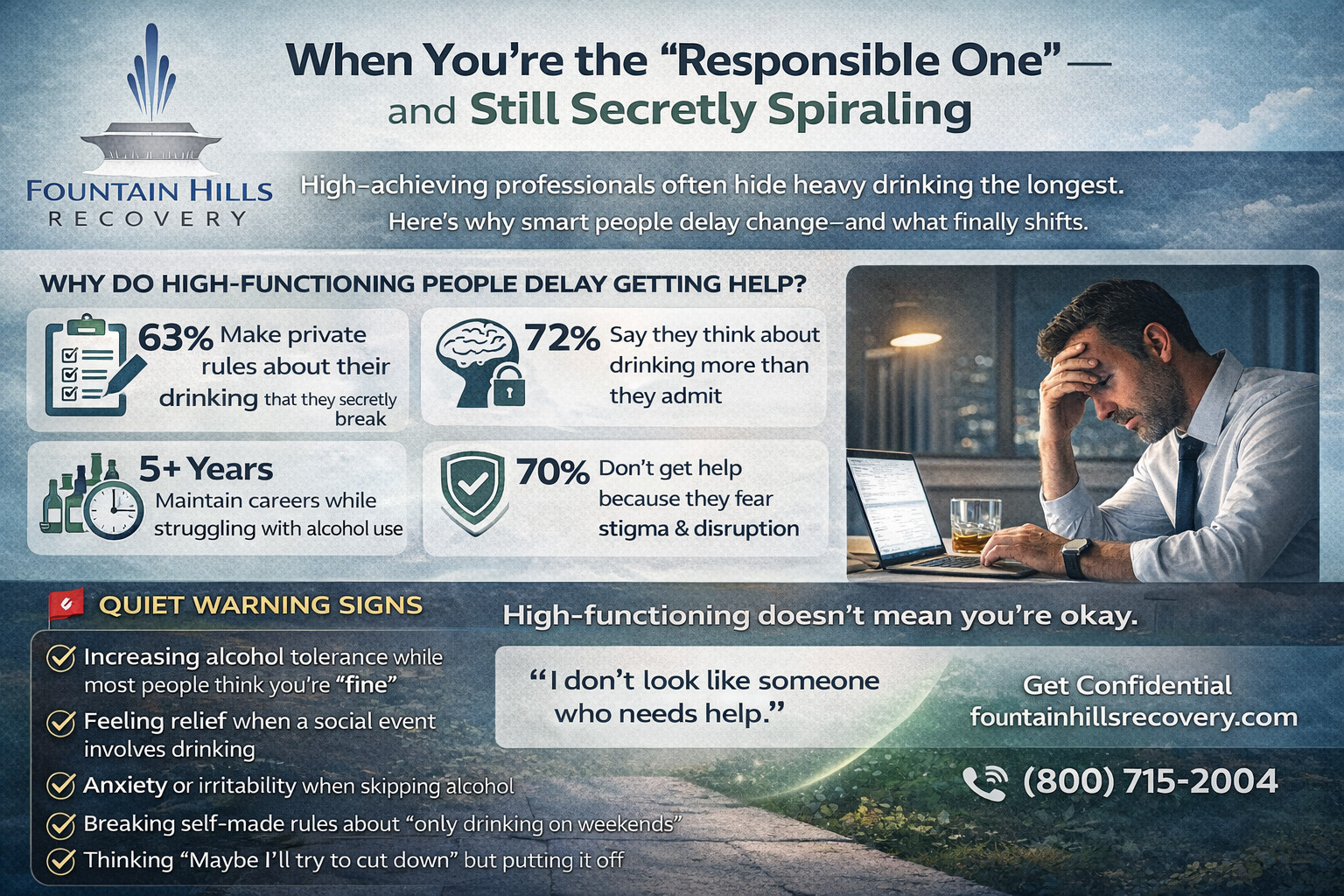
“I don’t look like someone who needs help.”
And that belief is exactly why they wait.
If you’ve quietly Googled options for alcohol addiction treatment but haven’t taken the next step, this is for you.
Not to scare you.
To level with you.
You’ve Built an Identity Around Competence
High-functioning people don’t panic easily.
You assess. You adapt. You optimize.
So when alcohol starts creeping from “reward” to “requirement,” you treat it like a systems problem.
You try:
- Only drinking on weekends
- Switching from liquor to wine
- No drinking before 7 p.m.
- Tracking units in an app
- Taking a “clean month” to reset
And when you manage a few good days—or even weeks—you convince yourself you’ve solved it.
But here’s what I often ask in session:
If you had truly solved it, would you still be thinking about it this much?
The mental energy alone is a signal.
When alcohol occupies planning space in a high-performing brain, it’s rarely casual anymore.
Success Becomes a Shield
You tell yourself:
- “I’ve never missed work.”
- “My kids are taken care of.”
- “I’m still making money.”
- “No one knows.”
And you’re right.
From the outside, nothing looks broken.
But high achievement can act as camouflage. Your structure protects you from consequences long enough to normalize behavior that would unravel someone else’s life faster.
You’re buffered by resources. By routine. By reputation.
That doesn’t mean the internal cost isn’t rising.
Sleep disruption. Irritability. Anxiety spikes at 3 a.m. Subtle memory gaps. A creeping dependence on that first drink to feel steady.
High-functioning drinking often looks polished.
It doesn’t feel polished.
You Redefine “Problem” to Stay Comfortable
Here’s a pattern I see frequently:
You define addiction as:
- Losing your job
- Getting arrested
- Drinking in the morning
- Physical withdrawal
And because you don’t meet those criteria (yet), you dismiss the concern.
But clinically, we don’t assess severity based only on catastrophe.
We look at patterns:
- Loss of control
- Increasing tolerance
- Persistent desire to cut down
- Continued use despite consequences
- Psychological reliance
You don’t have to implode to qualify for support.
Waiting for dramatic collapse is a strategy.
It’s just not a healthy one.
You’re Managing Stress With the One Tool That Makes It Worse
High achievers carry real pressure.
Leadership decisions. Financial exposure. Responsibility for teams or families.
Alcohol feels efficient. It quiets the noise fast.
But neurologically, alcohol increases baseline anxiety over time. It disrupts sleep architecture. It alters stress hormones. It reduces your brain’s natural capacity to regulate mood.
So what happens?
You drink to unwind.
You sleep poorly.
You wake up wired.
You power through the day.
You drink again to come down.
That cycle can run for years in high-functioning professionals.
The exhaustion you feel may not just be workload.
It may be chemical whiplash.
You’re Afraid Treatment Means Disruption
This is where many successful people stall.
You imagine:
- Stepping away from work for months
- Colleagues finding out
- Losing credibility
- Being “the one with a problem”
The image in your mind is often outdated or extreme.
In reality, care can be structured in different ways depending on clinical need and schedule. Some people benefit from live-in support. Others engage in structured daytime care or multi-day weekly treatment while maintaining key responsibilities.
The point isn’t to disappear from your life.
It’s to re-enter it more stable.
If you’re in Arizona and want options close to home, you can explore discreet support through treatment in Scottsdale or treatment in Fountain Hills.
The right plan should respect both your privacy and your reality.
You Fear the Identity Shift
Let’s say it plainly.
You’re scared of the word “alcoholic.”
You worry it will override everything else you’ve built.
But treatment isn’t about adopting a label. It’s about evaluating a pattern and deciding whether it’s sustainable.
I’ve worked with people who never publicly use that word and still do profound recovery work.
What matters isn’t the label.
It’s whether your relationship with alcohol is costing you more than it’s giving you.
Quiet Signs High-Functioning Professionals Ignore
You might be waiting too long if:
- You’ve made multiple private rules about drinking—and broken them
- You feel relief when social events are alcohol-focused because it gives you “permission”
- You’ve increased tolerance and need more to feel the same effect
- You experience irritability or anxiety when you skip a night
- You think about cutting back often but avoid fully trying
One of my clients once said:
“I’m not out of control. I’m just constantly managing.”
That’s not freedom.
That’s maintenance mode.
What Finally Moves Smart People to Act
It’s rarely a DUI.
Rarely a public meltdown.
It’s usually fatigue.
The fatigue of hiding.
The fatigue of negotiating.
The fatigue of wondering, How bad is this really?
And then the question shifts.
Instead of asking, “Is this bad enough?”
You ask, “Do I want to keep living like this?”
That’s the moment change becomes possible.
Not because you’re broken.
Because you’re done pretending this is sustainable.
FAQ: High-Functioning Drinking & Getting Help
How do I know if I actually need help if I’m still functioning?
Functioning isn’t the benchmark—freedom is.
If you’ve tried to cut back and can’t maintain it, feel psychological dependence, or notice growing mental and physical costs, it’s worth a clinical assessment. You don’t need to diagnose yourself. You just need to be willing to evaluate honestly.
Will treatment ruin my career?
Not seeking help is far more likely to damage your career long term.
Discreet care options exist. Many professionals complete structured programs and return to work clearer, sharper, and more emotionally regulated than they’ve felt in years.
Early intervention is often career-protective—not career-ending.
What if I’m not “that bad”?
That phrase alone is important. Many high-functioning individuals delay alcohol addiction treatment because they compare themselves to extreme cases.
The better question is: Is your current relationship with alcohol aligned with the life you want? If not, waiting won’t make alignment easier.
Can I just moderate instead of stopping completely?
Some people attempt moderation successfully. Many attempt it repeatedly and find the mental effort exhausting.
A structured assessment can help determine what’s clinically realistic for you. White-knuckling it alone often leads to cycles of short-term success and longer-term relapse.
I’m scared of being judged. Will I be?
No. Professionals in this field understand high-functioning patterns intimately. We see the intelligence, the drive, and the pressure you carry.
The goal isn’t to shame you. It’s to stabilize you.
What if I’ve tried before and it didn’t stick?
Previous attempts don’t mean you’re incapable.
They often mean the level of care, structure, or underlying mental health components weren’t fully addressed.
When mental health and substance use collide, surface-level change rarely lasts. Deeper work changes outcomes.
A Direct Word From a Clinician
If you’re high-achieving and quietly struggling, you are not weak.
You are likely overextended, under-rested, and chemically dysregulated.
And you’re smart enough to see patterns forming before they explode.
That’s an advantage.
The question is whether you’ll use that intelligence to intervene early—or to keep justifying the status quo.
You don’t have to wait for collapse to deserve support.
Call (800) 715-2004 or visit our alcohol addiction treatment services in to learn more about your next step.
You’ve built a life worth protecting. Now protect yourself.