


You’re still showing up. Still answering emails. Still laughing at the right moments.
But when you’re alone, it feels heavier than it should.
If you’re sober curious—or just life-curious—you might already be questioning patterns, habits, moods. And somewhere in that questioning, you’ve probably wondered whether you should look into depression treatment.
Then the second voice kicks in.
It’s not that bad.
Other people have it worse.
I should be able to handle this.
At Fountain Hills Recovery, we meet people in this exact space every day. Not in crisis. Not falling apart. Just quietly worn down and unsure if they’re “allowed” to ask for help.
If that’s you, here’s how to approach this without forcing yourself into labels you’re not ready for.
Step 1: Stop Measuring Your Pain Against Someone Else’s
Depression doesn’t always look dramatic.
It can look like:
- Cancelling plans you used to enjoy.
- Feeling emotionally flat instead of deeply sad.
- Getting through the day but dreading it.
- Snapping at people you care about.
- Sleeping too much—or not enough—but never feeling rested.
You don’t need to be crying constantly.
You don’t need to lose your job.
You don’t need a catastrophic moment.
If something feels persistently off, that matters.
One of the most common things we hear is, “I don’t think it’s severe enough.” But if you’re researching help at 11 p.m. while telling yourself it’s fine—that’s worth listening to.
Pain doesn’t need to qualify for assistance. It just needs to be present.
Step 2: Get Curious Instead of Decisive
You don’t have to decide today that you have a diagnosis.
You don’t have to commit to a 30-day plan.
You don’t have to promise to change your entire life.
Curiosity is enough.
Try asking yourself:
- When did I last feel steady?
- Am I more numb than I used to be?
- Do I wake up feeling neutral—or already behind?
- Have the people close to me noticed a shift?
Curiosity lowers the stakes. It keeps this exploratory instead of dramatic.
You’re not declaring something is wrong with you.
You’re asking if something could feel better.
That’s a very different posture.
Step 3: Understand That “Functioning” Isn’t the Same as Thriving
High-functioning depression is real. You can pay bills, show up to work, even excel professionally—and still feel empty.
Functioning means you’re surviving.
Thriving means you feel connected, purposeful, present.
If your internal world feels like you’re dragging a weighted blanket through every task, that’s not something you have to normalize forever.
A clinical conversation doesn’t take away your independence. It gives you information.
Sometimes what people need is weekly therapy.
Sometimes structured daytime care helps reset things.
Sometimes medication support stabilizes what willpower can’t.
The goal isn’t to overhaul your identity. It’s to remove unnecessary suffering.
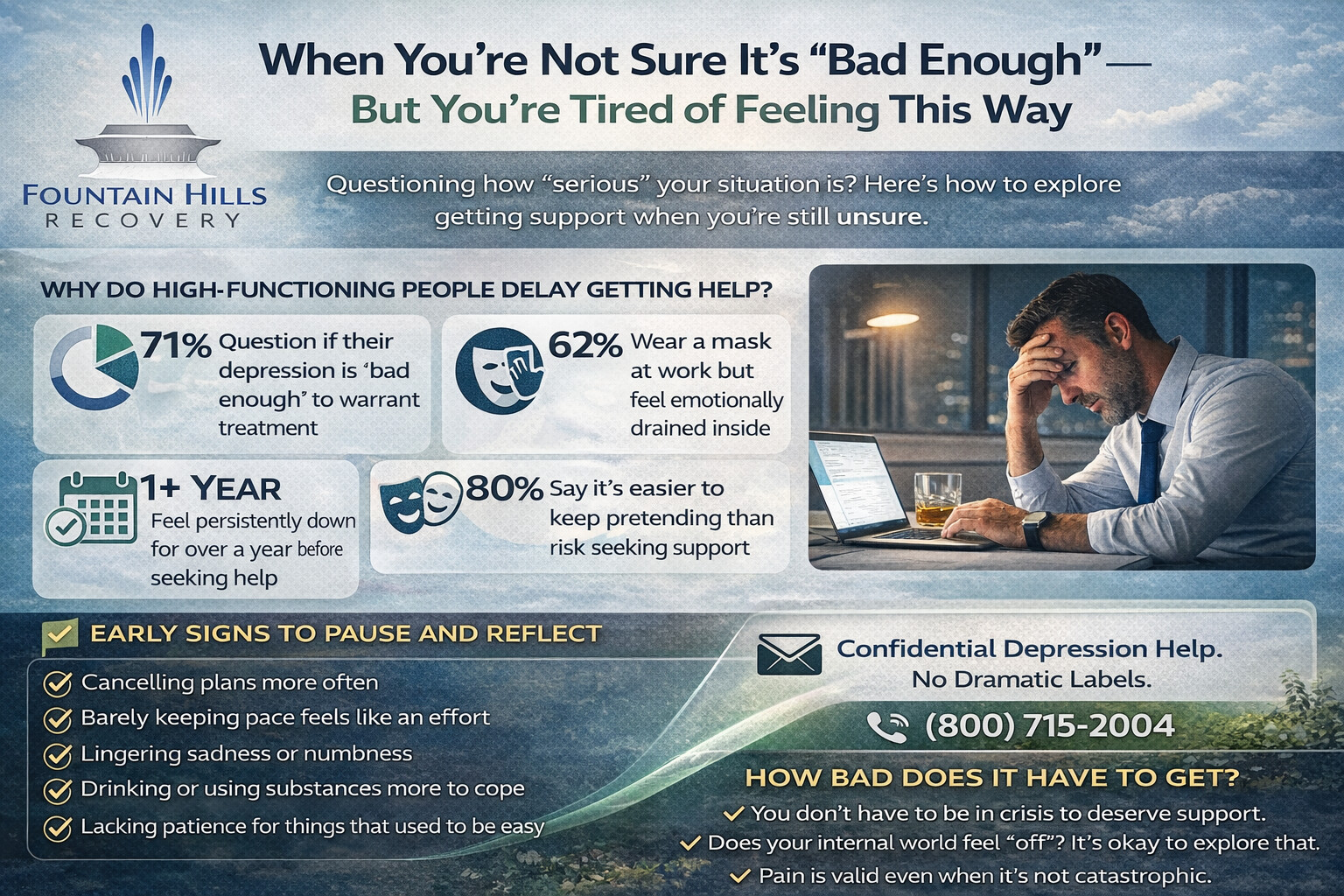
Step 4: Count the Quiet Costs
Depression has a way of shrinking your world in subtle ways.
It narrows:
- Your patience.
- Your creativity.
- Your social energy.
- Your willingness to try.
You may still be “fine.” But maybe you’re less you.
The longer low-grade depression lingers, the more it can hardwire itself into your routines. What once felt temporary starts to feel like personality.
It’s not.
One of the most powerful realizations people have after starting care is this: “I didn’t realize how much I had normalized.”
You don’t have to wait until it becomes unmanageable.
Step 5: Choose the Smallest Possible First Step
You don’t need certainty. You need movement.
That might look like:
- Calling and asking what an evaluation involves.
- Scheduling a consultation without committing beyond that.
- Asking about multi-day weekly treatment if you need more support but can’t step away from life entirely.
- Exploring therapy options before deciding anything else.
If you’re exploring care in Scottsdale Addiction Rehab and Mental Health, proximity can make this less intimidating. Being close to home matters when you’re unsure.
And if you’re considering support in Fountain Hills Drug and mental health services, staying local can help you feel anchored while you sort this out.
The first step should feel manageable—not overwhelming.
Step 6: Let the Assessment Be Information, Not a Verdict
Many people avoid reaching out because they’re afraid of what they’ll hear.
What if it’s “worse” than they think?
What if it confirms something they don’t want to admit?
Here’s the reality: an assessment is a conversation, not a sentence.
It’s collaborative. It’s paced. It’s designed to understand your symptoms, your history, and your goals.
You are not signing your autonomy away.
You’re gathering clarity.
Clarity reduces fear. Vagueness increases it.
Step 7: Allow the Possibility That You Could Feel Better
Depression is convincing.
It tells you:
- “This is just adulthood.”
- “You’re just tired.”
- “Nothing would really change anyway.”
But many people are shocked by how different they feel once symptoms begin to lift.
Energy returns gradually.
Interest creeps back in.
Your internal dialogue softens.
Hope doesn’t have to feel cinematic. It can be practical:
What if this heaviness isn’t permanent?
That question alone is enough to justify exploring support.
Frequently Asked Questions
How do I know if I really need professional help?
If your mood has been persistently low, flat, or irritable for weeks or months—and it’s affecting your relationships, work, or enjoyment of life—it’s worth talking to someone. You don’t need to be in crisis. Early support often prevents things from escalating.
What if I’m just stressed?
Stress and depression can overlap. A professional assessment helps clarify whether you’re experiencing situational stress, clinical symptoms, or a combination. The goal isn’t to label you—it’s to understand what’s driving how you feel.
Will I automatically be put on medication?
No. Treatment recommendations are individualized. Some people benefit from therapy alone. Others benefit from a combination of therapy and medication support. You always have a say in your care plan.
What if I’m not ready for something intensive?
That’s okay. Not everyone needs live-in treatment or daily programming. Options can range from weekly therapy to structured daytime care to multi-day weekly treatment. The right level of support depends on your symptoms, schedule, and goals.
Can I still work or go to school?
In many cases, yes. Treatment plans can be built around your life. Many people continue working or studying while participating in care. Flexibility matters, especially when you’re just beginning.
What if I start and decide it’s not for me?
You’re not locked in. Treatment is collaborative. If something isn’t working, adjustments can be made. The process is designed to support you—not trap you.
I’m sober curious. What if my mood is connected to alcohol or substance use?
It might be. Substances can impact mood significantly—even when use feels moderate. Part of a clinical conversation is exploring all contributing factors without judgment. You don’t need to identify as an addict to examine the connection.
If you’re still questioning yourself, that’s normal.
Most people who eventually seek help didn’t wake up one day fully certain. They reached a point where staying the same felt harder than exploring change.
You don’t need dramatic certainty.
You need enough honesty to say, “This isn’t working for me anymore.”
Call 800-715-2004 or visit our Depression Treatment services in to learn more about our Depression Treatment services in Scottsdale, AZ.