


I said I’d never come back.
Not in a dramatic way. Not slamming doors or storming off.
Just quietly, to myself.
“I’m not doing that again.”
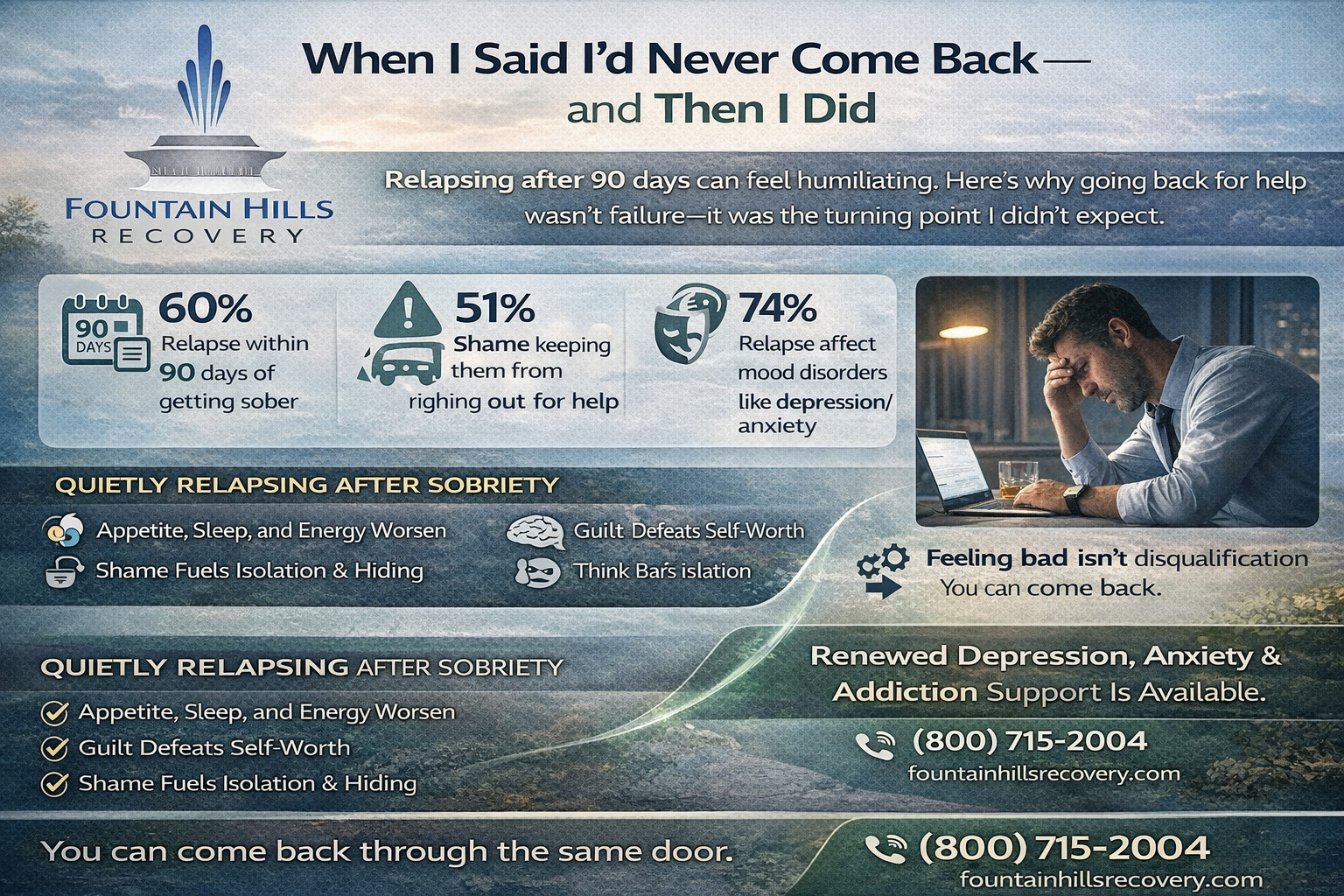
Ninety days sober felt like proof. Proof that I could handle it. Proof that I wasn’t “that bad.” Proof that whatever happened before was a phase.
Then depression came back—slow at first. Like a fog rolling in under the door. I didn’t even notice it until I couldn’t see clearly anymore.
And when I relapsed, the shame hit harder than the symptoms.
If you’re an alum reading this after slipping, I know that mix of emotions. The disorientation. The embarrassment. The quiet panic of, “I don’t even know if I can do this again.”
I didn’t want to go back for support. I wanted to disappear.
But disappearing is what got me there in the first place.
Within the first few days of spiraling, I found myself back on the page for depression treatment, not because I was hopeful—but because I was tired of pretending I didn’t need it.
That’s the part no one talks about enough: going back isn’t about weakness. It’s about honesty.
I Thought Relapse Erased Everything
That was the lie that almost kept me away for good.
I told myself:
- “You wasted everyone’s time.”
- “You should’ve known better.”
- “They’re going to look at you differently.”
- “You had your chance.”
Depression loves absolutes. Always. Never. Ruined. Hopeless.
But relapse didn’t erase my progress. It exposed what was unfinished.
I still had coping skills. I still had insight. I still had 90 days of lived experience proving I could build something better.
What I didn’t have was ongoing support when my mood started to collapse again.
There’s a difference between stabilizing and healing. I confused the two.
The Depression Came Back Quieter — and Meaner
The first time, my depression was obvious. I couldn’t get out of bed. I was openly miserable.
The second time, it was subtle.
I started canceling plans.
Stopped returning texts.
Snapped at people over nothing.
Stayed up too late.
Told myself I was “just tired.”
But underneath it was something heavier.
A flatness.
A dull ache.
A low hum of “What’s the point?”
I wasn’t in crisis. I was drifting.
And drifting is dangerous when you’ve already fought this hard to stay afloat.
Depression doesn’t always kick the door down. Sometimes it just slowly rearranges your thoughts until you can’t tell which ones are yours anymore.
By the time I relapsed, it wasn’t dramatic. It was almost predictable.
That scared me more than anything.
Pride Is a Dangerous Coping Mechanism
Here’s the spicy truth.
Part of me liked being “the one who made it.”
After 90 days, people treat you differently. There’s respect. There’s admiration. You become someone others look to.
Going back meant surrendering that identity.
It meant saying, “I’m not done.”
And I hated that.
But here’s what I had to learn: recovery isn’t about image. It’s about maintenance.
If your car starts shaking at 60 miles an hour, you don’t say, “Well, it ran fine for 3 months, so I guess I’m good.” You pull over and fix it.
Depression requires maintenance. Sometimes that means stepping back into structured daytime care. Sometimes it means multi-day weekly treatment. Sometimes it means adjusting medication, therapy, or support systems.
It doesn’t mean you failed.
It means your brain and nervous system need reinforcement.
Walking Back In Was the Hardest Step
I almost turned around in the parking lot.
The shame was physical. My chest was tight. My thoughts were racing.
I was bracing for disappointment.
Instead, I got, “We’re really glad you’re here.”
No lectures. No raised eyebrows. No “What happened?”
Just steady support.
That matters.
The second time wasn’t a repeat of the first. It went deeper. We talked about the perfectionism that fueled my crash. The pressure I put on myself to feel better quickly. The way I isolated the second things felt off because I didn’t want anyone to see me struggle again.
Depression feeds in isolation.
Going back interrupted that cycle.
What Changed the Second Time
I wasn’t a beginner anymore.
I knew the language. I knew the structure. I knew the rhythms of treatment. That familiarity actually made it more powerful.
Instead of learning what coping skills were, I learned when I avoid using them.
Instead of talking about obvious triggers, I talked about subtle emotional shifts.
Instead of trying to impress anyone, I told the truth.
That’s what made the difference.
The second time wasn’t about surviving crisis.
It was about preventing the next one.
And if you’re considering returning to treatment for depression, know this: you’re not starting from scratch. You’re building on experience.
There’s support available in Arizona, including care in Scottsdale Addiction Rehab and Mental Health, for people who need to recalibrate—not restart.
If You’re Avoiding the Call
Let me say what you might be thinking:
- “I can handle it myself.”
- “It wasn’t that bad.”
- “I don’t want to explain.”
- “I’m embarrassed.”
- “I’ll just wait and see if it passes.”
That last one almost cost me everything.
Depression rarely “passes” when it’s tied to relapse patterns. It deepens. It isolates. It distorts.
Calling again doesn’t mean you’re weak.
It means you recognize a pattern before it swallows you whole.
You’re not the first alum to come back.
You won’t be the last.
And the door isn’t locked.
FAQ: Going Back After Relapse & Depression
Is it normal to relapse after 90 days?
More normal than people admit.
Early recovery—especially when depression is involved—is still stabilization. Ninety days is significant, but it’s not immunity. Relapse can signal unresolved mood symptoms, stress, or insufficient support—not moral failure.
Does going back mean treatment didn’t work the first time?
No. It likely means it worked enough to help you stabilize—but depression is layered. Many people need continued or stepped-up support as life stressors evolve.
Recovery isn’t a one-and-done experience. It’s responsive.
What if I’m ashamed to face the staff again?
Shame is common. But treatment teams expect re-engagement. They understand relapse as part of many recovery journeys. You’re not a disappointment—you’re someone seeking support before things spiral further.
That’s responsible.
How do I know if I need structured support again?
You might benefit from returning if:
- Your mood feels persistently low or flat
- You’re isolating more than usual
- Sleep and appetite are disrupted
- You’ve relapsed or are close to it
- Coping skills feel out of reach
- You’re thinking, “I don’t want to do this again” but also “I can’t keep going like this”
When in doubt, reaching out doesn’t commit you to anything. It opens a conversation.
Will it feel like starting over?
Emotionally, maybe. Clinically, no. You bring insight, experience, and awareness with you. That changes the work. It can actually deepen it.
What if I wait too long?
Depression tends to narrow perspective over time. The longer it goes untreated, the harder it can feel to initiate change.
Earlier intervention often means less disruption and shorter stabilization time.
You deserve relief sooner—not later.
This Isn’t the End of Your Story
Relapsing after 90 days can feel like the closing chapter. It isn’t. It’s a comma.
Your nervous system still remembers what safety feels like. Your brain still remembers clarity. Your body still knows what stability is.
Depression may tell you it’s pointless to try again. It’s wrong.
If you’re in Arizona and need renewed support, options are available—including care in Scottsdale Addiction Rehab and Mental Health. You don’t have to pretend you’re fine just because you once were.
Going back wasn’t humiliation.
It was self-respect. It was choosing life again.
Call (800) 715-2004 or visit our Depression Treatment services in to learn more about our Depression Treatment services in Scottsdale, AZ.