
There’s a kind of silence that can settle in after sobriety.
You’re months—or years—past your last drink, past your last day in treatment. Life is steady. You’re not falling apart. You’re not in crisis. But something inside you feels… flat. Disconnected. Like the light’s still on, but nobody’s really home.
If that’s familiar, this blog is for you.
Not because something’s wrong—but because something might be calling. A quiet nudge. A reminder. This isn’t about relapse. This is about realignment. And it’s something we’ve seen before.
You’re not broken. You’re not failing. This is part of the arc. And we want to say something we should’ve said more often: here’s what we hoped you’d carry with you after our residential treatment program. Then, now, and in the middle of this strange stillness you might be in.
We Hoped You’d Learn to Name What’s Real
In treatment, we talked about feelings all the time. Naming them. Sitting with them. Not numbing out or chasing escape.
We hoped that practice would stay with you—not just during grief or stress, but in the quieter moments too.
Like now.
When things aren’t bad, just… dulled. When it feels like you’re moving through life on autopilot, not crashing but not really living either. That emotional flatness isn’t a failure—it’s a signal.
And your ability to name it—that’s the gift. The skill. The compass.
Because people in long-term recovery often aren’t running from catastrophe. They’re drifting from vitality. And naming that drift is the first step back to shore.
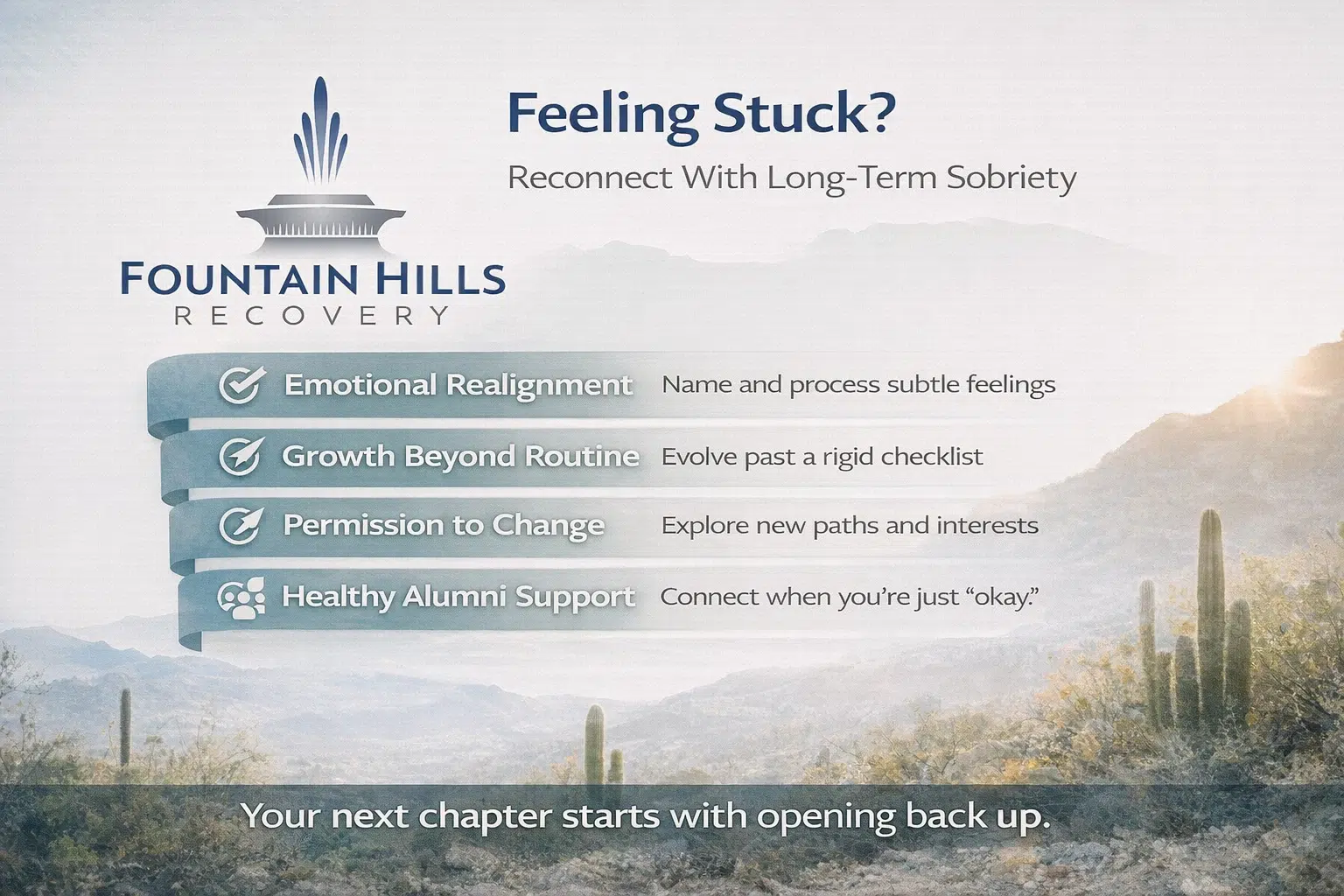
We Hoped You’d Outgrow the Checklist
Let’s be honest. Structure saves lives early on. Routines, commitments, guardrails—they matter. And we built our residential treatment program with that kind of solid scaffolding for a reason.
But it was never meant to be the whole house.
We hoped you’d outgrow the checklist—not abandon it, but grow beyond it. We hoped you’d stop measuring recovery by whether you hit every mark and start asking bigger questions.
Like:
- What makes me feel most like myself?
- Where am I coasting?
- What actually lights me up these days?
Because long-term recovery is not about checking boxes. It’s about building a life that doesn’t require constant repair.
We Hoped You’d Keep Evolving
Recovery is not a fixed identity. It’s not a personality trait. It’s not your final form.
We hoped you’d give yourself permission to change—to shift spiritually, emotionally, creatively.
Maybe you’re realizing the people you once leaned on don’t fit anymore. Maybe you’re rethinking your career. Maybe you’re noticing that what once felt like freedom now feels like a script.
All of that is valid.
You don’t have to stay who you were when you got sober. You’re allowed to evolve. In fact, we hoped you would.
We Hoped You’d Be Gentle With the Loneliness
Even in long-term recovery, loneliness can show up in sneaky ways.
You might be surrounded by people and still feel isolated. You might go to meetings and leave feeling unseen. You might smile on a Zoom call and feel hollow when you hang up.
We hoped you’d remember that loneliness isn’t a problem to fix—it’s a feeling to meet.
It doesn’t mean you’re doing something wrong. It just means you’re human. And when you can sit with it—not escape it—you’ll find what it’s pointing to: a hunger for something real. Something new. Something next.
And maybe that starts with one text. One walk. One honest moment.
We Hoped You’d Call When You Were Just “Fine”
This one might be the most important.
We hoped you’d reach out not just in the mess—but in the meh.
Because “fine” is the silent killer of depth. “Fine” keeps you from asking for more. “Fine” convinces you that wanting more means you’re greedy or dramatic or ungrateful.
It doesn’t.
You’re allowed to want more than stability. You’re allowed to want joy, purpose, spiritual fire. You’re allowed to say, “I’m grateful for what I have—and still, I’m restless.”
And you’re allowed to come back. Even if you’re not in crisis. Especially then.
Our residential treatment program was built for restarts and renewals. You don’t need a meltdown to deserve support.
We Hoped You’d Let It Get Messy Again
You don’t need to reinvent your life. But if something feels dull, it’s okay to disrupt it. We hoped you’d remember:
The mess didn’t mean you were failing. It meant you were in it. Engaged. Awake.
Don’t trade vibrancy for predictability. Don’t let fear of disruption keep you numb. Get curious again.
Try the weird class. Go on the awkward date. Take the walk without your phone. Text someone you used to laugh with. Meditate and hate it. Journal and throw it away.
Shake the box. See what rattles.
You can always return to your grounding tools. But don’t use them to keep life at arm’s length.
We Hoped You’d Know You Can Still Come Back
You don’t graduate from growth.
And if you’re reading this—maybe you already know. Maybe a part of you wants to reconnect. Not because things are falling apart, but because you want to feel more alive again.
Maybe it’s time for a few sessions. Or a deeper dive. Or just someone who remembers who you were when you showed up scared and left stronger.
We offer follow-up support and new treatment options in Scottsdale Addiction Rehab and Mental Health and beyond. And our doors are open.
Not just for the emergencies—but for the quiet mid-recovery ache you don’t always know how to name.
FAQ: Alumni Questions We Actually Love to Answer
I’m not in crisis. Can I still reach out?
Yes. You don’t have to be falling apart to come back. Many alumni reconnect just to feel more grounded, inspired, or emotionally supported.
I’ve drifted from recovery routines. Is that normal?
Absolutely. Life changes, and so do our needs. Drifting doesn’t mean failing—it means it might be time to realign or refresh.
Can I get support even if I finished treatment years ago?
Yes. We welcome alumni at any stage. Whether it’s been 6 months or 6 years, we’re still here for you.
I’m doing okay—but I feel spiritually stuck. What now?
That’s one of the most common long-term feelings. And it’s worth exploring. You might benefit from alumni groups, therapy, or just a reconnection point.
Do you offer help near Fountain Hills or Scottsdale?
Yes, we do. We offer options for help in Fountain Hills and surrounding areas. You’re not far from the next right step.
Your Story Isn’t Flat—It’s Just Between Beats
This part of your journey? It’s not failure. It’s a pause. A rest note in the music.
But maybe you’re ready to hear the next chord. To play a new part of the song.
You don’t need a crisis. You don’t need to justify. You just need to want something deeper again. Something real.
Call (800) 715-2004 to learn more about our residential treatment program in Scottsdale, Arizona.