
When your child starts using again—after therapy, after outpatient, after all the promises—it doesn’t just break your heart. It drains the hope right out of you.
You wonder if they’re even trying. You wonder if you did something wrong. And most painfully of all, you wonder if anything can still help.
That’s the question we hear from parents like you every day: “What could possibly make this time different?”
Here’s the honest answer: not everything works for everyone. But a true residential treatment program isn’t just a longer version of therapy or a stricter version of outpatient. It’s a different ecosystem entirely. And for some young adults, it’s the difference between staying stuck—and finally stepping forward.
1. It Removes Them from What’s Hurting Them
No matter how much your child says they want to stop, they can’t get better in the same environment that keeps triggering them. Friends, places, even smells—it all reinforces the cycle.
Residential treatment interrupts that cycle.
It offers total removal. Not punishment, not exile—relief. A place where the nervous system can finally exhale, where danger isn’t always around the corner.
They don’t wake up in the room where they used. They’re not walking past the liquor store every day. They’re surrounded by people who understand what they’re going through, and staff who aren’t judging—just showing up, again and again, with structure and care.
For many young adults, that’s what finally makes it possible to begin.
2. There’s Enough Time for Real Healing
Weekly therapy has value. But in 50-minute slices once a week, most of that time is spent catching up, not digging in.
In residential treatment, time is no longer the barrier.
Your child receives therapy multiple times per week—often including:
- Individual sessions with a licensed clinician
- Group therapy with peers who “get it”
- Family sessions that repair communication and trust
- Specialized support like trauma therapy, EMDR, or psychiatric care
And it’s not just formal therapy. The entire day is therapeutic. Mealtimes, med rounds, morning meditations—everything is built to support emotional growth.
It’s immersive. It’s slower. And for a burned-out young adult, that kind of container is life-changing.
3. It’s Not Just About Stopping—It’s About Starting Over
When someone stops using, they don’t automatically start thriving.
That’s where many programs fall short. They focus on abstinence but forget about reconstruction—rebuilding identity, learning how to handle stress, rediscovering motivation.
In our residential program, we ask bigger questions:
- Who are you without the substance?
- What do you want your life to feel like?
- How do you make decisions when no one is watching?
These aren’t rhetorical. We help clients explore them through life skills classes, creative expression, goal setting, and real conversations about what comes next.
It’s not just recovery—it’s re-entry into adulthood with more tools, more clarity, and more belief in themselves than they had before.
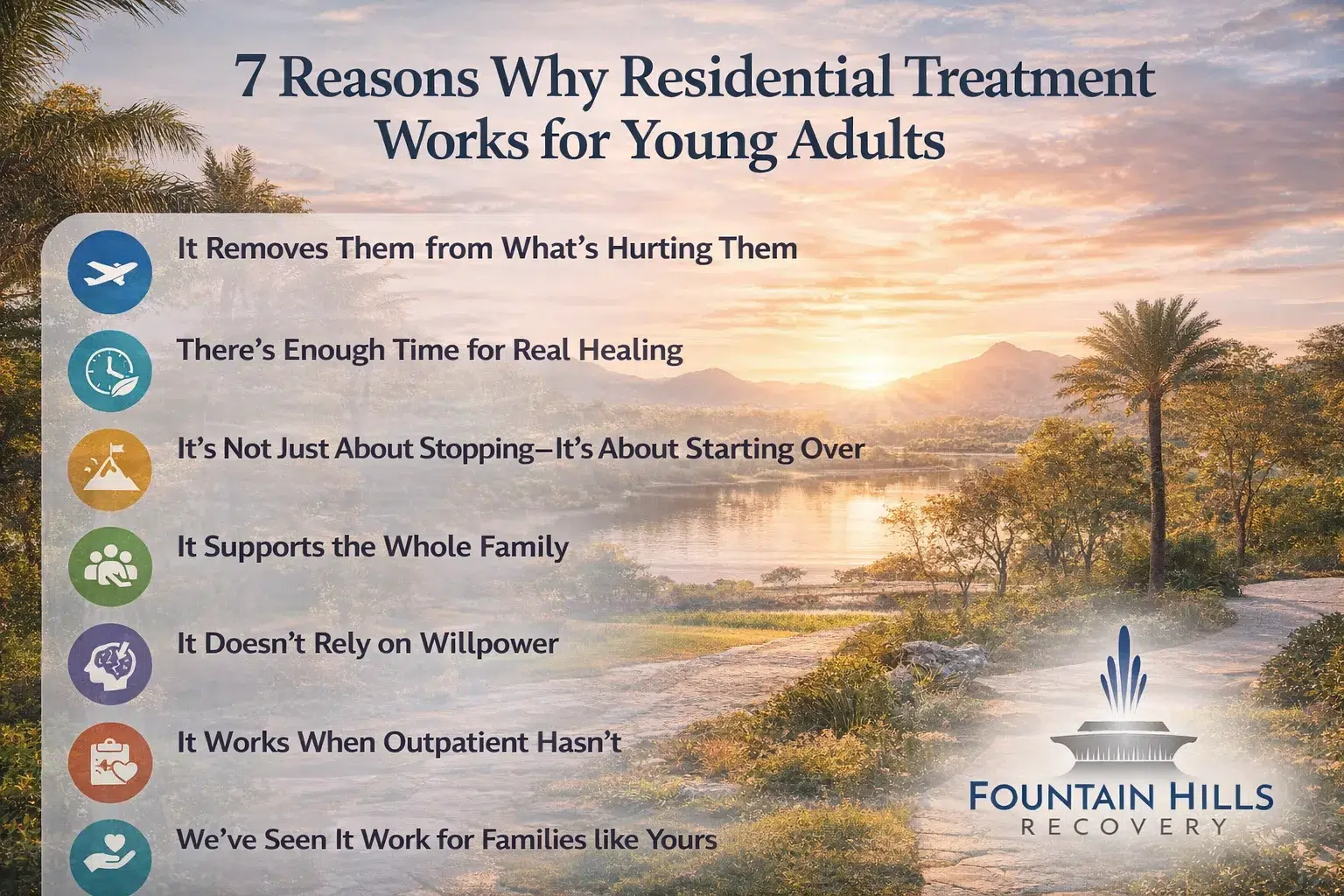
4. It Supports the Whole Family—Not Just the “Identified Patient”
Let’s name something hard: this hasn’t only impacted your child. It’s impacted you.
You’ve been living in fight-or-flight for months, maybe years. You’ve been the detective, the caretaker, the crisis team—and still, it wasn’t enough.
Residential treatment gives you your role back: parent.
You’re no longer the case manager. You don’t have to chase down updates or wonder if therapy happened. You’re looped in, supported, and finally given space to breathe.
We also work directly with parents—because healing the family system makes a real difference. You’ll get:
- Regular updates from our clinical team
- Invitations to participate in family therapy (virtually or in-person)
- Resources to help you process your own grief, fear, and exhaustion
Because your healing matters too.
5. It Doesn’t Rely on Willpower
If willpower could solve this, it would’ve worked already.
Addiction and co-occurring mental health issues aren’t about effort—they’re about wiring.
That’s why residential treatment doesn’t wait for motivation to kick in. It builds motivation through experience:
- Consistent routines that re-regulate the brain
- Nutritional support that stabilizes mood
- Peer support that reduces shame
- Clinical insight that reframes behavior without blame
We help clients experience small wins—“I made my bed today,” “I talked about something hard and didn’t shut down”—and those wins build momentum.
For someone who’s relapsed, that’s often the missing piece: proof that change is possible.
6. It Works When Outpatient Hasn’t
You may have tried therapy. IOP. Support groups. Meds.
If those things didn’t work, it doesn’t mean your child is beyond help. It likely means those levels of care weren’t enough.
Residential care is the right fit when:
- The home environment isn’t safe or stable
- The person has relapsed multiple times
- There’s co-occurring mental health diagnoses
- Previous outpatient attempts have failed
It’s not about escalating force. It’s about giving your child the level of support their brain and body actually need to stabilize, heal, and grow.
And yes—it can absolutely work, even if everything else hasn’t.
7. We’ve Seen It Work for Families Like Yours
We’ve worked with:
- College students who dropped out and said they “didn’t care about anything anymore”
- Young adults who swore off every program after their last experience
- Families holding on by a thread, unsure if another shot was even worth it
And we’ve seen them turn around—because they were finally in a space that understood them.
“My son didn’t believe in treatment anymore. Honestly, neither did I. But this place felt different from the beginning. They didn’t just treat his addiction. They helped him find his confidence again.”
– Parent, 2023
“Here, I got quiet enough to hear myself again.”
– Client, 20
This isn’t a guarantee. But it is hope. And that’s something worth holding onto.
Looking for Local Support?
If you’re searching for care in Fountain Hills or support in Scottsdale, we’re here. Our Arizona residential facility offers warmth, privacy, and real clinical depth—without losing the personal touch.
We take the time to get to know your family, your fears, and your goals. Because healing is never one-size-fits-all—and we wouldn’t want it to be.
FAQ: What Parents Often Ask About Residential Treatment
How long does residential treatment last?
Programs can range from 30 to 90 days, with some lasting longer based on clinical need. We work with each family to create a plan that’s realistic and effective—not rushed.
Can we stay involved while our child is in the program?
Yes. In fact, family involvement is encouraged. You’ll be invited to participate in sessions, receive progress updates, and access parent-focused support.
What if they don’t want to go?
That’s common. We help you navigate pre-admission resistance with compassion—not force. Our admissions team can guide you through what options exist and how to frame the conversation in a way that honors your child’s autonomy while protecting their safety.
What happens after residential treatment ends?
Aftercare planning begins before discharge. We coordinate outpatient therapy, sober living options, peer support, and family follow-up so your child doesn’t feel dropped after leaving.
How do I know if this is the right level of care?
If outpatient care hasn’t helped, or if you’re constantly worried about your child’s safety, this may be the right next step. Call us—we’ll walk through your situation together and recommend what makes sense.
You’re Not Out of Options—And You’re Not Alone
Call (800) 715-2004 to learn more about our residential treatment program in Scottsdale, Arizona.
Sometimes, the most loving thing you can do is step back—and let real help step in. We’re here when you’re ready.