
I didn’t want a diagnosis. I definitely didn’t want a pill.
At the time, taking medication felt like giving up. Like letting something else—not me—drive my brain.
I’d always prided myself on figuring things out on my own. I got through hard days by being sharp, quick, and intense. So when someone handed me a diagnosis and suggested medication, I felt like I was being told to trade all of that in.
I wasn’t just scared of the side effects. I was scared of losing the only version of myself I’d ever known.
But what I didn’t realize then—and what dual diagnosis treatment in Fountain Hills, AZ helped me slowly understand—is that medication wasn’t the enemy of who I was. In fact, it was the first real step toward reconnecting with the parts of me I thought I’d lost forever.
The Diagnosis That Shook My Identity
I don’t remember most of the words from that first psychiatric appointment. I just remember the feeling: dread, embarrassment, and a strange sense of grief.
I’d gone in because things were getting bad. Not sleeping. Panic attacks. I’d started canceling plans and missing deadlines. Something had to give.
So I sat in the chair, answered their questions, and when they gave me the diagnosis—anxiety disorder and depression, with traits of ADHD—I nodded like I understood.
But inside? I was falling apart.
If this is true… who have I even been this whole time?
There’s a weird disorientation that happens when you finally get a name for what you’re going through. Part of you is relieved. The other part? Feels like you’ve been unmasked.
Medication Felt Like Surrender
The provider was kind. She recommended starting a low dose of medication, just to take the edge off the panic and help me stabilize.
I left the office with a prescription in hand—and a voice in my head screaming: Don’t do it.
The fear wasn’t just about side effects. It was deeper. Existential. I was terrified that medication would flatten me, make me a zombie, or erase the intensity that made me feel like myself.
Every article I read online either promised miracles or horror stories. I didn’t want to be someone who needed a pill to function.
So, for a few weeks, I didn’t take it.
I Tried to Tough It Out—It Didn’t Work
I told myself I’d try harder. Sleep more. Cut caffeine. Journal. Meditate.
But every night, my thoughts still spun like a blender with the lid off. Every morning, I woke up more exhausted than the day before.
One night, after a panic spiral left me shaking on the floor of my apartment, I finally took the first dose.
And I cried—not because of how it made me feel, but because I felt like I had lost. Like I was failing at being human the “natural” way.
Dual Diagnosis Treatment Was the Turning Point
Taking medication was the first shift. But real healing didn’t start until I began dual diagnosis treatment.
I found a program that understood how deeply mental health and emotional patterns are intertwined. At Fountain Hills Recovery, they didn’t just monitor my meds. They asked about my history, my fears, and the stories I’d been telling myself for years.
I remember one of the therapists saying:
“Medication can stabilize the floor under you. But it’s therapy that helps you rebuild the house.”
That stuck with me.
In treatment, I learned that avoiding help was a coping mechanism too. One I had built out of fear, pride, and survival instincts. But it wasn’t serving me anymore.
Therapy Helped Me Take My Mind Back
Through therapy sessions, group work, and honest conversations with my care team, I started peeling back the layers.
I realized I’d internalized the belief that needing help made me weak. That my worth came from holding it all together—even if it was barely working.
But dual diagnosis care helped me rewrite that narrative.
I wasn’t broken. I was exhausted.
And medication wasn’t a muzzle. It was a life raft.
It gave me just enough stability to actually do the work—to feel my feelings without drowning in them, to challenge old thoughts without getting lost.
I Still Had Doubts—But They Didn’t Own Me
Even in treatment, there were days I wondered if I was cheating. If the “real me” was buried under serotonin and structure.
But I noticed something. The more supported I felt, the more me I became.
My creativity came back—not as a flood, but as a flicker. I started journaling again. I cracked jokes in group. I cried in therapy and didn’t apologize for it.
Medication didn’t flatten me. It cleared the static enough for my real voice to come through.
What I Wish Someone Had Told Me
If you’re newly diagnosed and scared to start medication, here’s what I wish I’d heard sooner:
- You’re allowed to have mixed feelings.
- Taking medication doesn’t mean you’re giving up.
- It’s okay to go slow, ask questions, and change your mind.
- You don’t have to feel better instantly for the treatment to be working.
- You are still you—and the right care will help you feel more like yourself, not less.
Healing Is a Process—Not a Personality Change
Dual diagnosis treatment gave me space to heal without having to “perform wellness.”
I didn’t have to prove anything to anyone. I just had to show up—and slowly, I learned how to trust myself again.
Recovery isn’t about becoming a different person. It’s about creating conditions where your real self feels safe to show up.
And for me, that meant embracing both medication and therapy as tools. Not as fixes. Not as crutches. But as support.
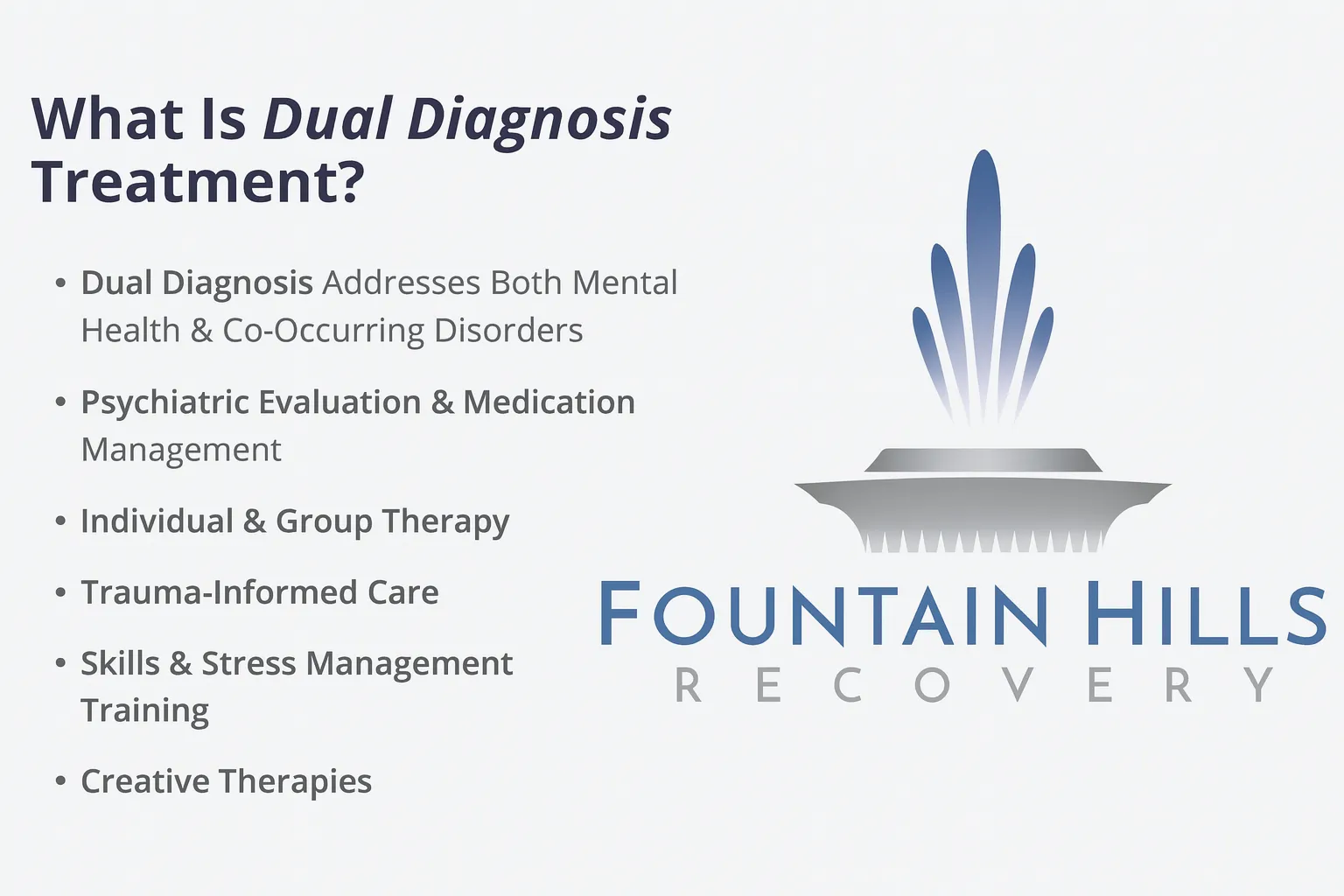
What Is Dual Diagnosis Treatment?
If this phrase is new to you, here’s a quick explanation:
Dual diagnosis treatment addresses both mental health disorders (like depression, anxiety, bipolar disorder) and co-occurring issues such as trauma, emotional dysregulation, or substance use. Even if you’re not dealing with addiction, dual diagnosis care helps people whose mental health is tangled with other challenges—whether it’s chronic stress, dissociation, or unhealthy coping behaviors.
At Fountain Hills Recovery in Arizona, this kind of care includes:
- Psychiatric evaluation and medication management
- Individual and group therapy for mental and emotional insight
- Trauma-informed support that honors your story
- Skills training to help you handle everyday stress
- Creative therapies to explore identity and healing
It’s not one-size-fits-all. It’s a layered approach that treats you—not just your symptoms.
FAQs About Dual Diagnosis and Medication
Is dual diagnosis treatment only for people with addiction?
Not at all. While it’s common in addiction recovery, dual diagnosis care is just as crucial for people navigating mental health challenges paired with trauma, chronic stress, or emotional dysregulation. It’s about addressing the full picture, not just a diagnosis in isolation.
What if I’ve tried medication before and it didn’t work?
That’s a valid concern—and you’re not alone. Dual diagnosis care involves close monitoring and adjustment. Sometimes it’s about finding the right medication, sometimes it’s about pairing it with the right kind of therapy. You won’t be left to figure it out alone.
Can I stop medication once I feel better?
That’s a personal decision—and one to make with a provider. Some people use medication short-term to get stable. Others stay on it long-term. There’s no shame in either. What matters is what’s right for you.
What if I’m scared medication will change who I am?
That fear is real—and worth talking about in treatment. The goal of medication isn’t to erase you. It’s to reduce the distress enough so you can access your strengths again. If anything feels off, it can be adjusted. You’re never stuck.
How do I know if dual diagnosis care is right for me?
If you’ve been diagnosed with a mental health condition—and you’re also feeling overwhelmed, stuck, or unsure how to manage day-to-day emotions—dual diagnosis treatment can help. You don’t need to hit rock bottom to deserve support.
You Don’t Have to Do This Alone
If you’re holding a new diagnosis in one hand and fear in the other, I get it.
Starting treatment doesn’t mean losing who you are.
It means choosing to stop white-knuckling your way through life.
It means getting support without letting go of your identity.
Dual diagnosis treatment at Fountain Hills Recovery met me in that in-between place—scared, unsure, and still fighting for something better.
If you’re there now, you deserve that same kind of care.
You don’t have to carry this alone.
Call (800) 715-2004 or visit Fountain Hills Recovery’s Dual Diagnosis Treatment to learn more about treatment options in Fountain Hills, AZ.