


There are moments in parenthood no one prepares you for.
Moments like finding an empty bottle in your child’s backpack, or watching them sleep through an entire day with the door locked. Moments when the kid you raised—who used to sing in the car or argue about curfew—suddenly becomes someone you barely recognize.
And the scariest part? You don’t know if it’s just a phase… or something much worse.
When your young adult is spiraling, drinking heavily, acting out, or disconnecting from reality, every instinct in your body screams to do something. But what? What will actually help? What if you make it worse?
If you’re here, you’re not overreacting. You’re not dramatic. You’re a parent in crisis trying to keep your child safe—and you’re not supposed to do that alone.
Here’s what alcohol addiction treatment can actually provide when your child is spiraling—and why reaching out might be the first thing that helps both of you breathe again.
A Real Understanding of What’s Beneath the Spiral
Parents are often left trying to interpret symptoms they were never trained to diagnose. Is this alcohol use… or depression? A trauma response… or just rebellion? Anxiety… or something more serious?
One of the most important things alcohol addiction treatment provides is assessment. Not guesswork. Not generalized advice.
Licensed clinicians spend time with your child to get a full picture—of their substance use, mental health, behavior patterns, trauma history, and emotional state. They ask the questions you’ve been afraid to ask and know how to listen without judgment.
That clarity can be life-changing. Because it’s not just about treating alcohol addiction. It’s about understanding what alcohol is trying to cover up.
A Structure That Doesn’t Rely on You
When your child is in crisis, the roles in your home shift. You become their nurse, counselor, chauffeur, security guard, and detective.
You can’t keep doing that. It’s not sustainable—and it’s not fair to you or them.
Treatment provides a contained, structured environment where professionals take over what you’ve been trying to manage solo. That includes:
- 24/7 supervision if needed
- Structured routines that regulate sleep, eating, and behavior
- Consistent access to therapy and clinical care
- Built-in accountability and daily monitoring
- Emotional safety that allows for breakdowns without consequence
At Fountain Hills Recovery, our programs relieve the pressure on families. We don’t just treat the person using alcohol. We support the people who’ve been trying to hold them up.
Interventions That Address More Than the Drinking
If you’ve been told, “They just need to stop drinking,” you’re not getting the full story.
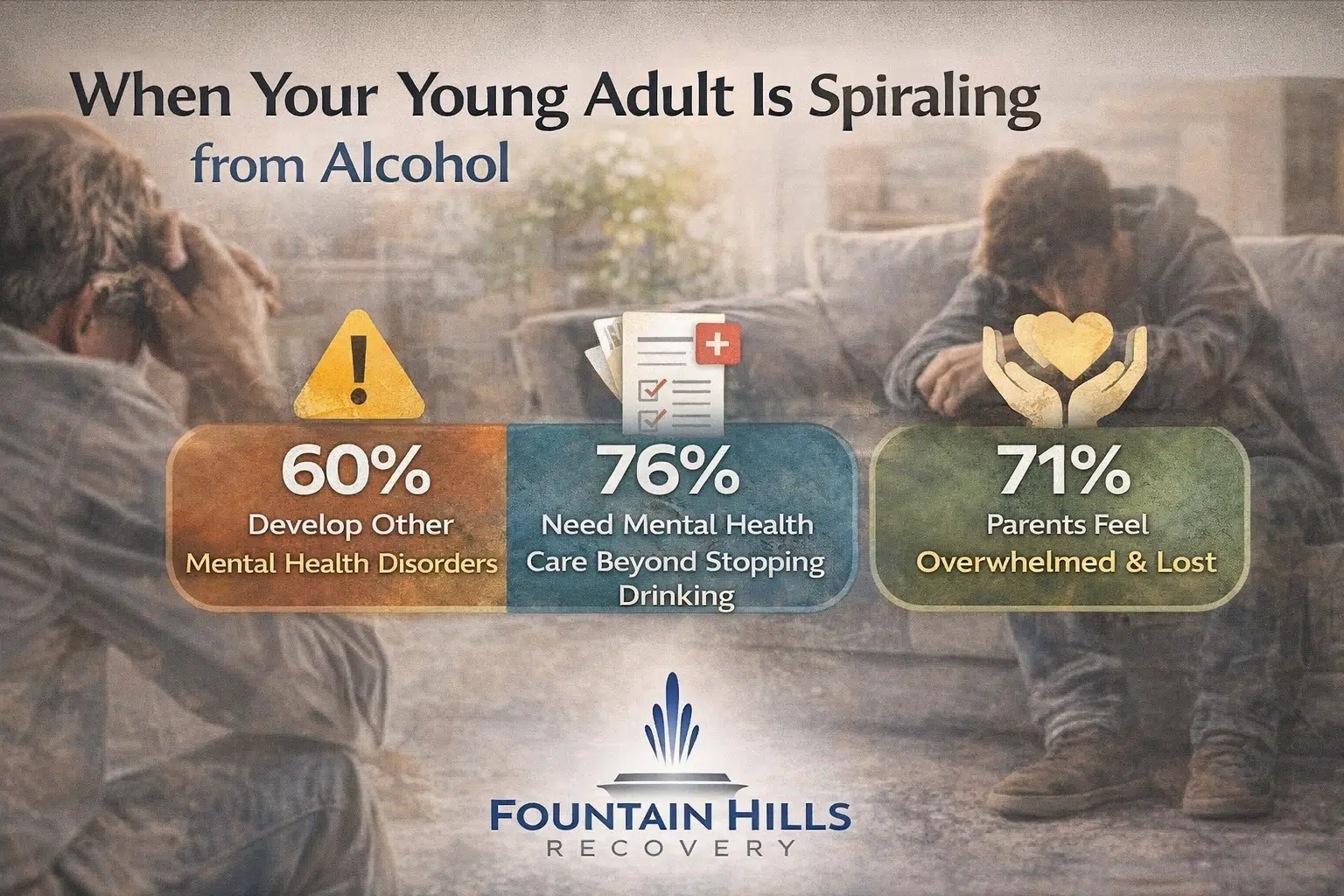
Alcohol is often the most visible part of a much deeper struggle—an attempt to numb out something else: anxiety, depression, unprocessed trauma, or even a psychiatric issue that hasn’t been diagnosed yet.
Treatment doesn’t just aim to stop the behavior. It works to replace the function alcohol was serving with something healthier, more sustainable, and rooted in real understanding.
That might include:
- Trauma-informed therapy
- Dual diagnosis care (mental health + substance use)
- Psychiatric evaluation and medication management
- Skills-based support (emotional regulation, distress tolerance)
- Rebuilding relationships and repairing trust
If your child’s spiral feels bigger than just alcohol, that’s because it probably is. Real treatment acknowledges that—and addresses it head-on.
Explore options for trauma-informed care in Scottsdale →
Support for You, Too—Without Shame
Here’s the part nobody talks about enough: when your child is sick, you get sick too. Not physically, but emotionally, spiritually, mentally.
You carry the guilt. The exhaustion. The late-night spiral of “What did I miss?” and “Is this my fault?”
Let me be clear: this is not your fault.
And good treatment doesn’t just support your child—it supports you. That might look like:
- Family therapy with clinicians who know how to hold complexity
- Psychoeducation about addiction, mental health, and trauma
- Coaching on boundaries and communication
- Community with other parents who get it
- Space to feel—without being judged for crying, raging, or just shutting down
At Fountain Hills Recovery, we see the whole family system. And we don’t offer platitudes. We offer tools, language, and healing that’s grounded in what real parents like you are actually facing.
A Break in the Chaos—So Change Can Begin
You don’t need to fix everything today. You just need a pause button.
That’s what residential or outpatient treatment provides. A break in the chaos. A chance to get your child into a safe, structured place where professionals are managing their care, and where you’re not waiting for the next crisis call.
When they’re in a program, you get to rest. You get to stop monitoring, worrying, guessing. And they get to experience what it’s like to live without alcohol and without pressure.
Sometimes, that pause is where the first shift happens—not because someone lectured them, but because their system finally had enough safety to ask: What am I doing?
Looking for that break close to home? Our treatment options in Fountain Hills Drug and behavioral care programs are built to hold both urgency and long-term healing.
A Chance to Be a Person Again—Not Just the Problem
It’s hard to admit, but sometimes, your child becomes “the crisis.”
They’re no longer the person you recognize. Every interaction is tinged with fear, frustration, or devastation. The relationship feels more like emergency response than parenting.
In treatment, they’re no longer the problem.
They’re a person.
A young person—scared, struggling, hurting, but worthy of care. And when they’re seen that way by someone outside the family, it can reawaken parts of them that have been buried for months, even years.
Real treatment sees their potential. And over time, they start to see it too.
Frequently Asked Questions
What if my child doesn’t want to go to treatment?
That’s very common. Our team is experienced in helping parents navigate this, including planning for interventions, working with ambivalence, or even helping your child consider a short-term assessment first.
Will treatment actually help if they’ve refused help before?
Yes—if it’s the right kind of treatment. Not all programs are the same. Trauma-aware, youth-focused care that doesn’t rely on shame or punishment can make a massive difference, even for those who’ve pushed back before.
Do I have to be involved in treatment?
Involvement is encouraged, but not mandatory. We offer ways for families to engage that respect your emotional capacity. You won’t be asked to do anything alone.
What if my child’s drinking is mixed with mental health issues?
We specialize in dual diagnosis care—treating both addiction and mental health together. You won’t be passed around or referred out. We do both, under one roof.
Where can I find this kind of care in Arizona?
Fountain Hills Recovery offers comprehensive addiction and mental health care across multiple Arizona locations, including Scottsdale and Fountain Hills. We know crisis—and we know how to meet it with clarity and compassion.
You don’t have to hold all of this by yourself. And your child doesn’t have to spiral alone.
Call (800) 715-2004 to learn more about our alcohol addiction treatment services in Arizona.