
You know something’s not working.
Maybe you’ve tried therapy here and there. Maybe you’ve downloaded the apps, changed your routine, joined a group, taken the edge off with medication—or something stronger.
You’ve probably even Googled the phrase “Do I need residential treatment?” more than once.
Here’s what I want you to hear: if you’re asking, it’s worth exploring. Not because you’re broken. Not because you failed outpatient. But because somewhere inside, you know you need space. Real space. Safe space. Space where you don’t have to fix everything while still trying to survive.
This isn’t about giving up. This is about finally allowing yourself to go deep enough to heal.
And that’s what a residential treatment program can offer in ways outpatient care simply can’t.
1. The Quiet That Reveals What You’ve Been Running From
Outpatient care gives you tools—but residential care gives you time.
Time to stop performing. Time to stop managing everyone else’s expectations. Time to feel what you’ve been numbing for years.
When you’re in residential treatment, the pressure to function is lifted. You’re not commuting. You’re not checking your phone during therapy. You’re not putting on a good face.
You’re just there. And that’s when the real truths surface.
Many of our clients at Fountain Hills Recovery have said the same thing: “I didn’t know how much I was avoiding until I didn’t have to anymore.” It’s not weakness—it’s awareness.
2. The Patterns You Can’t Spot While You’re Still in Them
Outpatient care often focuses on the “presenting problem.” You walk in, you talk about your week, and you work through what’s happening now.
But in residential treatment, clinicians and peers witness you all day—not just for 45 minutes.
That means we can see the subtle loops you might not notice:
- How you isolate when you’re triggered
- How your anxiety shows up in your sleep schedule
- How perfectionism bleeds into every conversation
- How your energy changes around certain memories
Residential care allows us to see the full pattern, not just the highlights—and help you connect the dots to break it.
3. A Nervous System That Feels Safe Enough to Let Go
If you’ve been stuck in anxiety, hypervigilance, or emotional shutdown, your nervous system is likely trying to survive, not heal.
In residential care, we give it something it hasn’t had in a long time: regulation.
That looks like:
- Consistent meal and sleep routines
- Limited exposure to triggers
- Calming, structured environments
- Staff trained in trauma responses
- Somatic and mindfulness-based therapies
When your system finally believes it’s safe, you can start feeling again—without overwhelm.
We’ve seen this transformation time and again in our treatment options in Fountain Hills and Scottsdale centers.
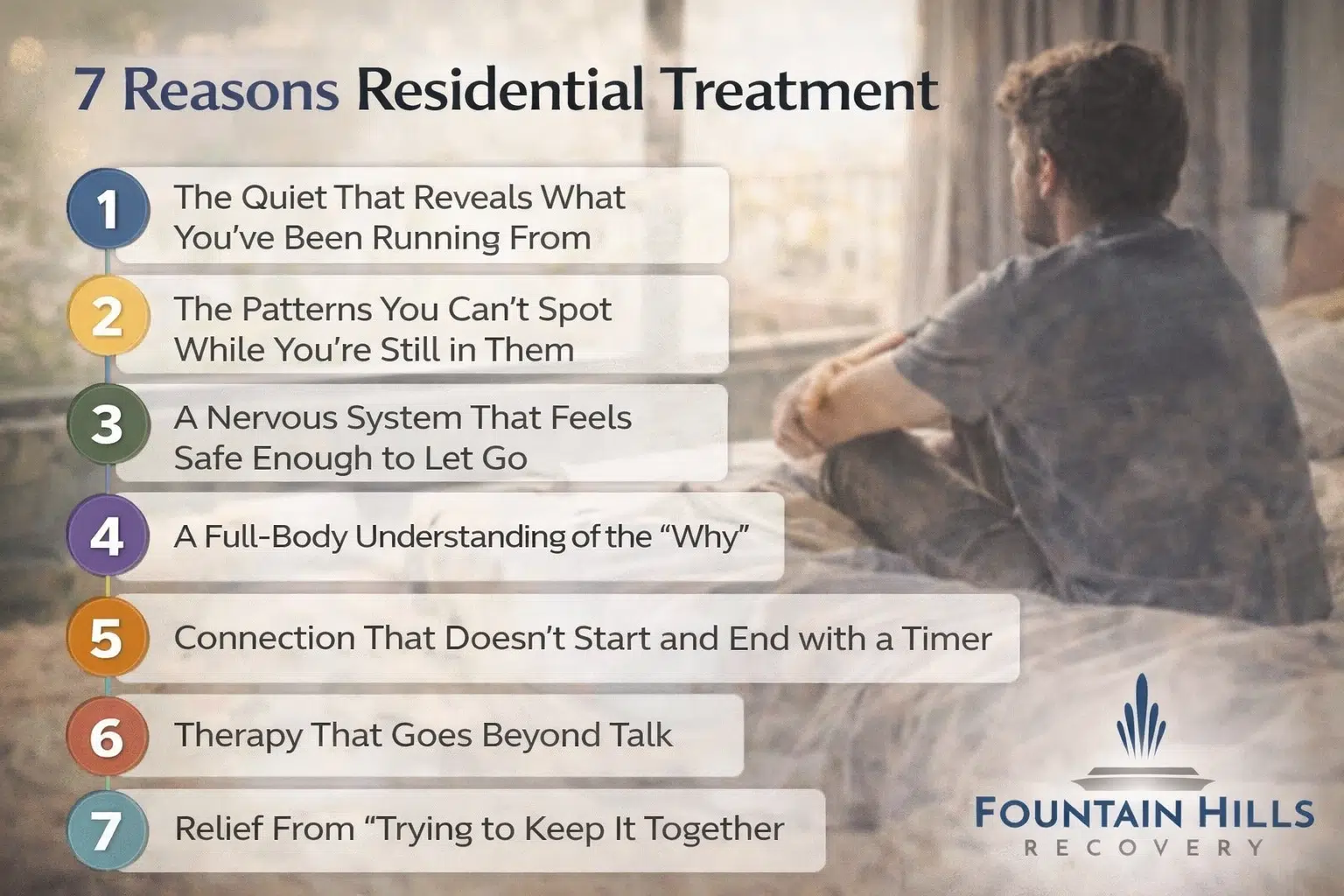
4. A Full-Body Understanding of the “Why”
Many outpatient clients know what they’re doing to cope—drinking, isolating, self-harming, pushing people away—but they don’t know why.
In residential treatment, the pace slows down enough for the “why” to come into focus.
Through therapy, reflection, peer interaction, and trauma-informed modalities, clients begin to uncover the deeper motivations behind their behaviors. It’s not just about what needs to stop—it’s about what needs to heal.
Because until you know why the wound is there, you can’t stop bandaging it the same way.
5. Connection That Doesn’t Start and End with a Timer
In outpatient care, the minute you start to open up, your session ends.
In residential treatment, connection isn’t just scheduled—it’s embedded.
You’re surrounded by people who are going through the same reckoning. You eat meals together. You sit in awkward silences together. You show up to therapy messy, unshowered, unsure—and no one flinches.
That kind of constant presence builds a bond that’s hard to describe—but impossible to fake.
And it reminds you, over and over: you’re not alone.
Want that kind of support? See our residential programs in Scottsdale.
6. Therapy That Goes Beyond Talk
While outpatient care may rely on cognitive therapies and weekly conversations, residential treatment gives you access to whole-person healing.
At Fountain Hills Recovery, this might include:
- EMDR and trauma therapies
- Somatic experiencing
- Adventure therapy
- Family systems work
- Psychiatric and medication support
- Group and community-based process work
These therapies take time and consistency—something outpatient rarely allows in depth.
Here, they’re not add-ons. They’re built in.
7. Relief From “Trying to Keep It Together”
Let’s be real. Most people don’t go to outpatient care for insight. They go because they’re trying to keep it together.
But when keeping it together starts costing your sanity, relationships, or safety, it’s time to ask: What would happen if I let go—just for a while?
Residential treatment isn’t a punishment. It’s not a failure.
It’s a chance to stop managing symptoms and start healing the root.
That’s what you’ll find at Fountain Hills Recovery. A place where keeping it together is replaced by coming together—piece by piece, day by day, with real support.
Frequently Asked Questions
How do I know if residential care is better for me than outpatient?
If you’ve tried outpatient and still feel like you’re drowning, if your symptoms are affecting your daily functioning, or if you’re struggling to stay sober or safe—residential care might be the next step.
Isn’t residential care only for “serious cases”?
No. That’s a myth. Residential care is for people who need time, structure, safety, and full immersion—not just for those in medical crisis. You don’t have to hit “rock bottom” to get help.
How long is a residential treatment stay?
Stays typically range from 30 to 90 days, depending on clinical needs, insurance, and your recovery goals. Some clients transition to outpatient or sober living afterward.
What makes Fountain Hills Recovery different?
We offer luxury residential treatment with evidence-based therapy, trauma-informed staff, holistic care, and flexible programming that meets you where you are—not where someone says you should be.
Do you treat mental health and substance use together?
Yes. We provide integrated dual diagnosis care, which means you don’t have to choose between treating your addiction or your anxiety, depression, or trauma—we treat all of it together.
You’re allowed to ask for more than maintenance. You’re allowed to want transformation.
Call (800) 715-2004 to learn more about our residential treatment program services in Arizona.