


The holidays aren’t always warm. Sometimes they’re sharp.
If you’ve stepped away from treatment—ghosted your IOP, dropped out mid-way, or just faded slowly out of group—this time of year might bring up a mix of guilt, grief, and a quiet question: Can I still go back?
Here’s the answer, plain and simple: yes.
And if the only thing heavier than your calendar right now is the fear of picking up the phone again, this guide is for you.
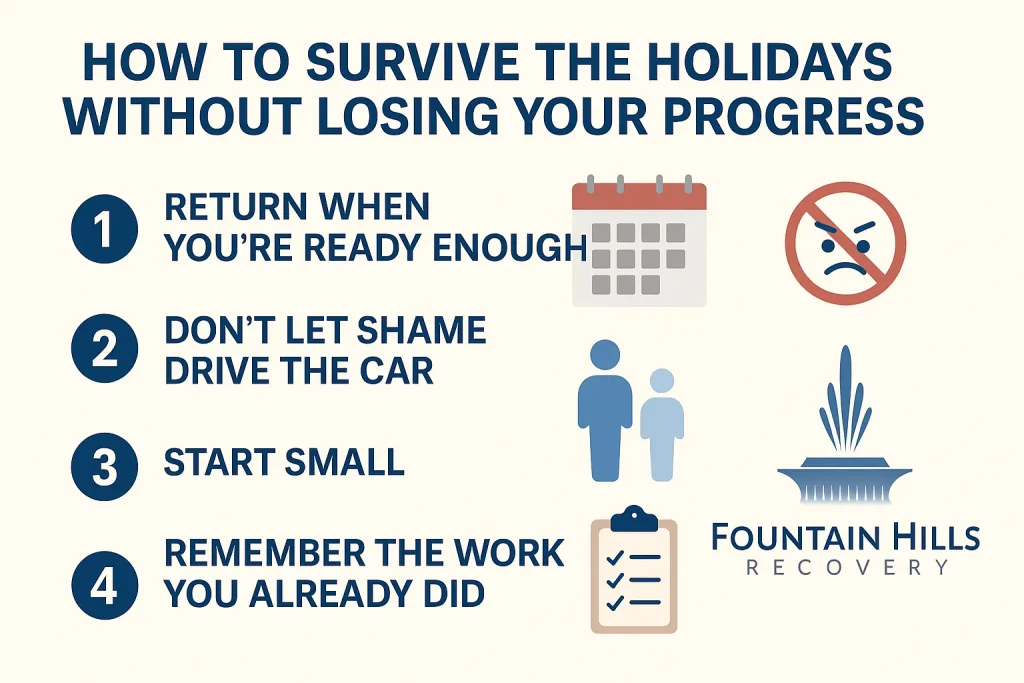
1. Forget Perfect Timing—Return When You’re Ready Enough
There’s no “right time” to come back. Only real time.
And right now, during the holiday chaos, emotional triggers can pile up fast—family pressure, financial stress, alcohol everywhere, unspoken grief, old habits knocking at the door.
We often hear:
“I was going to wait until after New Year’s.”
“I didn’t want to be the person who came back right before Christmas.”
“It’s just bad timing.”
But recovery doesn’t need perfect timing. It needs honesty—and a willingness to re-enter before the damage gets bigger.
Starting again now—even imperfectly—can protect the progress you already made. That matters more than any date on a calendar.
2. Don’t Let Shame Drive the Car
Let’s call it what it is: coming back after dropping out can feel awkward. You might assume:
- “They’ll think I failed.”
- “I wasted their time.”
- “I don’t deserve a second chance.”
But here’s what we think: you’re still trying. And that counts for more than you know.
At Fountain Hills Recovery, our Intensive Outpatient Program in Fountain Hills, AZ is built with real life in mind. People pause. People ghost. People stop showing up—and then realize they want to. And when they do, we open the door.
Not with shame. With steadiness.
3. You Don’t Need to Explain the Gap
You don’t owe us a detailed explanation. You’re not required to write a “why I left” monologue.
We know that life, emotions, triggers, and logistics sometimes collide in ways that make treatment feel impossible—or too vulnerable to continue.
What matters is that you’re thinking about re-engaging now. That you’re willing to say, “I want help again.”
That’s not weakness. That’s strength reactivated.
We’ll revisit your plan, meet you where you are today, and build from there. No scolding. No shame spiral. Just support.
4. Know Your Triggers (And Don’t Try to Outrun Them Alone)
The holidays can be a pressure cooker, especially when you’ve stepped away from your support system. Some common holiday triggers we hear about from clients include:
- Being around family who don’t “get it”
- Alcohol at every gathering
- Losses that resurface in quiet moments
- Financial strain
- Feeling like you’re behind everyone else
Trying to handle all of that solo—especially without the emotional regulation tools you were building in IOP—can make the season feel impossible.
Coming back into the structure of IOP gives you space to say:
“This is overwhelming. I need help making it through.”
And that’s not giving up. That’s refusing to let another year hurt more than it has to.
5. Start Small (Yes, Even One Group Counts)
You don’t have to jump back in five days a week. You don’t have to commit to an entire schedule right now.
Some returning clients ease back in with:
- One group per week
- A check-in with their therapist
- Rejoining part-time with a holiday-specific focus
- Just showing up to listen
You can come back quietly. Slowly. In the background. Whatever way makes the restart feel bearable.
What matters isn’t how loudly you return. It’s that you do.
6. Remember the Work You Already Did Still Counts
You might be telling yourself, “I lost all my progress.” You didn’t.
You still learned things. You still showed up. You still stretched into hard emotions and tried something new.
That work doesn’t evaporate just because you took a step back.
If anything, it gives your return more strength—because you already know where you left off. You know what helped. You even know what didn’t work. And this time, we can build a new plan with that insight in mind.
7. You’re Not the Only One Who Left Midway
If it helps, know this: you’re not rare. You’re not the one person who ghosted. It happens.
More often than not, someone else in your group has also taken a break, vanished for a month, or reappeared after a rough season. It’s part of the process—not a disqualifier from it.
At Fountain Hills Recovery, our clinicians are trained to support clients through disruption. You don’t need a smooth track record. You need a moment of courage—and we’ll meet it with care.
8. Reentry Can Be Quiet, Flexible, and Totally Yours
Coming back doesn’t mean fanfare. It doesn’t mean telling your friends or family. It doesn’t mean admitting failure.
It can just mean this:
- A quiet text that says “Hey… can I come back?”
- A call you hang up on the first two times before letting it ring
- A decision you make privately—and start acting on when it feels right
We’re not keeping score. We’re keeping the door open.
FAQ: Restarting Your Intensive Outpatient Program
What if I dropped out months ago—can I still come back?
Yes. Whether it’s been two weeks or six months, you’re welcome to reengage. We’ll work with you to re-assess your needs and update your care plan.
Will I have to explain why I left?
Only if you want to. We may ask what felt hard or didn’t work before—but only to help support you better this time. No guilt. No pressure.
What if I relapsed while I was out?
Relapse doesn’t disqualify you from care. In fact, it’s often the clearest sign that more support is needed. We’ll meet you with safety, not shame.
Can I come back at a different schedule than before?
Yes. Many returning clients adjust their level of care based on life needs or emotional bandwidth. We’ll build a plan that reflects now, not then.
What makes the Fountain Hills IOP a safe place to return?
We’ve created a program that honors disruption. Our team is trained to welcome you back with compassion and clarity—whether you’ve been gone two days or two years. Learn more about our program here.
The Bottom Line: You’re Allowed to Come Back
Not because you’re broken.
Not because you failed.
But because you deserve support, and you’re brave enough to ask for it again.
Your story didn’t end when you ghosted. It paused. And it can continue—with more honesty, more strength, and more self-trust than ever before.
Call (800) 715-2004 or visit Fountain Hills Recovery’s Intensive Outpatient Program to restart with care that respects your experience—not your gaps. You’re still allowed in. You always were.