
When I first heard the words “alcohol use disorder,” I didn’t feel relieved. I felt like someone had dropped a weight into my stomach.
It wasn’t like I didn’t know something was wrong—I did. I just wasn’t ready to hear it labeled. And I definitely wasn’t ready for what came next: talk of treatment, options, maybe even medication.
I remember nodding like I understood, but inside, I was spiraling.
Medication?
Am I broken?
Will this change me?
Is this really my life now?
That moment could have shut me down. Honestly, it almost did. But what changed everything wasn’t a prescription. It wasn’t even therapy at first.
It was information.
Someone finally took the time to explain—not just tell me what to do. They answered my weird questions, listened when I panicked, and gave me space to figure things out without pushing.
That’s why I’m writing this. If you’re newly diagnosed, scared of medication, or just trying to understand what alcohol addiction treatment really means, I want you to know: You don’t have to be ready for everything right now. You just have to be open to learning.
And that’s enough.
I Wasn’t Anti-Medication—I Was Afraid
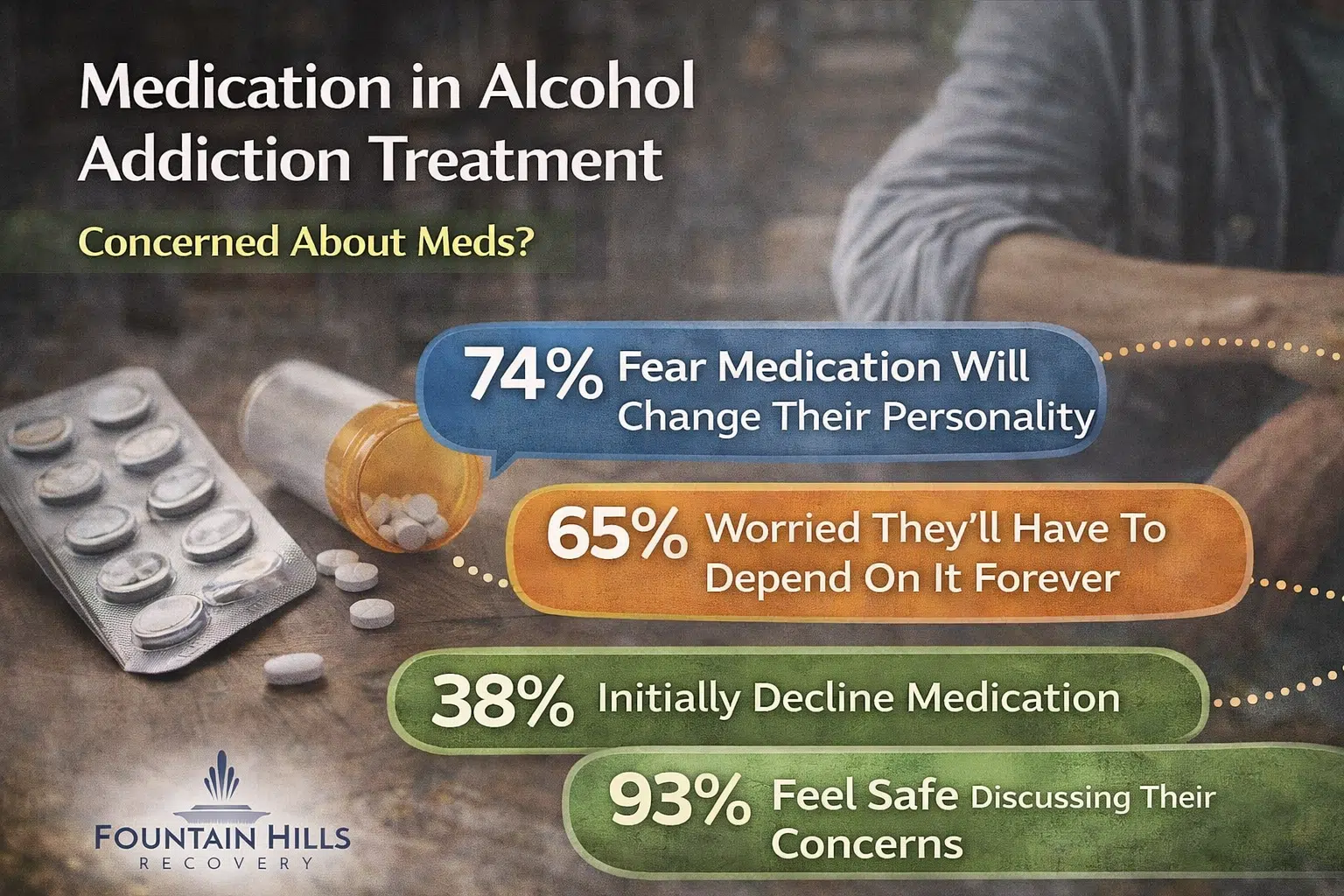
Before treatment, I thought medication would flatten me. I was afraid I’d lose whatever personality I had left. My creativity, my ability to connect, my edge—whatever that was, alcohol felt like it gave me access to it. Taking medication felt like waving the white flag.
The truth is, I didn’t understand what medication in recovery was. And I didn’t realize that most people in treatment… feel exactly the same way I did.
At Fountain Hills, they didn’t talk down to me. They didn’t act like I was ridiculous for being scared. They said, “Yeah. A lot of people feel that way. Let’s talk about it.”
Nobody Pushed a Pill on Me
This is important, so let me say it clearly: I was not given medication on day one.
I was met with conversation, not a prescription pad. I had space to ask the same question three times in a row. I had time to say, “I don’t know how I feel about this,” and have someone respond, “Okay. Let’s take it one step at a time.”
That’s what alcohol addiction treatment should look like—especially for someone newly diagnosed and scared.
I didn’t need to be convinced. I needed to be respected.
Understanding What Alcohol Was Doing for Me—Helped Me Let Go
One of the most healing parts of early treatment was this simple truth: Alcohol was doing something for me. It was calming my nerves, quieting my shame, helping me survive emotionally messy situations I didn’t have tools for.
Once I heard that, everything softened. I wasn’t a failure. I wasn’t weak. I was human, trying to cope the only way I knew how.
Medication wasn’t introduced as a replacement for alcohol. It wasn’t framed as “you need this because you can’t handle life.” Instead, it was explained like this:
“Your brain’s been rewired around alcohol. If medication helps stabilize things while we rebuild your tools, it’s something we can consider. But only if it feels right for you.”
That reframed everything. It became a choice, not a sentence.
I Asked All the “Stupid” Questions—and Got Real Answers
• “Will I be dependent on this forever?”
• “Isn’t this just trading one substance for another?”
• “Will it mess up my sleep? My weight? My energy?”
• “What if I feel numb?”
• “What if it actually helps and that scares me?”
I didn’t just ask once. I asked again and again.
And nobody ever rolled their eyes. The team treated every question like it deserved a real answer—because it did.
They explained things in plain language, not in medical jargon. They made sure I had information before I had to make a decision. And that changed everything for me.
I Had Options—and That Gave Me Back My Power
For the first time in a long time, I didn’t feel stuck.
When I learned that there were multiple medication options—and that I could say yes to one and no to another—I felt in control. Not every medication is sedating. Not every one is long-term. Some are short-term tools that just help your brain level out during early recovery.
And more importantly: you don’t have to say yes at all.
If you’re considering treatment options in Scottsdale or surrounding areas, you should know that real providers won’t force you. They’ll offer information. They’ll help you make an informed decision. But the final choice? That’s always yours.
The First Win Wasn’t Medication—It Was Safety
Before anything else, I needed to feel safe. Emotionally. Physically. Mentally.
I needed to know that my tears weren’t too much, my fears weren’t ridiculous, and my voice still mattered—even in a treatment setting.
And that’s what Fountain Hills Recovery gave me.
There was no rush to fix me. There was just room to breathe.
That safety made it possible for me to even consider medication. It made therapy work better. It made everything feel less like punishment and more like possibility.
I Eventually Chose Medication—Because I Understood It
Here’s what might surprise you: I did end up trying medication. But only after I had answers. Only after I had time to feel safe. And only after I realized I didn’t have to stay on it forever.
Medication helped with the insomnia that had wrecked me for months. It helped ease the edge of my cravings. It helped me focus in therapy, rather than just surviving it.
It didn’t take away who I was—it helped me come back to myself.
But even if I hadn’t taken it, my experience would still be valid. Because this wasn’t about the medication. It was about being given real, honest, supportive care.
And that made all the difference.
I’m Still Me—Just With More Access to My Life
Sobriety didn’t flatten me. Treatment didn’t erase me. And medication didn’t turn me into a zombie.
I’m still creative. Still sarcastic. Still weirdly obsessed with late-night TV.
The difference? I’m no longer trying to numb everything just to get through the day. I have tools now. I have support. I have a voice in my own healing.
If you’re afraid treatment means giving something up, I get it. But for me, it gave me more than it ever took away.
And if you’re still exploring what help might look like, you don’t have to decide everything today. You just have to start with information.
Fountain Hills Recovery offers programs where fear isn’t a weakness—it’s a welcome guest. You’ll never be forced into anything. You’ll be guided, supported, and respected—every step of the way.
Frequently Asked Questions
Do I have to take medication if I start alcohol addiction treatment?
No. Medication is always optional. Most reputable programs, including Fountain Hills, focus on educating you first, and then exploring what feels right for you.
What if I’ve had bad experiences with medication before?
That matters. You can absolutely talk about it in treatment. Providers will help you explore what went wrong and whether any options might feel safer or more supportive this time around.
Is it possible to just do therapy and no medication?
Yes. Many people begin recovery with therapy alone, and that’s completely valid. Others add medication later—or not at all.
What kinds of medications are used in alcohol addiction treatment?
There are a few types:
- Some reduce cravings (like naltrexone or acamprosate).
- Some support mood and sleep (like SSRIs or non-addictive sleep aids).
- Others may help with withdrawal symptoms short-term.
Everything is discussed with you, not decided for you.
How do I find a program that won’t push medication?
Look for one that offers integrated care, honors client autonomy, and focuses on informed decision-making. Fountain Hills Recovery is one such program offering support in Fountain Hills and beyond.
You don’t have to say yes to everything. You just have to say yes to starting.
Call (800) 715-2004 to learn more about our alcohol addiction treatment services in Arizona.