
It wasn’t supposed to be this way.
You made it through the hard part—detox, early days, group therapy. You got 90 days under your belt. Maybe even more. The fog was lifting. Life was starting to feel real again.
And then… it happened.
It might’ve started small. A stressful day. A familiar trigger. A voice that said, “Just once.” Or maybe it wasn’t a whisper—it was a freight train of pressure, pain, or loneliness.
Now here you are. Not newly sober. Not the “old” you. But not sure where to go next.
You are not alone.
At Fountain Hills Recovery, we want to be absolutely clear: you don’t start over after relapse. You start deeper.
Fountain Hills Recovery’s residential treatment program was never meant to be a one-shot solution. It’s a foundation—and real foundations are made to be built upon, even when life shakes the ground.
Relapse Isn’t the End—It’s a Message
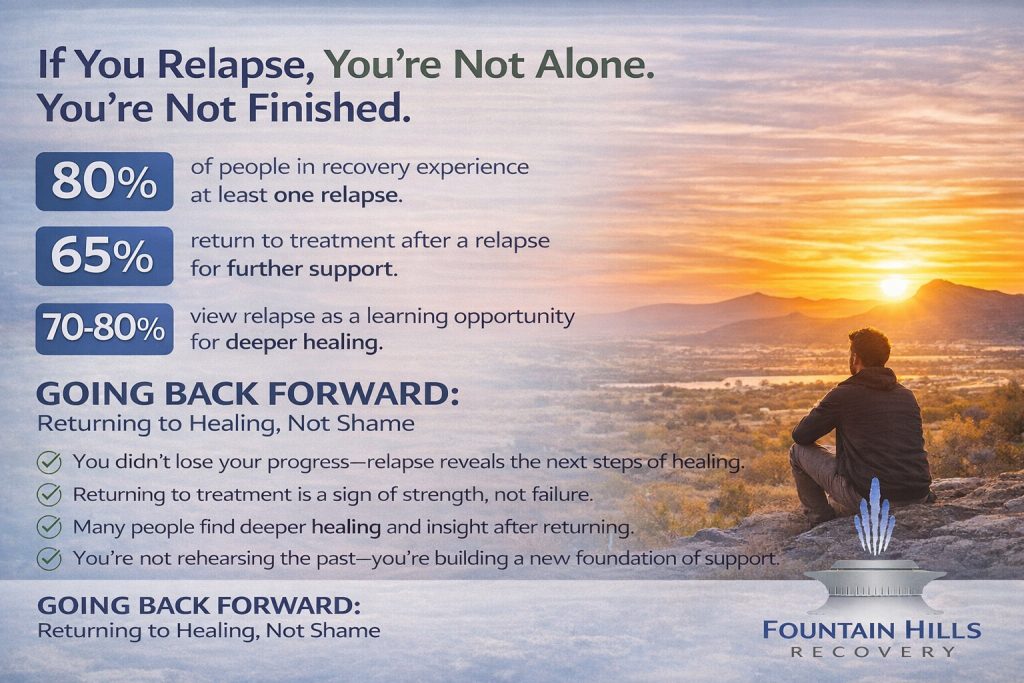
There’s a misconception that relapse means failure. That everything you worked for is gone. But relapse doesn’t wipe out your recovery. It reveals what still needs attention.
It’s information—not condemnation.
Maybe you left treatment before addressing a core trauma. Maybe you weren’t ready for the intensity of re-entry into work, family, or daily life. Maybe the pressure to be “okay” made you silence your struggles.
Whatever the reason, your relapse isn’t a character flaw. It’s a signal—and one we can help you respond to with care and clarity.
We Don’t Hand You a Fresh Start—We Hand You a Shovel
When alumni return to our care, we don’t treat them like strangers. We don’t wipe the slate clean and pretend none of it ever happened.
Instead, we ask: What have you learned about yourself since you left? What hurts are still alive underneath the progress? What worked, and what fell apart when the rubber met the road?
That’s the work. And it’s deeper.
This phase of healing often goes beyond stabilization. It’s where we get real about grief, shame, identity, family systems, or the quiet pressure to prove you’re “fine now.”
That’s why so many returning clients find renewed strength in our residential treatment program. They’re not checking boxes anymore—they’re digging into what matters.
Coming Back Doesn’t Mean You Failed
Let’s name the shame.
It’s common to feel like everyone will be disappointed—or worse, that they’ll be relieved to confirm their doubts. That internal monologue of “I blew it” can be loud. But it’s lying.
Coming back isn’t failure. It’s wisdom. It takes real courage to say, “I still need help.” And at Fountain Hills, that honesty is met with respect, not judgment.
We hold space for you as you are—experienced, tired, wiser, still healing.
Whether you live locally or are returning from out of state, there’s support in Scottsdale Addiction Rehab and Mental Health and access to care in Fountain Hills Drug for those seeking to return to safety, stability, and deeper healing.
A Relapse Isn’t a Reset—It’s a Reveal
A relapse doesn’t erase your insight. You don’t forget how to cope or stop deserving recovery. Often, people come back with more clarity about what’s missing—and what matters.
That might include:
- Deeper trauma processing that wasn’t ready to surface the first time
- Revisiting family boundaries that seemed “good enough” before
- Adjusting medication or mental health support as stress levels shift
- Reworking your aftercare plan now that you’ve seen where the gaps were
Your progress isn’t gone. It’s waiting. The relapse just pointed to the unfinished chapter.
You’re Allowed to Return Quietly—or Loudly
Some people want to share everything. Some want to check in quietly, see what’s possible, and take one step at a time.
Both are okay.
You don’t owe anyone a dramatic explanation or a redemption story. You don’t have to crawl back. You can walk in—messy, honest, uncertain—and be met with open hands.
Relapse is not a betrayal of your recovery. It’s part of many people’s reality. And so is coming back.
What a Return to Residential Treatment Might Look Like
Your second (or third, or fourth) time in residential treatment won’t look like the first.
You may not need as much structure. Or maybe you’ll crave even more.
You may connect faster, speak up sooner, or finally be ready to face something you avoided before. You might bring grief, or anger, or deeper questions about who you are in sobriety.
We meet you there—with a personalized approach, trauma-informed support, and the compassion of people who understand relapse not as failure but as feedback.
Recovery Isn’t Linear. Neither Is Your Strength.
We want you to know this: you didn’t lose your chance. You didn’t run out of tries. You don’t need to wait until you’re “ready” again.
Healing isn’t about perfection—it’s about honesty, safety, and connection. And that’s still available to you.
You didn’t fall behind. You just found your edge.
FAQ: Returning to Treatment After Relapse
Is it normal to relapse after 90+ days sober?
Yes. Many people experience relapse during early recovery, especially after transitioning out of structured care. It doesn’t mean you failed—it means your recovery needs more support.
Do I have to go through detox again?
That depends on the substance and severity of your relapse. If medical detox is needed, we’ll make that process as safe and comfortable as possible.
Will I be treated like a new client if I come back?
No. We respect your previous progress and tailor your care plan based on where you are now. You’re not starting over—you’re starting deeper.
What if I’m ashamed or afraid to reach out?
That’s completely understandable. Many alumni feel that way. Our team is here to meet you with empathy, not judgment. You’re not the first to come back—and you won’t be the last.
Can I talk to someone before committing to re-admission?
Absolutely. You can call us, ask questions, and take time to decide. There’s no pressure. Just honest support.
📞 Ready to come back stronger?
Call (800) 715-2004 or visit to learn more about our residential treatment program services in Scottsdale, AZ.