





You’ve been here before. First it was a slip. Then a promise you hoped was real. Then more worry. And now you’re reading this, thinking the unthinkable: Maybe what we did before isn’t enough.
That fear makes sense. You’re doing this out of love, not judgment. You want clarity. You want safety. You want a real chance for your child to heal.
That’s why understanding what inpatient drug rehab actually looks like for young adults matters — not as a scary “last resort,” but as a supportive, structured space where real change can begin.
At Fountain Hills Recovery, we work with families in this exact situation — parents who have been worried for a long time, and who need hope grounded in honesty. Below is a clear guide to what inpatient care looks like for young adults, how it works, and how it supports both your child and your family.
A safe space to shift out of chaos and into focus
In everyday life, your young adult might be surrounded by triggers: social pressures, chaotic schedules, unsupportive environments, easy access to substances, unresolved emotions, and life transitions that feel overwhelming.
Inpatient drug rehab provides a protected, structured environment — a place where those external pressures are gently set aside so your child can focus on healing.
This means:
- A calm, supervised residential setting
- Balanced daily routines
- Uninterrupted time for reflection and growth
- Professional oversight of health and emotional needs
For many young adults, stepping out of a familiar but harmful environment is not a retreat — it’s a breath of fresh air they didn’t know they needed.
What a typical day looks like — structure with purpose
One thing that surprises many parents is how purposeful the daily schedule can feel — without being suffocating.
Your child might have days that include:
- Morning check‑ins that help them start with intention
- Individual therapy sessions that explore personal struggles
- Small‑group workshops where peers process and learn together
- Skill‑building sessions on emotional regulation, communication, coping strategies
- Scheduled time for exercise, creative expression, or mindfulness
- Evening reflections or community circles
It’s not about making every moment “perfect.” It’s about helping your young adult notice patterns, think differently about stress and choices, and build skills that stick long after leaving treatment.
Therapy is individualized, not one‑size‑fits‑all
Each young adult enters treatment with a unique story — and inpatient care reflects that. Contrary to the myth of group therapy only, most programs balance:
- One‑on‑one therapy with trained clinicians
- Group therapy with peers of similar age or mindset
- Specialized mental health support when needed
This matters because many young adults don’t just struggle with substance use — they struggle with anxiety, trauma, identity, depression, or unprocessed stress. Treating these issues together, rather than separately, helps create more stable recovery.
At Fountain Hills Recovery, integrated care means mental health and substance use are addressed side by side — because they almost always interact.
Dual diagnosis support meets the whole person
Young adults often use substances to cope with emotional pain, unrecognized trauma, or mental health struggles. If we only address the substance use, the underlying pain stays.
That’s why inpatient drug rehab at Fountain Hills includes dual diagnosis treatment — the simultaneous care for both mental health and substance use challenges.
This kind of care:
- Helps your child understand why they use
- Provides tools to manage difficult emotions
- Identifies patterns that may have led to dependence
- Teaches adaptive ways to cope with stress and triggers
Your child isn’t treated as a “case.” They are treated as a whole person with history, emotions, struggles, and potential.
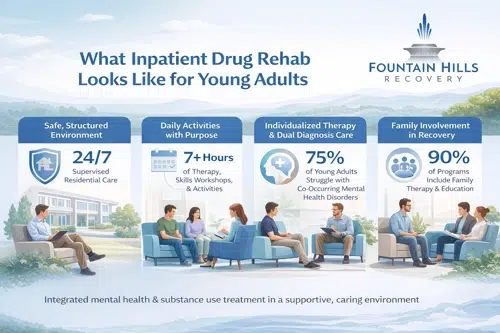
Family involvement is part of healing
One of the biggest concerns parents have is: Will I be left out of the process? The answer is no.
Treatment centers that truly care recognize that healing isn’t isolated. They involve families in ways that make sense for everyone.
That might include:
- Family therapy sessions (in‑person or remote)
- Education on effective communication and boundaries
- Help understanding your role in support without rescuing
- Guidance on how to rebuild trust after ups and downs
Your support matters, but it needs to be paired with tools — not just intention. Inpatient care aims to help you learn alongside your child, so you’re better equipped when they return home.
You don’t have to wait until things are “terrible”
A common misunderstanding is that inpatient drug rehab is only for the most extreme cases. That’s not true.
Many young adults are better served by inpatient care when:
- Outpatient treatment hasn’t been enough
- Their environment is unstable or enabling
- They show signs of deeper emotional struggle
- Family stress and conflict have built up
- They haven’t had enough time or space to focus on recovery
Inpatient rehab isn’t about hitting rock bottom. It’s about creating a foundation — a stable base from which lasting recovery can grow.
Success doesn’t always look dramatic — sometimes it’s steady
Success in inpatient care isn’t always marked by dramatic breakthroughs overnight. Often, it’s quiet growth:
- A young adult who used to avoid reflection now journals regularly
- Someone who resisted help begins to trust therapy
- A person who seemed numb starts sharing feelings
- A young adult who coped with use learns new ways to calm their nervous system
Healing can feel like small steps rather than leaps — and that’s okay. Recovery isn’t a race. It’s a return to stability, awareness, and agency.
Real stories from families who walked this path
We’ve seen parents who were once terrified of inpatient treatment end up feeling grateful they chose it.
One mother shared:
“I thought putting him in treatment meant giving up on him. What it really meant was giving him a chance to find himself again.”
Another parent said:
“I didn’t know inpatient care could be so compassionate. They treated him like a young adult — not a problem to be managed.”
These stories aren’t polished examples. They’re lived experiences — because recovery isn’t perfect, but it can be meaningful.
Frequently Asked Questions for Parents
Will inpatient drug rehab take my child away from life responsibilities?
Treatment is designed to support healing, not disrupt growth. Many young adults return with clearer focus, stronger emotional tools, and improved capacity to handle school, work, and relationships.
What if my child doesn’t want to go?
This is a common concern. Many young adults resist help initially. Treatment teams can talk with families about gentle, respectful ways to encourage participation — without cruelty or coercion.
How long does inpatient treatment last?
It varies. Some programs run 30 days, others 60 or 90. The length depends on your young adult’s needs, progress, and clinical recommendations. The focus is on preparedness, not a fixed timeline.
Can families be involved during treatment?
Yes. Family sessions, educational support, and structured communication are often part of comprehensive care. Parents don’t need to be excluded — they are an important part of the recovery journey.
What happens after inpatient care ends?
Exit planning is intentional and tailored. Your child will leave with:
- A personalized aftercare plan
- Referrals to outpatient or continued therapy
- Tools for coping and relapse prevention
- A roadmap for next steps
Rehab isn’t a start-and-stop event. It’s a launching point.
Is inpatient rehab only for severe addictions?
No. It’s for anyone who needs the kind of focused, structured support that can’t be sustained at home — especially when outpatient care hasn’t been enough.
You’ve cared for your child every step of the way. Choosing treatment isn’t a sign that you’ve failed — it’s a sign that you’re fighting for a future that feels better than the present.
Call (800) 715-2004 or visit Inpatient Drug Rehab in Fountain Hills, AZ to learn more about how we support young adults — and families — through meaningful, compassionate care that meets your child where they are.