
When you first admit to yourself that you need help, relief and fear can show up together. You might feel hopeful that healing is finally possible — and uneasy because you don’t know what type of care is right for you. Should you go somewhere full‑time? Can you stay home and still get the support you need?
At Fountain Hills Recovery, we know this uncertainty is normal. You don’t have to guess. You don’t have to decide alone. Understanding inpatient drug rehab and outpatient care, and how clinicians help you choose between them, can offer clarity and even a sense of control in a moment that feels overwhelming.
Today we’re going to walk through both, in clear, honest terms — because you deserve a path that feels right for you, not what someone else assumes you need.
What “levels of support” really mean
First, let’s set the stage with something deeply true: treatment isn’t a maze to get lost in. It’s a ladder of support. Each level — inpatient or outpatient — is designed to meet you where you are in your recovery, not to judge how you got there.
Treatment isn’t one size fits all. It’s fluid. Some people start in one place and transition to another. Others stay at one level for as long as they need. None of it is failure. It’s responsive care.
Here’s how clinicians help you understand your options.
How clinicians assess your needs
Before anything else, clinicians will ask questions — not to label you, not to put you in a box, but to understand you.
They’ll look at:
- Your physical health and safety
- How recent or severe your use has been
- Whether you’re experiencing medical or psychological symptoms
- Your living environment and support system
- Any co‑occurring mental health challenges
This isn’t a test you can “fail.” It’s a conversation that helps professionals recommend the safest, most effective path forward.
Some people walk in thinking they need one thing and end up doing another. And that’s okay. What matters is finding the care that actually works for your situation.
What inpatient drug rehab offers — and why it matters
Inpatient drug rehab is residential care. You live at the treatment center for a period of time, fully immersed in healing.
It may sound intense or scary at first. But here’s the honest truth: when your nervous system is out of balance, sometimes immersion works exactly the way rest or isolation doesn’t.
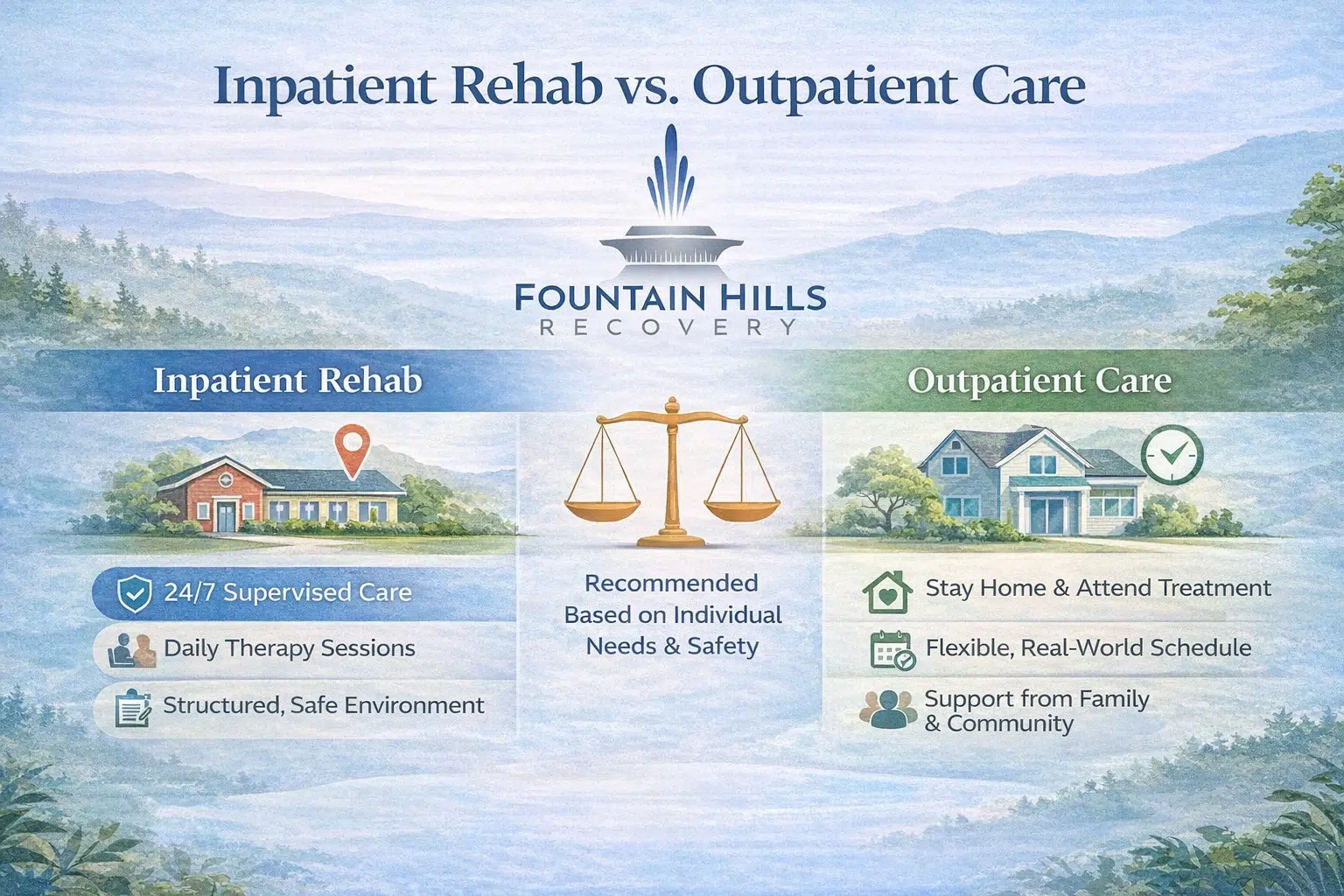
Inpatient care offers:
- 24/7 supervision and medical support
- Daily therapy — both group and individual
- A structured schedule that reduces decision fatigue
- Separation from environments and cues that trigger use
Imagine your early recovery like learning to swim. Inpatient care is the pool with the instructor standing right beside you, the lifeguard on watch, and no currents to pull you under. You get the space to learn, practice, and understand your own patterns without the weight of real‑world stress pulling at you each day.
For many first‑time seekers, this environment brings a sense of safety that outpatient care simply can’t match.
Outpatient care: healing while rooted in your real life
Outpatient treatment allows you to receive support during the day or evening while you return home each night. It’s a powerful option, especially when:
- You have a stable, low‑trigger environment
- Your medical needs don’t require constant supervision
- You have responsibilities you can’t step away from (work, caregiving, family)
Outpatient care can include:
- Individual therapy
- Group sessions
- Psychiatric support
- Skill‑building classes
Think of it as learning while living. You practice what you’re building in treatment right where you’ll use it — in your everyday world. Sometimes this is exactly what someone needs early on. Other times, it’s more effective after inpatient support has already provided structure and stability.
The key difference isn’t severity — it’s safety and focus
A lot of people hear “inpatient” and think, That must be for people who are worse off than me.
That’s a misconception.
The real difference between inpatient drug rehab and outpatient care is about where your recovery energy should be focused — on healing first or living while healing.
Inpatient gives you healing first:
- Time away from triggers
- Space to understand your patterns
- A chance to rebuild your nervous system
Outpatient gives you living while healing:
- Immediate integration with your daily world
- Support that you carry with you
- Opportunities to practice new skills in real time
Neither choice is better universally. What’s better — and what clinicians help you determine — is what’s more helpful for you at this moment.
When inpatient care is often recommended first
Here are signs clinicians may recommend inpatient drug rehab over outpatient care:
- You’ve tried outpatient before and still feel stuck
- You’re struggling with medical or mental health symptoms
- You live in an environment that reinforces old patterns
- You feel unsafe or unsupported at home
- You’ve experienced recent relapse or intense cravings
Inpatient care doesn’t mean you’re incapable. It means your brain and body need space to reset — without the day‑to‑day triggers breathing down your neck.
It’s a choice that honors the challenge you’re facing — not shames it.
When outpatient care may be a good starting point
Outpatient care can be appropriate when:
- Your living situation is secure and supportive
- Your use hasn’t created medical instability
- You have strong motivation and local support
- You want flexibility for work or caregiving
Outpatient isn’t “lighter.” It’s just different. It asks you to show up in your environment while also healing in treatment.
And that’s powerful — when your environment genuinely supports your recovery.
Making the right choice — with real partnership, not pressure
Here’s what most people fear: being told they’re “doing it wrong.”
But at Fountain Hills Recovery, we don’t see treatment as a test. We see it as a partnership where your story, your honest answers, and your goals guide the plan.
Clinicians don’t make decisions in isolation. They ask:
- What feels manageable right now?
- What feels safest right now?
- What level of structure feels comforting, not chaotic?
- How has your body and mind responded to stress?
Your honest answers to these questions help form a care plan that’s rooted in your life, not a generic checklist.
What to expect after you choose a path
No matter which path you and your clinician decide on, care doesn’t stop the moment the decision is made.
If you begin with inpatient drug rehab:
- You’ll have a clear transition plan for outpatient support afterward.
- You’ll learn skills to integrate into your daily life.
- You’ll build a support network that extends beyond the center.
If you begin with outpatient care:
- You’ll have touchpoints throughout the week to check in.
- You’ll gradually build confidence in your ability to manage triggers.
- You’ll have clinicians monitoring your progress and adjusting as needed.
The goal isn’t to rush you in or out of anything. It’s to help you feel steady and connected — at every step.
Frequently Asked Questions
How do clinicians decide if inpatient drug rehab is necessary?
They look at your safety, environment, mental health symptoms, history of relapse, and medical needs. The goal isn’t to judge, but to recommend the level of support that keeps you safe and growing.
Is outpatient care less serious or effective?
No. Outpatient care is effective for many people — especially those with stable environments and strong motivation. It’s a different approach, not an inferior one.
Can I switch from outpatient to inpatient if needed?
Yes. Many people begin outpatient care and transition to inpatient support if their needs change. Recovery isn’t linear, and adjusting plans is normal.
What if I’m afraid of inpatient treatment?
That fear is understandable. Most people are nervous at first. But inpatient care is designed to support you — not punish you. Clinicians walk with you through every step.
How long does inpatient rehab usually last?
Length varies based on individual needs. Some programs run 30 days; others may be longer or shorter. What matters most is that it meets you where you are — not a predetermined clock.
You don’t have to know the difference between inpatient drug rehab and outpatient care to take the first step. You just have to talk to someone who understands what you’re going through — without judgment, without pressure, and with real compassion.
Call (800) 715‑2004 or visit Inpatient Drug Rehab in Fountain Hills, AZ to learn more about how we help first‑time treatment seekers choose the right level of support — so you can start healing in a way that feels safe and genuine.