




It usually doesn’t happen all at once.
It’s quiet. A thought, a moment, a justification that feels small—until it isn’t.
Watch for the small pattern after 30 days sober that keeps catching people off guard.
If you’ve relapsed after 90 days or more, you’re probably carrying more than just the weight of the drink. You’re carrying the story that came with it: I ruined everything.
Let’s slow that down. Because that story isn’t accurate—but it is trying to tell you something important.
And we can work with that.
Early on, it may help to revisit what kind of structure actually supports you best. If you’re unsure, this breakdown of alcohol addiction treatment services can help you understand where you might need more (or different) support right now.
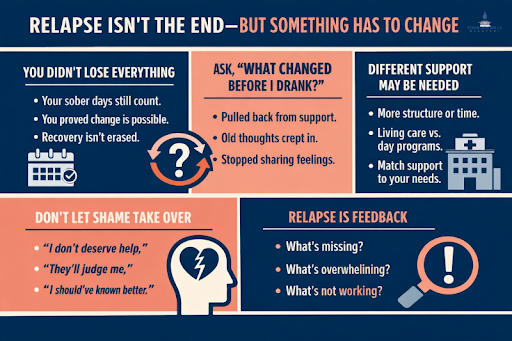
Relapse Doesn’t Erase Your Progress
Ninety days sober is not nothing. It’s evidence.
It means your body began to reset. Your mind started to clear. Others describe not seeing how far I’d drifted until everything felt flat. You proved—at least once—that change is possible.
That feedback is easier to act on once you understand coming back after relapse in recovery.
Relapse doesn’t delete that. It interrupts it.
But interruption is not the same as failure.
From a clinical perspective, relapse is often part of the recovery process—not because it’s inevitable, but because recovery exposes patterns you haven’t fully worked through yet.
That’s not a character flaw. That’s unfinished work.
The Real Question Isn’t “Why Did I Drink?”
It’s: What changed before I did?
Relapse rarely starts with the drink. It starts earlier—emotionally, mentally, sometimes quietly.
You might recognize this:
- You stopped talking about what you were feeling
- You started negotiating with old thoughts
- You pulled back from support just a little
- You told yourself, I’ve got this now
None of those things feel dramatic. That’s why they’re easy to miss.
But they matter.
You’re Not Back at the Beginning—But You’re Not Where You Were Either
This is the part that feels disorienting.
You’re not the same person you were before treatment. You have awareness now. You’ve lived sobriety. You know what’s possible.
But you’re also not standing in the same place you were at day 90.
Try looking at the 30-day wall through a different lens — it’s a checkpoint, not a verdict.
And that in-between space? It can feel unstable.
That’s why the next step isn’t punishment—it’s recalibration.
Not All Support Looks the Same (And That Matters More Than You Think)
One of the most common misconceptions is that treatment is a one-time event.
It’s not.
Different stages of recovery often require different levels of care. Some people do well with structured daytime care. Others need something more immersive again—at least for a period.
If you’ve been trying to figure out what actually works, especially in the context of inpatient vs outpatient alcohol rehab, the real answer is this:
What works is what matches your current level of need—not what worked before.
That might mean stepping back into a more supportive environment, even temporarily. Not because you failed—but because your situation changed.
Shame Will Tell You to Disappear—Don’t Listen to It
Even with progress, life after sobriety feels empty or disconnected for some — and that’s addressable.
Shame is loud after relapse.
It says things like:
- “They’re going to judge me”
- “I should’ve known better”
- “I don’t deserve help again”
But here’s what I want you to understand, clearly:
The door is not closed.
In fact, this is the exact moment where staying connected matters most.
The clients who re-engage after relapse—honestly, without hiding—often build a stronger, more sustainable recovery than before.
Not because relapse is helpful.
But because what comes after it can be more honest.
Something Needs to Change—And That’s Not a Bad Thing
Relapse is feedback.
It’s not gentle feedback—but it’s specific.
Many alumni say it felt different after treatment — and not in the way they expected.
It tells us:
- Where support wasn’t strong enough
- Where stress wasn’t processed
- Where patterns went unchallenged
- Where something internal got missed
That’s not failure. That’s information.
And information is something we can use.
You Don’t Have to Start Over Alone
If you’re reading this, you haven’t disappeared. That matters.
There are still options. Still support. Still a path forward that doesn’t require pretending this didn’t happen—but also doesn’t define you by it.
If you’re nearby, you can explore treatment in Scottsdale addiction rehab and mental health or find support closer to home with treatment in Fountain Hills drug and alcohol care.
Both are simply ways of saying: you don’t have to figure this out by yourself.
A Final Thought to Hold Onto
Relapse doesn’t mean you can’t recover.
It means your recovery needs something different now.
And that’s something we can respond to—together.
Call (800) 715-2004 or visit alcohol addiction treatment services in Fountain Hills, AZ to learn more about your next step.