





You don’t have to have everything figured out to be here. A lot of people start by quietly wondering if there’s a way to feel better—without choosing between their mental health and their relationship with alcohol.
If you’ve been searching for something that can help with both mental health and substance use, it’s normal to ask: what does that actually feel like day to day?
Let’s walk through it, honestly.
Does it feel structured… or overwhelming?
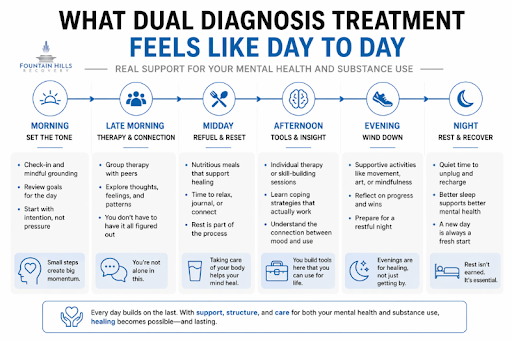
Most days follow a rhythm—but not a rigid, clinical one.
You might have a morning check-in, a few group sessions, maybe a one-on-one conversation. There’s space to breathe in between. Time to think. Time to not perform.
At first, structure can feel strange—especially if your days have been unpredictable. But many people end up describing it as a relief. Like someone finally turned the noise down just enough for you to hear yourself think.
Will I have to talk about everything right away?
No. And you’re not expected to.
You’ll be invited to share, not pushed. Some days you might open up more. Other days, you might just listen. Both count.
A lot of people come in worried they’ll have to explain their entire life story on day one. That’s not how it works. Trust builds slowly—and that’s respected.
What actually happens in a typical day?
It’s less about “fixing” you and more about understanding patterns.
You might explore:
- How your mood and drinking are connected
- What triggers certain thoughts or habits
- Healthier ways to cope when things feel heavy
This is where the work to treat depression and addiction together starts to feel real—not theoretical. You begin to see how one affects the other, in your own life.
And that awareness? It can be surprisingly grounding.
Will I feel out of place?
Almost everyone worries about this.
But the reality is, most people there are asking some version of the same question you are:
“Is it okay that I’m not okay… but also not completely falling apart?”
You’ll meet people who look like they have it together. People who don’t. People somewhere in between.
There’s something quietly powerful about being in a room where you don’t have to explain why you’re tired.
Is it all serious all the time?
Not at all.
There are hard moments, yes. Honest ones. But there’s also laughter—sometimes more than people expect.
Recovery spaces aren’t just about processing pain. They’re also about reconnecting with parts of yourself that haven’t had much airtime lately.
Small moments start to matter again. A conversation. A joke. A clear head at the end of the day.
What changes first?
It’s usually not something dramatic.
It might be:
- Sleeping a little better
- Feeling less reactive
- Noticing your thoughts instead of being pulled by them
Change tends to show up quietly before it becomes obvious.
One person described it like this:
“It wasn’t that everything got better overnight. It’s that things stopped getting worse so fast.”
How do I know if this is the right step?
You don’t need certainty to take a step.
If you’ve been thinking about getting support—especially something that looks at both your mental health and your drinking—it’s worth exploring. Not committing forever. Just exploring.
If you’re nearby, you can look into treatment in Scottsdale or consider care in nearby areas that make it easier to stay consistent.
Final thought
You don’t have to hit a breaking point to deserve support.
Sometimes the decision isn’t about whether things are “bad enough.”
It’s about whether you’re ready for them to feel a little different.
Call 800-715-2004 or visit our dual diagnosis treatment services in Fountain Hills, AZ to learn more.