




A little over three months after leaving treatment, I convinced myself I was different.
Not better. Not cured. Just different enough that I could handle things on my own.
At first, it sounded reasonable. I stopped returning calls. I skipped meetings. I told myself I was busy. Then I told myself I was fine.
The problem was that I wasn’t fine.
I was carrying around the same stress, the same exhaustion, and the same quiet voice that kept suggesting one drink wouldn’t matter.
I knew where that road went. I’d already driven it before.
What surprised me wasn’t the relapse. It was what happened next.
In the middle of feeling embarrassed and defeated, I clicked on a page about alcohol addiction treatment and started looking into my options. I wasn’t even sure why. Part of me expected to find another reason not to go back.
Instead, I found something that changed the conversation entirely.
I Thought the Hard Part Was Admitting I Needed Help
For me, the hardest part wasn’t saying, “I’m struggling again.”
It was admitting that I couldn’t fix it by myself.
There’s a strange pressure that comes with being the person who always handles things. The dependable one. The strong one. The one who already went to treatment and was supposed to know better.
Relapse can make you feel like you’ve lost the right to ask for help.
I carried that belief for weeks.
The longer I waited, the heavier it became.
The Excuse I Kept Repeating
My favorite excuse was money.
Not because I had researched anything. I hadn’t.
I simply assumed treatment would be too expensive, insurance wouldn’t help, and there was no point looking into it.
That assumption gave me permission to stay stuck.
A lot of us do this. We build entire walls out of guesses.
Then one day, usually when things become painful enough, we finally check.
The Five Minutes That Changed My Direction
I remember staring at my phone, almost annoyed with myself.
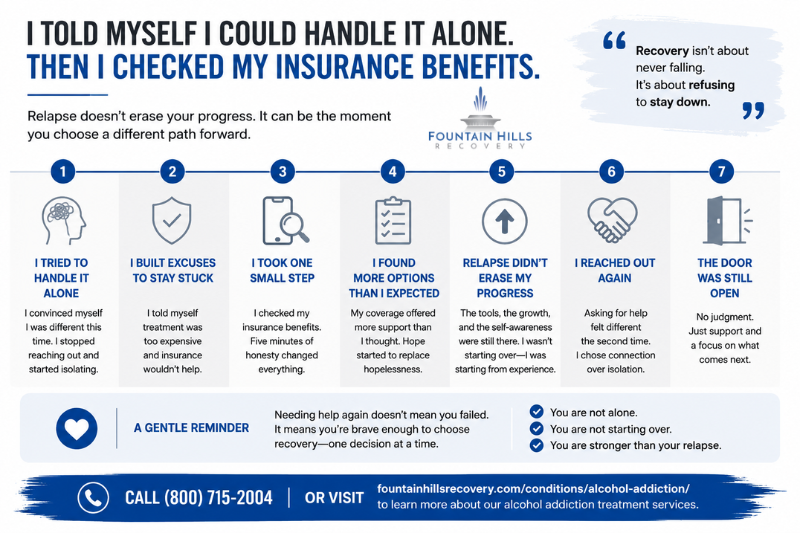
I checked my benefits.
That was it.
Five minutes.
Not a commitment. Not an admission. Not a promise.
Just information.
What I discovered was that my insurance offered more support than I expected. The story I’d been telling myself about affordability wasn’t actually true.
For the first time in weeks, I felt something other than shame.
I felt possibility.
For many people, understanding their alcohol rehab insurance coverage removes a barrier they assumed was permanent. It doesn’t solve everything. But it can turn “I can’t” into “maybe I can.”
Relapse Didn’t Erase the Work I’d Already Done
This was the lesson I needed most.
Relapse made me feel like I had thrown away ninety days.
Recovery taught me that wasn’t true.
The coping skills were still there.
The self-awareness was still there.
The relationships I’d built were still there.
I wasn’t starting from zero. I was starting from experience.
That’s a very different place.
A relapse can feel like a house fire. But sometimes, once the smoke clears, you realize the foundation survived.
Asking for Help the Second Time Felt Different
The first time I entered treatment, I was scared.
The second time, I was honest.
There’s a difference.
I knew what happened when I isolated myself.
I knew what happened when I tried to white-knuckle everything.
Most importantly, I knew recovery wasn’t about proving how strong I was.
It was about staying connected.
That perspective changed everything.
The Door Was Still Open
One of the biggest fears after relapse is believing you’ve disappointed everyone.
Staff.
Friends.
Sponsors.
Family.
Yourself.
What I found instead was an open door.
No lectures. No punishment. No one asking me to explain every mistake.
Just people focused on what came next.
That’s why I always encourage alumni who are struggling to reach out sooner rather than later. The story in your head is usually harsher than reality.
If you’re exploring treatment options, it may help to look at available support and local resources, including treatment options in Scottsdale Addiction Rehab and Mental Health or care in Fountain Hills Drug.
You Don’t Have to Carry This Alone
If you’re reading this after a relapse, I want you to hear something I wish someone had told me.
The fact that you’re struggling does not erase the work you’ve done.
The fact that you’re scared does not mean you’ve failed.
And the fact that you need help again does not make you weak.
Sometimes recovery begins with a major breakthrough.
Sometimes it begins with a five-minute insurance check.
Mine did.
Call (800) 715-2004 or visit our alcohol addiction treatment services to learn more about our alcohol addiction treatment services.