




Three days after I relapsed, I sat in my car outside a gas station convincing myself I didn’t deserve help anymore.
Ninety days sober had turned into ninety-one excuses. I told myself I’d blown my shot. That people would be disappointed. That going back to treatment would feel humiliating.
What I actually needed wasn’t another lecture. I needed someone to answer the phone and say, “Okay. Come in.”
That’s why finding immediate support matters so much. For a lot of people searching for alcohol addiction treatment, the hardest part isn’t admitting the relapse happened. It’s believing they’re still worthy of help afterward.
Relapse can make time feel dangerous. Every hour becomes a negotiation with yourself. Every drink feels both relieving and devastating at the same time.
Relapse Doesn’t Erase the Work You Already Did
This part matters more than people realize.
You did not “fake” your sobriety because you relapsed. Those ninety days were real. The meetings were real. The healing was real. The mornings you woke up clear-headed still count.
A relapse is painful because the progress mattered.
People love to talk about recovery like it’s a straight line. Most of us know better. Recovery can look more like learning how to walk across ice—careful, uneven, sometimes slipping hard enough to scare yourself.
That doesn’t mean you stop walking.
“I thought everyone at treatment would be angry at me for coming back. Instead, they just looked relieved I came back alive.”
– Alumni Client
The Worst Part Was Thinking I Had to “Hit Bottom” Again
I kept telling myself it wasn’t bad enough yet.
That sentence almost wrecked me.
A lot of alumni relapse quietly at first. Maybe it starts with “just one night.” Maybe it turns into hiding bottles again. Maybe it becomes waking up with that familiar panic in your chest and realizing the old thinking came back faster than expected.
The dangerous part is how quickly shame isolates you.
You stop answering texts. You disappear from meetings. You convince yourself you need to suffer longer before you’ve earned another chance.
You don’t.
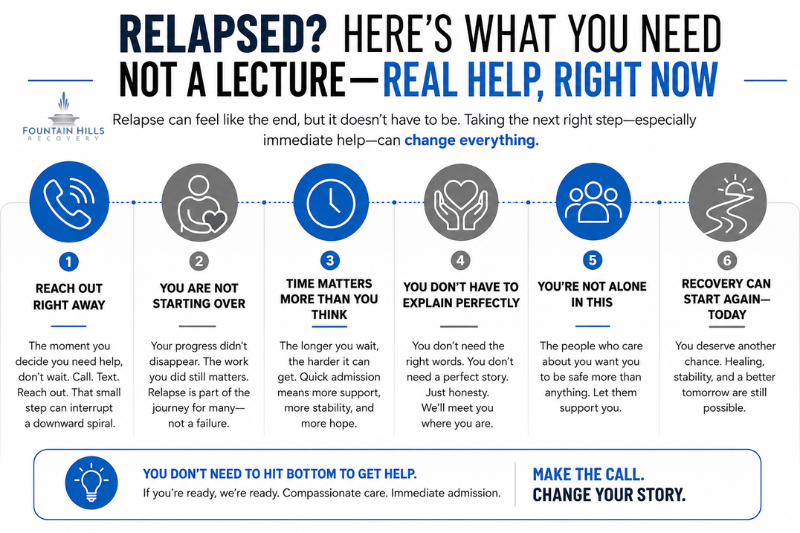
You are allowed to interrupt the spiral early.
Sometimes Immediate Admission Is the Difference
There’s a specific kind of fear that hits after relapse: What if I change my mind tomorrow?
That urgency is real.
A lot of people searching for help after relapse aren’t calmly planning next month’s treatment schedule. They’re trying to hold onto a tiny moment of willingness before shame talks them out of it.
That’s why immediate access matters.
Not because your life has to become catastrophic first. But because alcohol has a way of getting louder the longer you wait.
For people looking into alcohol rehab arizona, quick admission can remove one more barrier between the thought “I need help” and the action of actually getting it.
Sometimes the bravest recovery decision lasts about eight minutes. Long enough to make the call. Long enough to say yes before fear takes over again.
You Don’t Need to Explain Yourself Perfectly
I used to think I needed the right speech before asking for help again.
Something honest enough. Serious enough. Shameful enough.
Turns out, most people in recovery already understand the language behind the silence.
You can call while crying.
You can call while drunk.
You can call unsure if you even mean it yet.
You don’t need a polished redemption arc before treatment begins.
You just need honesty for one moment.
The People Who Love You Are Probably More Scared Than Angry
Relapse has a way of distorting everything. Especially relationships.
You may assume your family is exhausted. Your friends are disappointed. Your sponsor is frustrated.
Some of them might be hurt. That’s real.
But most people who care about you are not sitting around demanding perfection. They’re hoping you survive this. They’re hoping you come back before the relapse hardens into another lost year.
And honestly? Many of them would rather get a difficult phone call today than a devastating one later.
Recovery Can Start Again Faster Than You Think
One of the strangest things about returning to treatment is how quickly relief can show up.
Not happiness. Not clarity. Just relief.
A real meal. A safe bed. Someone looking you in the eye without disgust. The nervous system softening for the first time in weeks.
Sometimes healing starts there.
Not with motivation.
Not with confidence.
Just with finally not hiding anymore.
If you’re exploring care in Scottsdale or looking into treatment options in Fountain Hills, remember this: returning after relapse is not embarrassing. It’s human.
And human beings deserve another chance before things get worse.
Relapse can make you feel like you’ve disappeared from yourself. But the version of you that fought for sobriety before is still in there. Buried maybe. Exhausted maybe. But not gone.
Call (800) 715-2004 or visit our alcohol addiction treatment services to learn more about our alcohol addiction treatment services.