




A lot of people disappear from treatment quietly.
Not because they don’t care. Not because they “failed.” Usually, it’s because something inside them got overwhelmed. The schedule felt confusing. The intensity felt scary. Or they honestly couldn’t tell which kind of support they needed anymore.
If you’ve ever sat in your car outside a therapy office wondering whether to walk in or drive away, you’re not alone.
And if you’ve been trying to understand the difference between structured daytime care, multi-day weekly treatment, and regular counseling appointments, this might help make things feel less blurry.
Within the first few weeks of recovery, many people start comparing different levels of care and wondering what actually fits their life. That’s where understanding a structured outpatient recovery program can make the next step feel less intimidating.
Some People Need More Than One Hour a Week
There’s a version of recovery advice that sounds simple.
“Just go to therapy.”
But for many people, especially after relapse, emotional burnout, or a mental health spiral, one hour a week can feel like trying to stop a flood with a paper towel.
That doesn’t mean you need residential care. It also doesn’t mean you’re beyond help.
Sometimes people need more structure for a season. More support. More accountability. More contact with people who understand what’s happening beneath the surface.
That’s where different treatment levels come in.
Not as punishment. As support matched to reality.
The Difference Usually Comes Down to Time and Stability
The biggest difference between these care options is how much support someone needs right now.
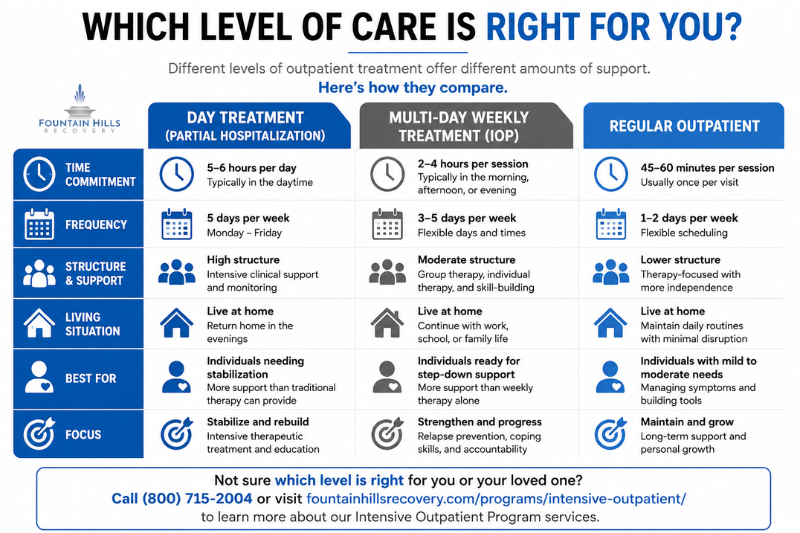
Regular outpatient care is often the lightest level. You might meet with a therapist once or twice a week while continuing daily life mostly unchanged.
Multi-day weekly treatment offers more consistency. People usually attend several sessions per week while still living at home, working part-time, or managing family responsibilities.
Structured daytime care is more intensive. It often involves treatment several hours a day, multiple days a week, with a stronger clinical focus and closer monitoring.
The goal isn’t to label someone as “worse” or “better.” It’s to create enough support that healing actually has room to happen.
Because white-knuckling recovery alone is exhausting.
A Higher Level of Care Doesn’t Mean You Failed
This part matters.
A lot of people hear “day treatment” and immediately think:
Things must be really bad.
Not necessarily.
Sometimes it simply means:
- You’ve been trying to hold everything together alone
- Symptoms keep escalating
- Relapse patterns are repeating
- Mental health and substance use are feeding each other
- You need a steadier rhythm before things unravel further
There’s no medal for struggling with less support than you actually need.
One client once described stepping into structured care like finally putting down grocery bags they’d been carrying for miles. Not cured. Not magically transformed. Just… able to breathe for the first time in months.
That’s often what the right level of care feels like.
Why People Step Down Over Time
Most people don’t stay in intensive treatment forever.
Recovery usually works more like physical therapy after an injury. At first, you might need frequent support and close guidance. Over time, as stability grows, the structure can gradually decrease.
Someone might begin with daytime treatment, then move into a multi-day weekly schedule, then eventually transition into regular outpatient counseling.
That progression is normal.
It’s also common for people to move backward temporarily during stressful periods. A relapse, depressive episode, panic attacks, grief, or isolation can increase support needs again.
That doesn’t erase progress.
It means you’re human.
The Question Isn’t “Which Program Is Best?”
The better question is:
What level of support gives you the best chance to stay connected instead of disappearing?
Because many people don’t leave treatment dramatically.
They just slowly stop answering calls.
Miss one session.
Then another.
Then convince themselves they’re too embarrassed to return.
That’s especially common for people searching terms like PHP vs outpatient program. Underneath the search is often a quieter fear:
What if I pick wrong again?
But treatment isn’t a lifelong contract. It’s allowed to adjust as your needs change.
The important thing is staying connected somewhere.
You Don’t Have to Earn Your Way Back
If you left treatment before, there’s something worth hearing clearly:
You are still allowed to come back.
Most clinicians have worked with people who disappeared for weeks or months before returning. Sometimes ashamed. Sometimes defensive. Sometimes exhausted.
And honestly? The strongest recovery stories are rarely the clean, linear ones.
They’re the stories where someone came back after believing they couldn’t.
If you’re exploring care in Scottsdale Addiction Rehab and Mental Health or looking into treatment options in Fountain Hills Drug, you deserve support that meets you where you are now — not where you think you should already be.
Recovery isn’t usually one brave leap. More often, it’s one honest return.
Call (800) 715-2004 or visit our Intensive Outpatient Program services to learn more about our Intensive Outpatient Program services.