






If you’ve been researching neurofeedback for ADHD, you’ve probably noticed two extremes. Some websites describe it as a breakthrough that can permanently “rewire” the brain. Others dismiss it as ineffective altogether.
The truth is more nuanced.
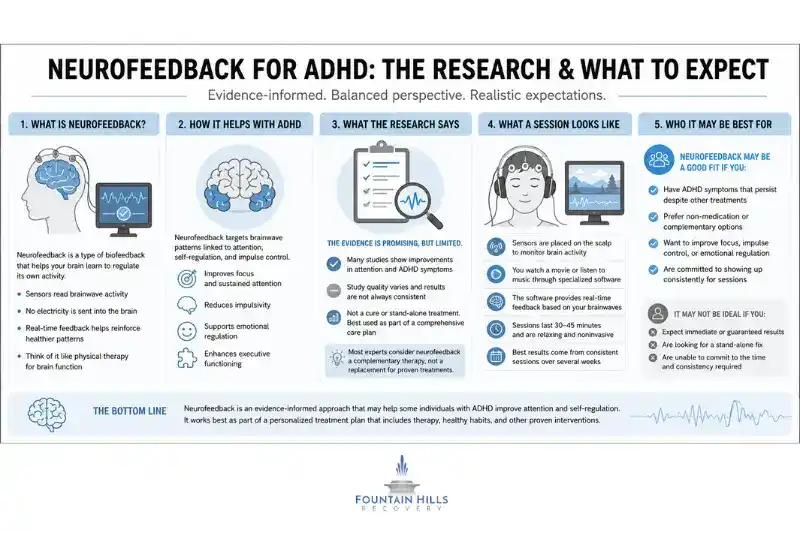
Neurofeedback is an evidence-informed therapy that’s been studied for decades. While research suggests it may help some people improve attention, self-regulation, and impulse control, it is not considered a cure for ADHD or a replacement for treatments with stronger evidence, such as behavioral therapy or medication. Instead, many clinicians view it as a complementary approach that may benefit carefully selected individuals.
At Fountain Hills Recovery, we use BrainPaint neurofeedback as part of individualized treatment for mental health and substance use disorders. Understanding what neurofeedback can—and cannot—do helps patients make informed decisions based on realistic expectations rather than marketing claims.
What Neurofeedback Actually Is
One of the biggest misconceptions about neurofeedback is that it changes the brain by sending electricity into it.
It doesn’t.
Neurofeedback is a type of biofeedback. Sensors are placed on the scalp to measure the brain’s natural electrical activity (brainwaves), but they do not deliver electrical stimulation. Instead, specialized software provides real-time feedback while you watch a movie, listen to music, or complete another activity.
As your brain produces targeted patterns of activity, the software provides positive feedback. Over repeated sessions, the goal is to help the brain become better at producing healthier patterns associated with attention, emotional regulation, and cognitive performance.
Think of it like physical therapy for brain function. The equipment isn’t doing the work for you. Instead, it provides immediate feedback that allows the brain to practice new patterns through repetition.
How Neurofeedback Is Used for ADHD
People with ADHD often experience challenges involving sustained attention, impulsivity, working memory, and executive functioning. Neurofeedback is designed to support some of these underlying self-regulation processes.
Depending on the individual’s assessment, treatment may focus on helping improve:
- Sustained attention during tasks
- Impulse control
- Emotional regulation
- Mental flexibility
- Cognitive endurance
- The ability to recover from distractions
It’s important to recognize that ADHD affects people differently. Neurofeedback isn’t intended to “normalize” every brain or eliminate every symptom. Instead, clinicians typically use it alongside other evidence-based interventions as part of a broader treatment plan.
For many individuals, that plan may also include psychotherapy, medication management, behavioral strategies, sleep improvement, exercise, and lifestyle changes.
What the Research Says—Honestly
The research surrounding neurofeedback for ADHD is encouraging, but it also has limitations.
Several clinical trials and systematic reviews have found that neurofeedback may improve attention and reduce some ADHD symptoms, particularly when measured over time. Some studies have reported lasting improvements after treatment ends, suggesting participants may retain learned self-regulation skills.
At the same time, researchers point out important caveats.
Study quality varies considerably. Different neurofeedback systems use different protocols, making results difficult to compare. Some studies rely heavily on parent-reported outcomes rather than blinded assessments. Professional organizations also differ in how they rate the current strength of the evidence.
Because of these factors, neurofeedback is generally not considered a first-line or stand-alone treatment for ADHD.
That doesn’t mean it lacks value.
Instead, many clinicians view it as a promising complementary intervention that may benefit certain patients, particularly those seeking a non-medication option or looking to supplement an existing treatment plan.
The most credible position is neither “it cures ADHD” nor “it never works.” The evidence suggests that neurofeedback may help some individuals improve attention and self-regulation, while additional high-quality research continues to refine who benefits most and why.
What a BrainPaint Neurofeedback Session Looks Like at Fountain Hills
Knowing what happens during a session often helps reduce uncertainty.
Treatment typically begins with a clinical assessment to determine whether neurofeedback is appropriate and how it fits into your overall care plan.
During a typical BrainPaint session:
- Sensors are gently placed on your scalp to monitor brainwave activity.
- No electricity is delivered into your brain.
- You’ll sit comfortably while watching visual media or listening to audio connected to the BrainPaint software.
- The software continuously responds to your brain’s activity, providing real-time feedback.
- Sessions usually last around 30 to 45 minutes.
Because neurofeedback works through repeated learning, most people participate in multiple sessions over several weeks. Progress is monitored over time rather than judged after a single appointment.
If you’d like to learn more about how this approach is integrated into individualized behavioral health care, explore our neurofeedback therapy page:
https://fountainhillsrecovery.com/brainpaint-neurofeedback-therapy/
Who Neurofeedback for ADHD Is Best Suited For
Neurofeedback may be worth discussing with a qualified clinician if you:
- Have ADHD symptoms that continue despite other treatments
- Prefer to explore complementary, non-medication approaches
- Are looking for additional tools alongside therapy or medication
- Want to improve attention, focus, or emotional regulation through structured training
- Are interested in a personalized treatment plan rather than a one-size-fits-all solution
It’s equally important to recognize who may not be a good candidate.
Neurofeedback requires consistency and active participation over multiple sessions. People looking for an immediate fix or guaranteed results may become frustrated because improvements, when they occur, typically develop gradually.
A comprehensive evaluation can help determine whether BrainPaint neurofeedback is an appropriate addition to your care.
If ADHD symptoms are affecting your daily life, relationships, or emotional well-being, it’s also worth exploring our ADHD treatment resources to better understand the full range of available treatment options.
Frequently Asked Questions
Does neurofeedback work for ADHD?
Research suggests neurofeedback may help some people improve attention, impulse control, and self-regulation. However, results vary from person to person, and it is generally viewed as a complementary treatment rather than a cure for ADHD.
Is neurofeedback scientifically proven?
Neurofeedback has been studied for decades, and many findings are promising. However, researchers continue to debate the overall strength of the evidence because study designs, treatment protocols, and outcome measures vary. Most experts recommend viewing neurofeedback as one part of a comprehensive ADHD treatment plan.
What happens during a neurofeedback session?
During a session, sensors monitor your brainwave activity while you watch visual media or listen to audio. The system provides real-time feedback based on your brain’s activity, helping reinforce healthier patterns over repeated sessions. The process is noninvasive and does not involve electrical stimulation.
A Balanced Approach to Neurofeedback for ADHD
Healthy skepticism is reasonable when evaluating any emerging treatment.
The strongest evidence doesn’t support claims that neurofeedback cures ADHD, but it also doesn’t support dismissing it outright. For some individuals, it may become a valuable part of a broader treatment strategy focused on improving attention, self-regulation, and daily functioning.
At Fountain Hills Recovery, BrainPaint neurofeedback is integrated into comprehensive, individualized care rather than presented as a stand-alone solution. If you’d like to learn more about whether this approach may be appropriate for you or a loved one, visit our neurofeedback therapy page to explore how BrainPaint fits into our broader mental health treatment philosophy.