




You did the hard part. You showed up, stayed, and did the work. And now… something feels off.
As many discover, therapy isn’t a time-out from life — it’s often the first time people finally exhale.
Not chaotic. Not out of control. Just quiet in a way that doesn’t feel peaceful.
If that’s where you are, you’re not alone—and you’re not doing anything wrong.
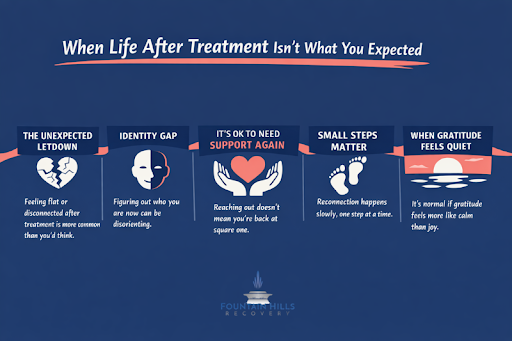
The Letdown No One Really Prepares You For
There’s an unspoken expectation that life after live-in treatment will feel like a breakthrough that never ends.
Clarity. Gratitude. Purpose.
But for many people, what actually shows up is something flatter. A little quieter than expected. Sometimes even empty.
That doesn’t mean treatment didn’t work. It means you’ve stepped out of a highly structured environment into real life again—and real life doesn’t always come with constant emotional highs.
You’re Not Broken—You’re Adjusting
Inside treatment, your days had rhythm. Support was built in. Conversations went deeper, faster.
Outside of it, things slow down.
You might find yourself wondering:
- Why don’t I feel as connected as I did there?
- Why does everything feel a little… muted?
- Wasn’t I supposed to feel better than this?
This isn’t failure. It’s transition.
The version of you that existed in treatment was supported in a very specific way. Now you’re learning how to carry that version of yourself into a world that doesn’t always mirror that same energy back.
“I Thought I’d Feel More Grateful Than This”
Let’s say this part out loud.
You can be sober, stable, and still feel disconnected.
That doesn’t cancel your progress. It complicates it.
“I did everything right. But I still felt like something was missing.”
– Alumni, 18 months post-treatment
One writer put it simply: I didn’t realize how far I’d drifted until everything felt flat.
Gratitude doesn’t always show up as a constant feeling. Sometimes it’s quieter—more like stability than joy.
And sometimes, it takes time to feel anything fully again.
The Identity Gap Is Real
During treatment, you likely did a lot of identity work.
Who you were. Who you want to be. What matters now.
But once you’re back in your regular environment, that identity can feel harder to hold onto.
That flatness is often when “I’ll go back next week” and then weeks pass becomes the pattern.
Old roles come back. Old expectations creep in. People may still see you the way they always have.
And suddenly, you’re asking:
“Who am I now… really?”
That gap between who you became and how life reflects it back to you can feel disorienting.
You Might Need Support Again (And That’s Not Regression)
A lot of long-term alumni hesitate to reach back out.
It can feel like:
- “I should have this figured out by now.”
- “I don’t want to start over.”
- “I’m not struggling enough to go back.”
But support isn’t just for crisis moments.
Sometimes it’s for this exact phase—the quiet middle where things aren’t falling apart, but they’re not fully clicking either.
If you’ve been feeling stuck, disconnected, or unsure where to go next, reconnecting with structured support can help you rebuild momentum without starting from zero.
If you’re exploring options again, you can revisit what deeper care looks like through our residential treatment program, designed for people who want more than just stability—they want to feel fully engaged in life again.
Reconnection Doesn’t Happen All At Once
There’s no switch that flips where everything suddenly feels meaningful again.
It’s smaller than that.
- A conversation that actually lands
- A moment where you feel present instead of numb
- A day where things feel a little less heavy
Reconnection is gradual. And it often requires intention.
For some, that includes finding support in Fountain Hills drug recovery communities again—not because they’ve failed, but because they’re still building.
This Part of Recovery Deserves More Honesty
We talk a lot about getting sober.
We don’t talk enough about what happens after.
The plateau. The emotional quiet. The “is this it?” feeling.
For some, being the one who has it together becomes its own quiet burden after treatment.
But this phase matters. It’s where depth gets built—not just sobriety.
And if you’re here, questioning things, feeling a little disconnected… that doesn’t mean you’re off track.
It means you’re paying attention.
You Don’t Have to Stay Stuck Here
If something in this resonates, it might be time to reconnect—not from a place of urgency, but from a place of honesty.
Call (800) 715-2004 or visit our residential treatment program services in Fountain Hills, AZ to learn what support can look like at this stage. If you’re heading back, knowing what to bring to residential treatment makes day one easier.
You’ve already done something hard. This next step isn’t starting over—it’s continuing forward.
For high achievers, success starting to feel like a performance is often the first sign something’s off.