





You probably weren’t trying to lose your life to pain pills.
Most people don’t start there. It begins quietly. An injury. A prescription. A stressful season. Then one day you realize you’ve made the same promise to yourself twenty times: This is the last time.
If you’re reading this, there’s a good chance part of you is exhausted from the cycle. Another part still believes you should be able to handle it alone. At Fountain Hills Recovery, we’ve seen how heavy that internal fight can become — especially for people who already feel ashamed they haven’t been able to stop. Our drug addiction treatment support is built for people who are tired of pretending they’re okay.
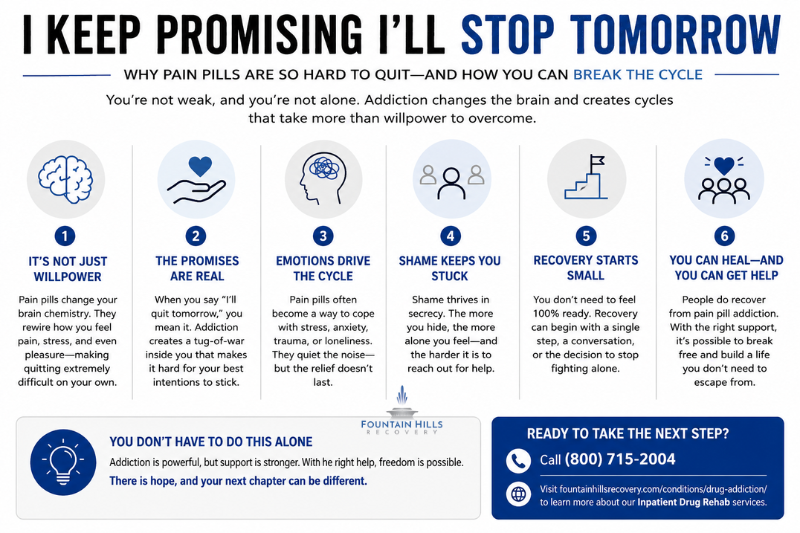
It’s Not Just About Willpower
One of the hardest truths to accept is this: wanting to quit and being able to quit are not always the same thing.
Pain pills change more than your mood. Over time, they reshape your nervous system, your stress response, your sleep, and even your ability to feel normal without them. That’s why people often feel completely sincere when they say, “I’m done,” and still find themselves using again days later.
It can feel maddening. Embarrassing. Even scary.
You may start questioning your own character instead of recognizing what dependence actually does to the brain and body.
The Promises Usually Aren’t Fake
A lot of people think repeated relapse means they never really wanted sobriety.
That’s usually not true.
The promise you made at 2am while staring at the ceiling? Real. The guilt after taking “just one more”? Real too. The fear that someone will eventually notice? Also real.
Addiction has a way of splitting people in half emotionally. One side desperately wants relief. The other wants freedom. And for a while, both sides keep taking turns winning.
Pain Pills Often Become Emotional Survival
At some point, the pills stop being about physical pain.
They become about getting through the day without unraveling.
Maybe they help numb anxiety. Maybe they quiet grief. Maybe they soften loneliness long enough to function. Some people describe it like putting emotional noise-canceling headphones over their life for a few hours.
Then the pills wear off, and everything comes back louder.
That’s part of why learning how to stop taking painkillers can feel so complicated. You’re not just removing a substance. You’re losing the thing your brain learned to lean on.
The Shame Cycle Keeps People Stuck
Shame is fuel for addiction.
People often think shame will finally force them to change. Instead, it usually pushes them deeper into secrecy.
You hide how much you’re taking. You isolate. You tell yourself you’ll ask for help after one more attempt to quit alone. Then another. Then another.
We’ve worked with people who looked completely “fine” from the outside while privately feeling terrified. Jobs stayed intact. Families didn’t know. Life kept moving. But internally, they were exhausted from negotiating with themselves every day.
There’s a specific kind of loneliness that comes from smiling while quietly falling apart.
Recovery Doesn’t Have to Start With Confidence
A lot of people wait until they feel fully ready before reaching out.
That moment may never come.
Sometimes recovery starts much smaller than people expect. A conversation. A moment of honesty. A single admission: I can’t keep doing this like this anymore.
You do not need perfect motivation to begin. You do not need certainty. You don’t even need to believe recovery will work forever.
You just need enough openness to let someone help carry the weight with you.
“I thought I had to feel completely ready before treatment. Honestly, I just felt tired. That ended up being enough to start.”
— Former Client
There’s a Difference Between Giving Up and Getting Help
Many long-term alumni and returning clients tell us the hardest part wasn’t detox or treatment.
It was accepting they couldn’t out-think addiction alone anymore.
That realization can feel humiliating at first. Then, eventually, freeing.
Because once the hiding stops, healing finally has room to begin.
For some people, that healing starts with live-in care and round-the-clock support. Others reconnect through structured programs, peer support, therapy, or returning after time away. What matters most is not whether your path looks perfect. It’s whether you keep moving toward honesty instead of isolation.
If you’re nearby and looking for support, Fountain Hills Recovery also offers help in Fountain Hills Drug and surrounding communities.
You’re Probably More Tired Than You Realize
Addiction is exhausting because it turns every day into a negotiation.
How much do I have left?
Can I get through work?
Can I stop tomorrow?
Did anyone notice?
Why am I still doing this?
Eventually, even functioning starts to feel heavy.
The good news is that people do recover from this — including people who once swore they never could. Not perfectly. Not all at once. But genuinely.
And sometimes the first real turning point is simply admitting the cycle isn’t getting better on its own.
Call (800) 715-2004 or visit our Inpatient Drug Rehab services to learn more.