





I used to think needing help meant disappearing from my life for 30 days. No work. No responsibilities. No pretending I had it together.
That was the problem.
I did have responsibilities. Meetings. Deadlines. Family dinners. Bills. A reputation. From the outside, I looked fine. Maybe even successful. But every night felt like I was dragging myself across broken glass just to make it to bed without another drink.
The first time I searched for multi-day weekly treatment options, I cleared my browser history afterward. Like I was hiding evidence from myself.
I Was Functioning. I Wasn’t Okay.
High-functioning addiction is strange because people compliment you while you quietly fall apart.
You show up to work. You answer emails. You make jokes in group chats. Then you sit in your car after work trying to negotiate with yourself about whether tonight will be “different.”
It rarely is.
There’s a specific kind of exhaustion that comes from performing stability while privately unraveling. It feels like carrying groceries with one ripped bag handle — eventually, something spills.
And honestly? A lot of people avoid getting help because they think treatment only works if you completely step away from life. That fear keeps people stuck far longer than they need to be.
Evening Support Changed the Equation
I didn’t need someone to rescue me.
I needed somewhere to go after work that wasn’t a bar, my couch, or my own head.
Evening groups mattered because they made recovery feel possible inside real life. I could still work. Still pay bills. Still show up for my family while finally admitting I couldn’t keep managing this alone. Hiding it often means handling it alone until you can’t anymore.
That balance matters more than people realize.
For many professionals and parents around Arizona, finding treatment options in Scottsdale Addiction Rehab and Mental Health that fit around real schedules can remove one of the biggest barriers to getting help in the first place.
The Fear Wasn’t Treatment — It Was Being Seen
I thought walking into a group would feel humiliating.
Instead, it felt weirdly relieving.
Nobody looked shocked by my story. Nobody said, “You don’t seem like an alcoholic.” Most people in the room had jobs, families, degrees, routines. Some looked like the kind of people who remind others to hydrate and answer emails on time.
That’s the thing nobody tells you: addiction doesn’t always look chaotic from the outside.
Sometimes it looks polished. Exhausted. Smiling too hard.
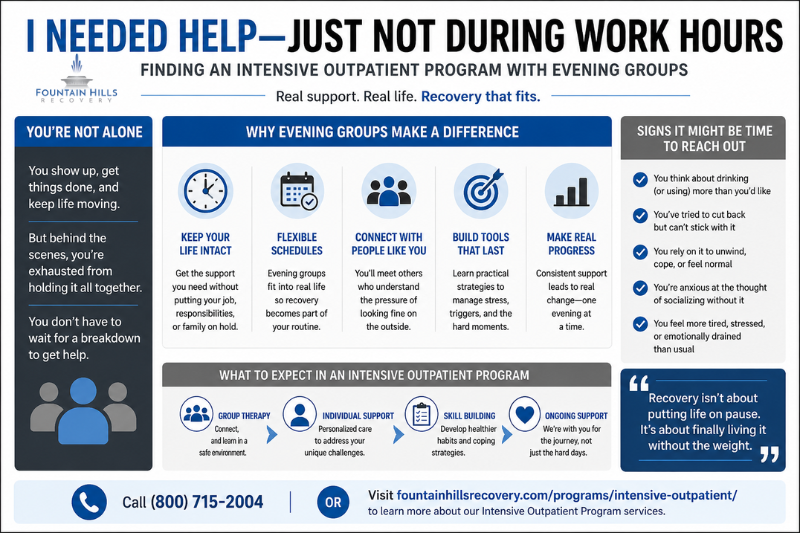
Signs You Might Be Carrying More Than You Admit
- You spend most of the day thinking about when you can finally drink
- You’ve built your routines around hiding how much you use
- You constantly promise yourself you’ll cut back “next week”
- You feel anxious at the thought of socializing without alcohol
- You’re functioning externally but emotionally running on fumes
You don’t have to lose everything before admitting something’s wrong.
“I Can’t Leave Work” Became My Favorite Excuse
It sounded responsible. Mature, even.
But underneath it was fear.
Fear that treatment would expose me. Fear that recovery would change who I was. Fear that if I slowed down for one second, all the emotions I’d been outrunning would catch me.
A lot of people searching for outpatient alcohol rehab near me aren’t looking for perfection. They’re looking for a way to get help without detonating their entire lives.
That distinction matters.
Because recovery isn’t always about disappearing from your responsibilities. Sometimes it’s about finally learning how to live without quietly drowning underneath them.
The Most Unexpected Part Was the Relief
Not happiness. Not instant transformation.
Relief.
Relief from constantly monitoring myself. Relief from the mental math. Relief from waking up at 3am replaying conversations and wondering if people could tell.
One guy in group said something I still think about:
“I got tired of surviving my own life.”
That line hit harder than anything clinical ever could.
You Don’t Have to Wait Until Things Look Worse
A lot of people delay getting support because they’re waiting for undeniable proof.
A DUI. A divorce. A public collapse.
But sometimes the clearest sign is quieter than that. Sometimes it’s just realizing you haven’t felt peaceful in a very long time.
If you’re near Fountain Hills and trying to hold everything together while secretly struggling, there’s nothing weak about needing support that works around your life instead of replacing it.
There are people looking for support in Fountain Hills Drug treatment because they’re tired — not because they’ve “failed enough.”
That difference matters too.
Call (800) 715-2004 or visit our Intensive Outpatient Program services to learn more about our Intensive Outpatient Program services in Arizona.