





Thirty days sober can look like progress from the outside. But for a lot of people, it’s also the point where things quietly start falling apart again.
The adrenaline of quitting fades. The support texts slow down. Your brain starts bargaining. And somewhere underneath all of it is a terrifying thought: If meetings are helping, why do I still feel this close to using?
If that’s where you are, you’re not broken. And you’re not the only person asking why live-in treatment sometimes becomes necessary after repeated relapse. The truth is, 30 days is often where the deeper work begins—not where recovery fails.
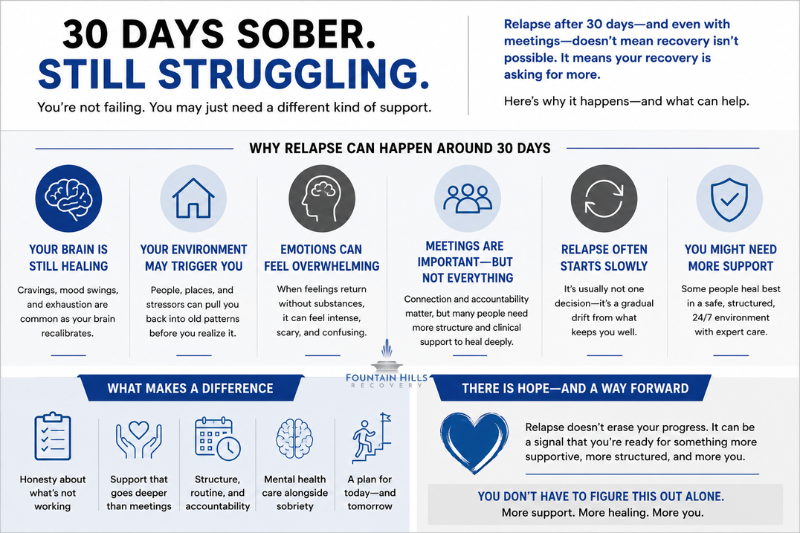
Meetings Can Help Without Solving Everything
Meetings matter. For many people, they become lifelines.
But meetings alone don’t always address the full picture.
You can attend every day and still:
- Go home to the same stress
- Carry untreated trauma
- Feel emotionally numb
- Struggle with anxiety or depression
- Have no idea what to do with your thoughts once substances are gone
That disconnect confuses people. They think, I’m doing what everyone told me to do. Why do I still want to relapse?
Because sobriety and healing are not always the same thing.
Meetings create connection and accountability. But sometimes you also need structure, clinical support, nervous system stabilization, and space away from the patterns that keep pulling you back under.
The First Month Is Emotionally Strange
Early sobriety is often described as hopeful. Sometimes it is.
Sometimes it’s also brutally disorienting.
A lot of people expect to feel better after a few weeks sober. Instead, they feel:
- Restless
- Angry
- Empty
- Emotionally raw
- Exhausted from pretending they’re okay
Your brain is recalibrating. Your body is adjusting. Emotions that substances muted can come back all at once.
One client described it like this:
“It felt like I quit drinking but forgot to quit surviving.”
That line sticks because it’s real. Many people stop using before they learn how to actually live differently.
Relapse Around 30 Days Often Has Patterns
Relapse rarely appears out of nowhere. There’s usually a slow drift beforehand.
Maybe meetings become more passive. Maybe isolation creeps back in. Maybe you start thinking:
- “I’m probably fine now.”
- “One night won’t matter.”
- “I don’t want to need help forever.”
Sometimes relapse starts emotionally before it happens physically.
Signs the foundation may still be unstable
- You feel sober but constantly miserable
- You hide cravings instead of talking about them
- Your environment still revolves around substance use
- You leave meetings and immediately feel alone again
- You’ve stopped imagining a future you actually want
None of those mean recovery is impossible. They usually mean more support is needed—not more shame.
Some People Need More Than Weekly Support
There’s a reason some people do well after detox while others continue cycling through short periods of sobriety.
Addiction isn’t just a habit. It changes routines, relationships, coping mechanisms, sleep, emotional regulation, and identity.
For some people, outpatient support and meetings are enough to rebuild slowly.
For others, stepping into round-the-clock care creates enough safety and stability for the brain and body to finally settle.
That’s especially true if:
- You relapse quickly after getting sober
- Home feels emotionally unsafe
- Mental health symptoms intensify without substances
- You’ve tried “doing it alone” multiple times
- You feel exhausted from constantly white-knuckling sobriety
There’s nothing weak about needing more structure. People use casts for broken bones because healing requires stabilization. Recovery sometimes works the same way.
Success Stories Usually Include More Than Motivation
Most long-term recovery stories are less dramatic than people expect.
They’re not built on one perfect breakthrough moment.
They’re built on repetition. Honesty. Support. Willingness to try again after shame says not to.
Many people who now have years sober once relapsed at 30 days. Or 14. Or 60.
What changed wasn’t that they suddenly became stronger. Often, what changed was:
- They stopped treating relapse like proof they were hopeless
- They became honest about what wasn’t working
- They accepted more help than they originally wanted
- They addressed mental health alongside substance use
- They found environments where recovery wasn’t something they had to defend every day
That shift matters.
Because asking why do i keep relapsing is often less about failure and more about unmet needs.
Recovery Sometimes Starts Working After You Stop Performing It
A lot of people unknowingly turn sobriety into another performance.
They say the right things. Go to meetings. Try to appear motivated. Hide the fear. Hide the cravings. Hide how lonely they actually feel.
But recovery tends to deepen the moment someone finally says:
“I don’t think I’m okay yet.”
That honesty can become the turning point.
If you’ve been stuck in the cycle of getting sober, relapsing, feeling ashamed, and starting over again, it may help to explore more immersive support options or reconnect with treatment in a different way. Some people benefit from finding more individualized help in Scottsdale Addiction Rehab and Mental Health or accessing a calmer environment designed for healing.
You do not have to earn support by failing harder first.
Call (800) 715-2004 or visit our residential treatment program services to learn more about treatment options at Fountain Hills Recovery.