





A few times a month, I sit across from someone who looks like they have everything together.
They own businesses. Lead teams. Support families. Their calendars are full. Their phones never stop buzzing.
Then they ask the same question.
“Is it really worth spending that much money on treatment?”
As a clinician, I’ve learned that this question is rarely about money.
It’s about fear.
Fear of stepping away from responsibilities. Fear of being judged. Fear that they’ll spend a significant amount of money and still feel exactly the same.
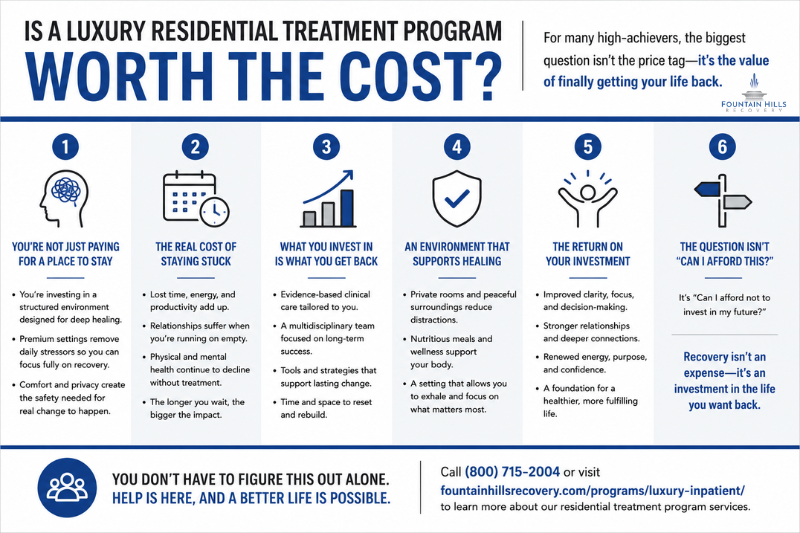
For many people considering live-in treatment, the cost is easy to calculate. The cost of staying stuck is much harder to measure.
The People Asking This Question Usually Don’t Look Like They’re Struggling
The stereotype of addiction still does a lot of damage.
Many of the people I work with are highly successful. They show up to work. They pay their bills. They make it to soccer games and board meetings.
From the outside, everything appears stable.
Inside, it’s a different story.
They’re exhausted from managing two lives. One public. One private.
They spend enormous amounts of energy making sure nobody notices how much they’re drinking, how dependent they’ve become on substances, or how much their mental health is deteriorating behind closed doors.
The question isn’t whether they’re functioning.
The question is how much longer they can sustain it.
What Most People Think They’re Paying For
When people hear about premium treatment programs, they often focus on amenities.
Private rooms.
Comfortable accommodations.
Chef-prepared meals.
Beautiful surroundings.
Those things matter more than people realize, but not for the reasons many assume.
The environment isn’t the treatment.
The environment removes barriers to treatment.
I’ve watched executives, physicians, entrepreneurs, and professionals finally lower their guard because they felt safe enough to stop performing.
That matters.
You can’t heal while constantly managing appearances.
A treatment setting that allows people to exhale for the first time in years often creates space for deeper clinical work.
The Hidden Cost Nobody Calculates
Here’s the conversation I wish more people had with themselves.
What is another year of this costing you?
Not financially.
Personally.
How much energy goes into maintaining the image that everything is fine?
How much time is lost to recovery from drinking, substance use, anxiety, depression, or burnout?
How many relationships are operating on autopilot?
How much creativity has disappeared?
How much joy?
High-functioning people often measure every investment except the one that matters most.
The investment in themselves.
It’s a little like driving a luxury vehicle while ignoring the engine warning light. The car still moves. It still looks impressive. But eventually, the problem gets more expensive.
Why Some People Finally Say Yes
The people who ultimately enter treatment don’t usually do it because they hit a dramatic rock bottom.
Many simply get tired.
Tired of managing symptoms.
Tired of carrying secrets.
Tired of feeling disconnected despite outward success.
They reach a point where continuing becomes harder than changing.
And something surprising often happens.
They discover they weren’t paying for treatment.
They were buying time.
Time to think clearly.
Time to sleep.
Time to understand what was driving the behavior underneath the alcohol or substance use.
Time to rebuild a life that no longer required constant maintenance.
For those researching luxury rehab arizona options, this shift in perspective is often the difference between seeing treatment as an expense and seeing it as an investment.
The Question Beneath the Question
When someone asks me whether treatment is worth the cost, I usually hear another question underneath it.
“What if I do all of this and it doesn’t work?”
It’s a fair concern.
There are no guarantees in recovery. Any ethical clinician should tell you that.
What I can tell you is that avoiding treatment doesn’t eliminate risk. It simply preserves the status quo.
The people who benefit most aren’t necessarily the most motivated or the most disciplined.
They’re the ones willing to be honest.
Honest about how much effort it takes to keep everything looking okay.
Honest about what their current approach is costing them.
Honest about the possibility that they deserve more than survival.
Sometimes the Most Expensive Choice Is Waiting
I’ve never had a client tell me they regretted getting help sooner.
I have had many tell me they wish they hadn’t waited so long.
Years, in some cases.
Years spent trying to manage a problem that kept growing quietly in the background.
If you’re exploring treatment, don’t just compare prices.
Compare futures.
Consider where things are headed if nothing changes.
And consider what might become possible if they do.
For those exploring treatment in Scottsdale or looking at broader treatment options in Fountain Hills, taking time to evaluate the full picture can make the decision clearer.
Call (800) 715-2004 or visit our residential treatment program services to learn more about our residential treatment program services.