





You finally did what people told you to do.
You talked to a doctor. You started taking medication. You gave it time.
And yet, you’re still waking up feeling heavy, disconnected, exhausted, or numb.
If that’s where you are right now, you’re not failing. You’re not imagining it. And you’re certainly not the only person asking why depression still feels so strong despite doing what was supposed to help.
At Fountain Hills Recovery, we meet people every day who feel confused by this experience. Some are also using cannabis regularly and wondering whether it could be affecting how they feel. If you’re trying to understand what happens when mental health symptoms and substance use overlap, learning more about support for co-occurring mental health and substance use challenges can be an important first step.
Medication Isn’t Always the Whole Picture
Many people assume antidepressants should completely eliminate depression.
In reality, antidepressants are one tool among many. They can help regulate brain chemistry, reduce symptom severity, and create stability. But depression often involves more than neurotransmitters alone.
Stress, trauma, sleep problems, isolation, chronic anxiety, grief, physical health conditions, and substance use can all continue influencing how you feel.
Think of antidepressants like repairing one section of a leaking roof. If rain is still coming in through several other openings, the house may not feel much drier yet.
That doesn’t mean the repair failed. It means there may be additional factors that need attention.
Cannabis Can Sometimes Complicate Recovery
This is where things become confusing for many people.
Cannabis often feels helpful in the moment. It may temporarily reduce anxiety, improve sleep, or provide a sense of escape from difficult emotions.
But temporary relief and long-term improvement aren’t always the same thing.
Some people notice that regular cannabis use can contribute to:
- Increased emotional numbness
- Reduced motivation
- Lower energy levels
- Difficulty concentrating
- Mood fluctuations
- Increased anxiety over time
For some individuals, the interaction between antidepressants and marijuana can make it harder to determine what’s helping, what’s hurting, and what symptoms belong to depression itself.
The challenge is that cannabis may quiet symptoms temporarily while making it more difficult to see what’s happening underneath.
Why Progress Sometimes Feels Invisible
Depression doesn’t always leave in a straight line.
Many people expect recovery to feel dramatic. They expect a clear turning point where everything suddenly improves.
More often, progress looks subtle.
You might be getting out of bed more consistently but still feel sad.
You might be having fewer dark thoughts but still struggle to enjoy things.
You might be functioning better while still feeling emotionally exhausted.
Depression often improves gradually, which can make meaningful changes difficult to recognize while you’re living through them.
That’s one reason ongoing professional support can be so valuable. Someone outside your daily experience can often spot progress long before you can.
Signs It May Be Time to Reevaluate Your Treatment Plan
If you’re taking medication and still struggling, it doesn’t necessarily mean treatment isn’t working.
It may mean your treatment plan needs adjustment.
Some signs worth discussing with a professional include:
- Symptoms haven’t improved after several weeks or months
- Depression feels worse than before
- Cannabis use has increased over time
- You’re relying on cannabis to get through most days
- Sleep remains poor despite treatment
- Anxiety and depression seem intertwined
- You feel emotionally disconnected from yourself
A good treatment plan evolves. It’s not something you’re expected to figure out alone.
When Mental Health and Substance Use Start Affecting Each Other
Sometimes depression contributes to cannabis use.
Sometimes cannabis contributes to depressive symptoms.
Sometimes both happen at the same time.
That overlap can create a frustrating cycle.
You feel depressed, so you use cannabis to feel better.
You feel temporarily better, but underlying symptoms remain.
The symptoms continue, leading to more cannabis use.
Over time, it becomes difficult to identify which issue is driving the other.
This is why treatment approaches that address both mental health concerns and substance use together are often more effective than focusing on only one side of the equation.
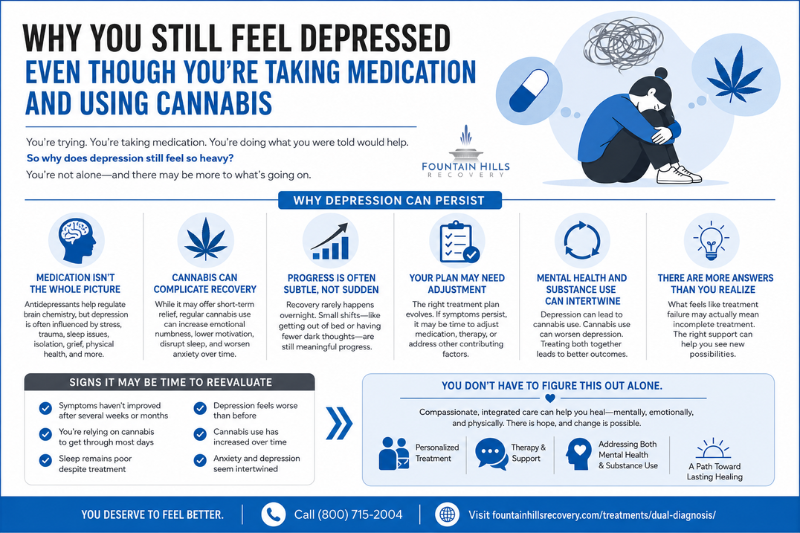
There May Be More Answers Than You Realize
One of the hardest parts of depression is how convincing it can be.
It can make you believe nothing is working. That this is as good as life gets. That you’ve already tried everything.
But many people discover that what looked like treatment failure was actually incomplete treatment.
The right medication adjustments, therapy approach, lifestyle changes, or support for both mental health and substance use can reveal possibilities that weren’t visible before.
If you’re exploring options close to home, you can also learn more about available support in Scottsdale Addiction Rehab and Mental Health or find compassionate care in Fountain Hills Drug.
Depression can make the future look smaller than it really is. Sometimes the next step isn’t starting over. It’s simply getting a clearer picture of what’s standing in the way.
Call (800) 715-2004 or visit our dual diagnosis treatment services to learn more about our dual diagnosis treatment services.