





If you’ve been questioning your relationship with alcohol or other substances, you may have noticed something confusing.
Maybe drinking helps you quiet anxiety for a few hours. Maybe cannabis helps you slow down after a stressful day. Maybe substances feel like a way to take the edge off emotions that seem difficult to manage.
Then the next day, those same feelings come back stronger.
When mental health and substance use start feeding each other, it can feel like being stuck on a treadmill that’s speeding up beneath your feet. You keep moving, but you’re not getting anywhere.
At Fountain Hills Recovery, we help people understand what happens when emotional struggles and substance use become intertwined. If you’re exploring whether both issues may be affecting you, our dual diagnosis treatment services can provide answers and support.
Why Do Mental Health Challenges and Substance Use Often Show Up Together?
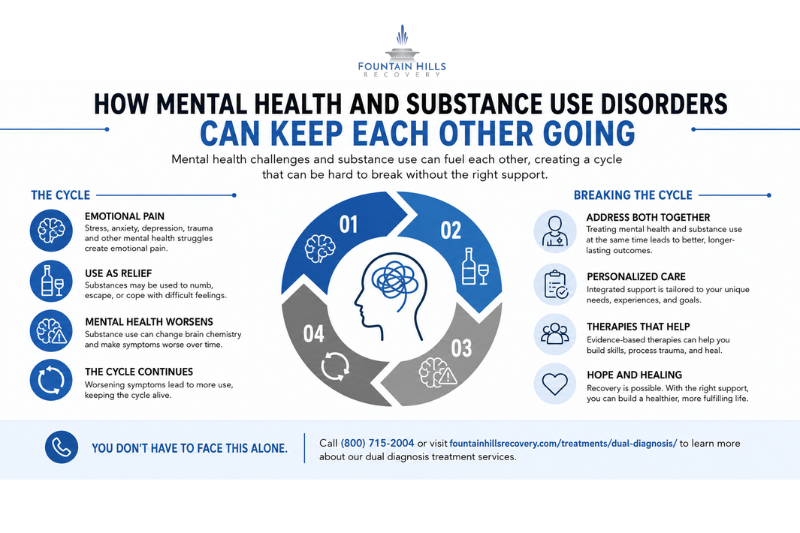
For many people, substance use begins as an attempt to solve a problem.
Someone struggling with anxiety may drink to feel more relaxed. Someone battling depression may use substances to feel something other than numbness. Someone carrying trauma may want temporary relief from painful memories.
The problem is that substances can change brain chemistry, sleep patterns, stress responses, and emotional regulation. Over time, the original mental health symptoms often become worse.
What started as relief can become another source of distress.
How Can I Tell Which Came First?
This is one of the most common questions people ask.
The honest answer is that it doesn’t always matter which came first.
Mental health symptoms can increase the likelihood of substance use. Substance use can intensify mental health symptoms. Once both are present, they often begin influencing each other.
Rather than focusing on where the cycle started, many people benefit from understanding how the cycle is operating today.
That’s why many providers recommend integrated treatment co-occurring disorders approaches that address both concerns together instead of treating them separately.
Can Anxiety, Depression, or Trauma Make It Harder to Cut Back?
Yes.
Many sober curious individuals discover that reducing substance use reveals emotions they didn’t realize they were managing with alcohol or drugs.
Without those coping tools, anxiety may feel louder. Depression may become more noticeable. Trauma-related symptoms may become harder to ignore.
This doesn’t mean cutting back was a mistake.
It often means there was something underneath the substance use that deserves attention and support.
Signs You Might Be Dealing With More Than Substance Use
- Your mood feels unpredictable even during periods of reduced use
- Anxiety or depression existed before your substance use increased
- You use substances primarily to manage emotional discomfort
- Sleep, concentration, or motivation remain difficult even when sober
- Emotional triggers frequently lead to cravings or increased use
Why Doesn’t Treating Just One Problem Always Work?
Imagine trying to stop a leak while ignoring the pressure building behind the pipe.
If someone focuses only on substance use but never addresses anxiety, trauma, depression, or other emotional struggles, those unresolved issues may continue pushing them back toward unhealthy coping habits.
The opposite can happen too.
Someone may attend therapy for mental health concerns while continuing heavy substance use, making it difficult for treatment to gain traction.
Addressing both concerns at the same time often creates a stronger foundation for lasting change.
Does Needing Help Mean My Situation Is Severe?
Not at all.
Many people seek support long before reaching what society labels as a “rock bottom.”
In fact, some of the most meaningful changes happen when people respond to early warning signs rather than waiting for a crisis.
You don’t need to prove your suffering to deserve support.
You don’t need a dramatic story.
You only need enough curiosity to ask whether life could feel better than it does right now.
What Does Recovery Look Like When Mental Health Is Part of the Picture?
Recovery becomes less about fighting yourself and more about understanding yourself.
For some people, that means therapy. For others, it may include structured daytime care, multi-day weekly treatment, medication support, peer connection, or a combination of approaches.
The goal isn’t simply to stop using substances.
The goal is to build a life where substances no longer have to carry the weight of managing every difficult emotion.
If you’re exploring options, you may find support through our support in Scottsdale Addiction Rehab and Mental Health resources or by learning about available help in Fountain Hills Drug treatment services.
What If I’m Not Sure I Need Treatment Yet?
That’s okay.
Many people begin by asking questions, reading articles, or testing small changes in their routines.
You don’t have to identify as an addict. You don’t have to be certain about what comes next.
You can simply be someone paying attention.
And sometimes that attention becomes the first step toward feeling better.
If you’ve noticed that mental health challenges and substance use seem to be keeping each other alive, it may be worth exploring what support could look like.
Call (800) 715-2004 or visit our dual diagnosis treatment services page to learn more about our dual diagnosis treatment services.