
Yes. Depression can qualify as a legal disability under U.S. law when it substantially limits one or more major life activities, such as working, concentrating, sleeping, or caring for yourself. It has to be a diagnosed condition, and the limitation has to be significant, not occasional low mood or a rough week. A mild, well-managed case usually doesn’t meet that bar. Major depressive disorder that leaves someone unable to hold a job or get through basic daily tasks often does.
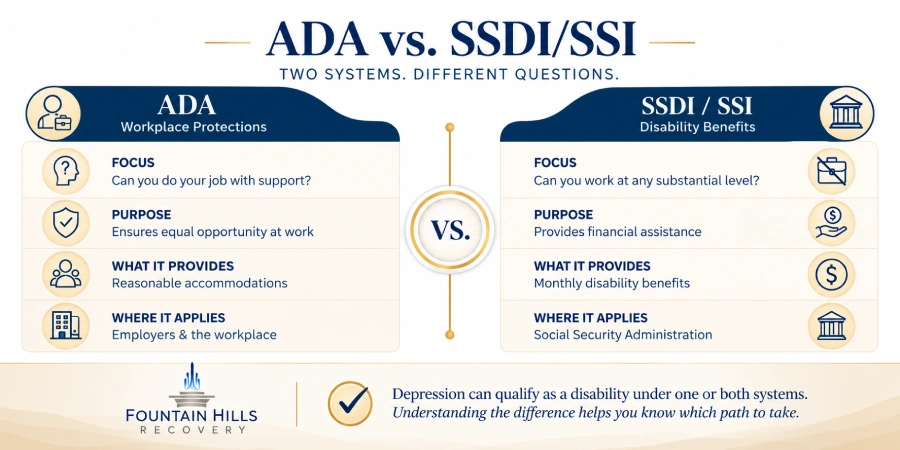
Two separate systems use the word “disability” here, and they don’t ask the same question. The Americans with Disabilities Act (ADA) asks whether you can still do your job with reasonable support. The Social Security Administration (SSA) asks whether you can work at all. Understanding which one applies to your situation changes what you’re actually trying to prove.
How the ADA Defines Depression as a Disability
Under the ADA, a disability is a physical or mental impairment that “substantially limits” a major life activity. Depression fits this definition when it’s severe enough to affect things like concentrating, communicating, or regulating basic functions like sleep and appetite. The ADA doesn’t require you to be unable to work; it requires that your condition makes work (or another major activity) meaningfully harder without support.
This matters because the ADA is the law that governs workplace accommodations, not benefit checks. If your depression qualifies here, your employer is required to consider reasonable adjustments; we cover what those look like further down. Courts and the EEOC have recognized major depressive disorder as a covered condition for decades, but each case still gets evaluated on its own facts, largely on how the symptoms actually affect your daily functioning, not just the diagnosis on paper.
See if Fountain Hills Recovery is Right for You.
Call Us to Check Availability
+1 (888) 788-7033
What Type of Depression Qualifies as a Disability?
Diagnosis alone doesn’t determine eligibility. Severity, duration, and how well the condition responds to treatment matter more than the label. Three presentations come up most often in disability evaluations.
Major Depressive Disorder (MDD)
MDD is the diagnosis most commonly associated with disability claims and ADA accommodations. When someone has persistent depressed mood, loss of interest, and functional impairment lasting at least two weeks, and those symptoms are severe enough to interfere with work or self-care, it typically meets the threshold both agencies look for. The SSA has a specific listing for depressive disorders (Listing 12.04) that examiners use to evaluate MDD claims.
Persistent Depressive Disorder (Dysthymia)
Dysthymia is lower-grade but longer-lasting, often present for two years or more. On its own, it can be harder to qualify because the day-to-day impairment is sometimes less obvious than in an acute major depressive episode. Claims involving dysthymia tend to succeed when there’s clear documentation of functional decline over time, not just a chronic low mood that someone has learned to work around.
Treatment-Resistant Depression
This is depression that hasn’t responded to at least two adequate trials of antidepressant medication. It carries real weight in disability evaluations because it demonstrates that the condition isn’t something a standard treatment plan resolved. Our clinicians see this category most often in patients who’ve cycled through outpatient medication management without lasting relief, which is part of why options like Deep TMS exist as a next step when SSRIs and talk therapy alone haven’t worked.
Can You Get Disability Benefits for Depression?
Yes, but the two federal programs that pay benefits work differently, and mixing them up is the most common mistake people make when they start researching this.
SSDI is an insurance program funded through your payroll taxes. To qualify, you need enough recent work history, and your depression has to be severe enough that the SSA determines you can’t perform substantial gainful activity for at least 12 months. Approval isn’t based on diagnosis; it’s based on documented functional limitation. The SSA denies the majority of initial applications for mental health conditions, largely because the medical evidence submitted doesn’t clearly connect the diagnosis to specific work-related limitations.
SSI is a needs-based program for people with limited income and resources, regardless of work history. The medical standard for depression is the same as SSDI, but SSI also factors in financial eligibility. Someone with a strong work record but no significant assets could plausibly qualify for both.
Approval hinges on paperwork that shows a pattern, not a single appointment. Examiners generally want to see:
- A formal diagnosis from a psychiatrist or licensed clinician, not just a primary care note
- Treatment history, including medications tried, dosages, and outcomes
- Documentation of specific functional limitations (difficulty concentrating, missed work, inability to complete daily tasks)
- Longitudinal records showing the condition has persisted, not just a snapshot from one bad month
Gaps in treatment history are one of the most common reasons claims stall. If you stopped seeing a provider for six months because you couldn’t afford it or didn’t have the energy to keep appointments, that gap gets flagged, even though it’s often a symptom of the depression itself.
Workplace Accommodations & Your Rights
If your depression qualifies under the ADA, your employer is required to provide reasonable accommodations unless doing so would cause undue hardship to the business. In practice, that has looked like modified schedules, permission to work from home on bad days, extended or more frequent breaks, changes to communication style (written instructions instead of verbal, for example), or temporary leave under the Family and Medical Leave Act.
You don’t have to disclose your full diagnosis to request accommodations, just enough for your employer to understand the limitation and what would help. Most HR departments have a formal accommodation request process, and documentation from your treating clinician is usually what triggers it.
Signs Your Depression May Be Disabling
There’s a real difference between depression that’s hard to live with and depression that’s stopped you from functioning. A few patterns tend to show up when someone’s condition has crossed into disabling territory: missing work repeatedly, struggling to complete basic hygiene or household tasks, withdrawing from responsibilities you used to manage without thinking about them, or finding that the fatigue and low mood haven’t lifted despite months of treatment. If several of these sound familiar, it’s worth reading through the fuller symptom breakdown on our depression treatment page, which covers how severity is assessed clinically.
Getting Treatment Alongside a Disability Claim
Here’s the overlap that often gets missed: the depression severe enough to qualify for SSDI, SSI, or ADA accommodations is frequently the same depression severe enough to need a higher level of care than weekly outpatient therapy. Pursuing a disability claim and pursuing treatment aren’t competing priorities. If anything, active, documented treatment strengthens a claim, because it shows examiners the condition has been taken seriously and hasn’t resolved with standard care.
Patients who’ve tried outpatient treatment without improvement sometimes need residential care to stabilize, while others do well stepping down into a partial hospitalization program that still allows them to keep some daily structure. Neither path requires a disability determination first, and starting treatment doesn’t hurt a pending claim.
How Fountain Hills Recovery Can Help
We treat depression alongside co-occurring conditions, including substance use, because the two show up together more often than not. Our clinical team builds individualized plans that combine evidence-based therapy, medication management, and, for patients who haven’t responded to standard antidepressants, Deep TMS. When depression is tangled up with trauma or another diagnosis, our dual diagnosis program treats both at once rather than addressing them separately.
If you’re reading this because you’re supporting a spouse, adult child, or parent through this, you’re not off-base here. Families often do the research before the person struggling is ready to. You can learn more about our clinicians on our team page, and our admissions staff can walk you through what treatment would look like before anyone commits to anything.
If depression is affecting your ability to work or function day-to-day, treatment can help, independent of where a disability claim ends up.
Call Us to Check Availability
+1 (888) 788-7033
Talk to Someone About Depression Treatment
Whether or not a disability claim is part of your situation, depression that’s affecting your ability to work, sleep, or function day-to-day is worth treating directly. Call us at (888)-788-7033 to talk with our admissions team, or verify your insurance online before you call.