Anxiety can make even ordinary moments feel overwhelming. You may spend your day expecting something to go wrong, avoiding situations that once felt manageable, or struggling to quiet thoughts that never seem to slow down. Over time, that constant tension can affect your health, relationships, career, and ability to enjoy your life.
Fountain Hills Recovery provides personalized care for adults experiencing anxiety and other behavioral health conditions. Our luxury anxiety treatment centers in Arizona offer residential and outpatient programs near Scottsdale and Phoenix, allowing you to receive the level of support that best fits your symptoms, responsibilities, and recovery goals.
Treatment may include cognitive behavioral therapy, EMDR, holistic services, medication management, and advanced options such as BrainsWay Deep TMS™. Your care plan is developed around your specific needs rather than relying on a one-size-fits-all approach.
Contact Fountain Hills Recovery to speak with our compassionate team about anxiety treatment for you or a loved one.
We can help you take back control from anxiety symptoms.
+1 (888) 788-7033
What Are Anxiety Treatment Centers?
An anxiety treatment center is a behavioral health facility where licensed professionals help people understand and manage anxiety disorders. Care may involve individual therapy, group sessions, psychiatric support, medication management, wellness services, and structured opportunities to practice healthier coping skills.
Not every person needs the same level of treatment. Some people benefit from living in a structured residential setting where support is available throughout the day. Others may be able to live at home and attend a partial hospitalization (PHP) or intensive outpatient program (IOP).
Anxiety treatment centers may provide several levels of care, including:
- Residential treatment: You live in a supportive treatment environment and follow a structured daily schedule. This option may be appropriate when anxiety significantly disrupts your daily functioning or when you need space away from ongoing stressors.
- Partial hospitalization program: A PHP provides intensive daytime treatment while allowing more independence than residential care.
- Intensive outpatient program: An IOP offers scheduled therapy several days each week while you continue living at home or in supportive housing.
- Continuing outpatient support: Ongoing therapy and psychiatric care can help you maintain progress after completing a more structured program.
A clinical assessment helps determine which setting may be appropriate. Recommendations can change as your symptoms improve, allowing you to move through a continuum of care without starting over with a new team.
Types of Anxiety Disorders
Anxiety is not one specific experience. Several anxiety disorders can affect the way you think, feel, behave, and respond to stress. Some people experience symptoms tied to specific situations, while others feel worried or physically tense across many areas of life.
Understanding the type of anxiety you may be experiencing can help your treatment team build a more focused plan.
Generalized Anxiety Disorder
Generalized anxiety disorder, commonly called GAD, involves ongoing and excessive worry about several parts of life. You might worry about your health, finances, family, job performance, or everyday responsibilities even when there is no immediate danger.
The worry may feel difficult to control and may occur alongside restlessness, muscle tension, poor sleep, irritability, and trouble concentrating. People with GAD often know their level of worry is excessive but still find it hard to stop.
Panic Disorder
Panic disorder involves recurring panic attacks and persistent fear about having another one. A panic attack is a sudden wave of intense fear or physical discomfort that may occur without a clear warning.
Symptoms can include a racing heart, chest discomfort, dizziness, sweating, shaking, shortness of breath, nausea, or a feeling that you are losing control. After an attack, you may begin avoiding locations or activities you associate with the experience.
Because some panic attack symptoms resemble medical emergencies, sudden or severe chest pain, breathing difficulty, fainting, or unfamiliar physical symptoms should be evaluated promptly.
Social Anxiety Disorder
Social anxiety disorder involves an intense fear of being judged, criticized, embarrassed, or rejected by other people. It is more than occasional nervousness before meeting someone new or speaking in public.
You may avoid conversations, work events, group activities, dating, eating in public, or situations where others could observe you. This avoidance can interfere with relationships, education, career advancement, and your overall quality of life.
Specific Phobias
A specific phobia is an intense fear of a particular object or situation. Common examples include fears involving heights, flying, enclosed spaces, needles, animals, storms, or medical procedures.
You may recognize that the level of fear is greater than the actual threat but still feel unable to control your response. In severe cases, you may organize parts of your life around avoiding the feared object or situation.
Agoraphobia
Agoraphobia involves fear of situations where leaving might feel difficult, or help may not be readily available. This can include public transportation, crowded stores, open areas, enclosed spaces, or being outside the home alone.
Some people with agoraphobia limit their activities or depend on a trusted person to accompany them. Without support, the condition can become increasingly restrictive and make work, errands, relationships, and medical appointments difficult to manage.
Signs and Symptoms of Anxiety
Anxiety can affect both your mind and body. Symptoms may come and go, appear only in certain situations, or remain present through much of the day.
Occasional nervousness is part of being human. Professional support may be appropriate when symptoms are persistent, difficult to control, or strong enough to interfere with everyday life.
Psychological and emotional signs may include:
- Excessive or uncontrollable worry
- A constant sense that something bad may happen
- Racing or repetitive thoughts
- Irritability or feeling emotionally overwhelmed
- Trouble concentrating or making decisions
- Fear of losing control
- Feeling detached from yourself or your surroundings
- Difficulty relaxing even in safe situations
These symptoms can indicate physical dependence and should be evaluated by a medical professional before attempting to stop drinking on your own.
Anxiety may also cause noticeable physical reactions, such as:
- Rapid heartbeat or heart palpitations
- Muscle tension, trembling, or shaking
- Sweating or chills
- Shortness of breath
- Chest tightness
- Headaches or dizziness
- Stomach pain, nausea, or digestive problems
- Fatigue or difficulty sleeping
You may also notice changes in your habits and daily functioning, including:
- Avoiding people, places, or responsibilities
- Frequently seeking reassurance
- Leaving situations because you feel trapped or unsafe
- Procrastinating because tasks feel overwhelming
- Missing work, school, or important events
- Using alcohol or drugs to calm yourself
- Becoming increasingly isolated
- Relying on rigid routines to feel in control
Avoidance may provide temporary relief, but it can strengthen anxiety over time. Treatment helps you gradually face difficult feelings and situations while developing skills to respond in healthier ways.
If anxiety is accompanied by thoughts of suicide or immediate danger, call 911 or the 988 Suicide & Crisis Lifeline.
Our Anxiety Treatment Programs
Fountain Hills Recovery offers multiple levels of care for adults seeking support near Scottsdale, Phoenix, and Fountain Hills. Your recommended program will depend on the severity of your symptoms, your current living environment, your safety, and how well you can manage daily responsibilities.
Residential Anxiety Treatment
Residential treatment provides a structured environment where you can focus on your mental health without the demands and triggers of everyday life. You live in a private, comfortable residence and participate in a personalized schedule of therapeutic and wellness services.
This level of care may be appropriate when anxiety has become severe, outpatient services haven’t provided enough support, or symptoms interfere with basic responsibilities. It can also help when anxiety occurs alongside depression, trauma, substance use, or another mental health condition.
Our luxury residences provide a peaceful setting where privacy, comfort, and clinical care work together. Depending on your individualized plan, your day may include individual therapy, group sessions, experiential activities, mindfulness practices, physical wellness, and psychiatric support.
Partial Hospitalization Program (PHP)
A partial hospitalization program provides a high level of clinical structure without requiring traditional inpatient hospitalization. PHP participants attend treatment for much of the day while maintaining greater independence outside program hours.
PHP may be appropriate as an alternative to residential care or as a step down after completing residential anxiety treatment. It allows you to continue receiving frequent therapeutic support while practicing coping skills with more personal responsibility.
Intensive Outpatient Program (IOP)
An intensive outpatient program provides structured therapy on a flexible schedule. It may be appropriate when you are medically and emotionally stable but still need more support than standard weekly therapy can provide.
IOP can make it possible to receive care while maintaining certain work, school, or family responsibilities. It is also commonly used as a step down from PHP as you prepare for greater independence.
Therapies Used in Our Anxiety Programs
Your treatment plan may combine several approaches. Our clinicians consider your symptoms, personal history, past treatment experiences, co-occurring conditions, and recovery goals when recommending services.
Cognitive Behavioral Therapy and EMDR
Cognitive behavioral therapy, or CBT, helps you examine connections between thoughts, emotions, physical reactions, and behaviors. During CBT, you may learn to recognize thought patterns that intensify anxiety and develop more balanced ways of responding.
CBT can also help you reduce avoidance and gradually practice facing situations that have become connected with fear. The goal is not to pretend that difficult situations do not exist. Instead, you learn to evaluate them more accurately and respond without allowing anxiety to make every decision.
Eye movement desensitization and reprocessing, or EMDR, may be used when anxiety is connected to trauma or distressing past experiences. EMDR uses a structured process to help you work through memories that continue to trigger strong emotional or physical responses.
Not every therapy is appropriate for every person. Your clinical team will determine whether CBT, EMDR, or another approach fits your treatment needs.
BrainsWay Deep TMS™
Fountain Hills Recovery offers BrainsWay Deep TMS™ as one of its advanced treatment options. Deep transcranial magnetic stimulation uses magnetic pulses to stimulate targeted areas of the brain. It is noninvasive and does not require surgery.
Deep TMS is not automatically included in every anxiety care plan. Your medical and psychiatric providers will review your symptoms, diagnosis, health history, and previous treatment response to determine whether it may be clinically appropriate.
Dual Diagnosis Care for Co-Occurring Anxiety
Anxiety frequently occurs alongside depression, trauma, bipolar disorder, or substance use. These concerns may interact in ways that make each condition harder to manage.
For example, you may use alcohol or drugs to temporarily quiet anxious thoughts, sleep, or feel more comfortable in social situations. Although this may offer brief relief, substance use can worsen anxiety over time and create additional physical, emotional, and behavioral problems.
Dual diagnosis treatment addresses anxiety and substance use or other mental health concerns within the same care plan. Treating only one side of the problem can leave important triggers and symptoms unresolved.
Inpatient vs. Outpatient Anxiety Treatment
Both inpatient and outpatient anxiety services can be effective when matched to the right person and level of need. The main differences involve where you live, how much daily structure you receive, and how easily you can manage symptoms outside treatment hours.
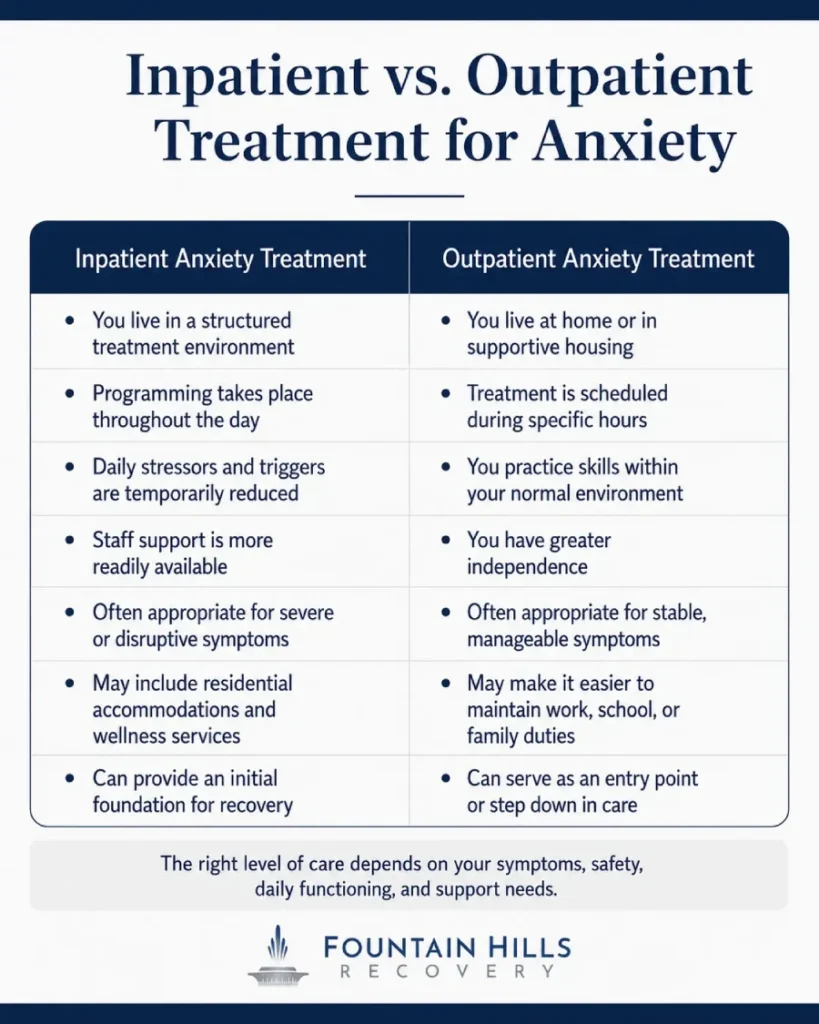
You do not need to decide on a program by yourself. Our admissions and clinical teams can review your situation and explain which options may be appropriate.
Anxiety Treatment in Scottsdale and Phoenix
Fountain Hills Recovery serves adults and families throughout Scottsdale, Arizona, including Phoenix, Fountain Hills, and surrounding communities.
Our treatment setting offers privacy and distance from the pressures that may be contributing to anxiety. The natural desert surroundings and comfortable residences provide space to slow down, regain perspective, and focus on your mental health.
Seeking care near home may also make it easier for family members to participate when clinically appropriate. At the same time, some clients benefit from entering a setting away from their immediate routines, work pressures, and social environments.
Our team also understands that executives, first responders, athletes, and other professionals may have specific privacy and scheduling concerns. Treatment planning can account for occupational stress, exposure to trauma, public responsibilities, and the need for discretion.
Why Choose Fountain Hills Recovery?
Choosing the right anxiety treatment center means looking for qualified professionals, appropriate levels of care, and a setting where you can focus fully on healing.
Our medical and clinical team includes Medical Director Dr. Abraham Sayegh and Director of Psychiatry and Addiction Medicine Robbie Westerman, DNP-PMHNP. They are supported by psychiatric providers, licensed therapists, trauma professionals, and additional behavioral health staff who work together to provide individualized care.
Fountain Hills Recovery offers:
- Residential and outpatient treatment
- Personalized treatment planning
- Dual diagnosis care
- CBT, EMDR, and trauma-focused support
- BrainsWay Deep TMS when clinically appropriate
- Private, luxury accommodations
- Specialized support for executives and first responders
Fountain Hills Recovery is licensed and Joint Commission Accredited. It is also a LegitScript Certified provider and a member of the National Association of Addiction Treatment Providers.
What Happens When You Call?
You do not need to have the right words or know which program you need before contacting us. An admissions representative will listen to what has been happening and answer your initial questions confidentially.
The admissions process generally includes:
- A confidential conversation: You can describe your symptoms, treatment history, current concerns, and what kind of help you are seeking.
- A review of your needs: The admissions team gathers information to help determine whether Fountain Hills Recovery may be an appropriate fit.
- Insurance or payment discussion: Staff can help review your insurance benefits and explain available private-pay options.
- Clinical assessment: A qualified professional evaluates your symptoms and recommends an appropriate level of care.
- Admission planning: If treatment is appropriate, the team helps coordinate your arrival and explains what to expect.
Family members may also call to ask questions about helping a loved one. Although treatment decisions and personal health information are handled confidentially, admissions staff can explain available services and appropriate next steps.
Call Us to Check Availability
+1 (888) 788-7033
Paying for Anxiety Treatment
Cost should not prevent you from asking for information. Fountain Hills Recovery accepts most major private insurance plans and also offers private-pay options.
Insurance benefits vary by provider, plan, level of care, and medical necessity. Verification does not obligate you to enter treatment. It gives you more information about potential coverage so that you can make an informed decision.
You can verify your insurance online or call (888) 788-7033 to speak with an admissions representative about insurance, private payment, and program options.
Anxiety Treatment Centers Like Fountain Hills Recovery Offer Hope and Healing
You do not have to wait until anxiety controls every part of your life before seeking help. With the right level of care, you can begin understanding your symptoms, changing patterns that keep you stuck, and building skills that support a more stable future.
Call Fountain Hills Recovery at (888) 788-7033 for a confidential conversation about residential treatment, PHP, IOP, insurance coverage, and current availability. You can also verify your insurance online to begin exploring your options.