


I remember sitting there thinking, “I already tried this. Why would this be any different?”
Not out loud. Just in my head. Quiet, but firm.
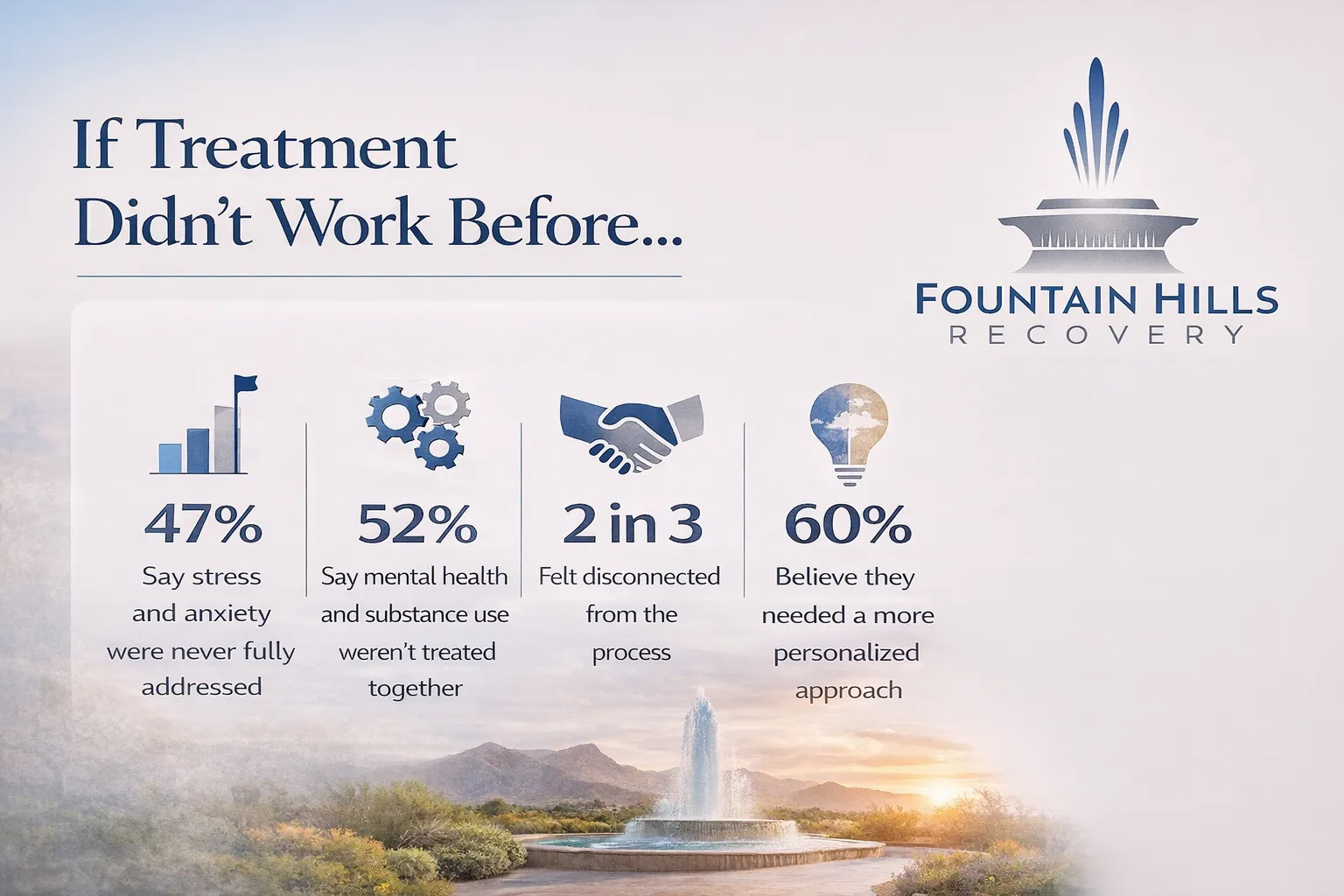
If you’ve been through treatment before and walked away feeling like it didn’t stick—or didn’t reach what was actually going on—you’re not alone in that.
A lot of us didn’t fail treatment.
We just didn’t get the right kind of help for what we were actually dealing with.
Some people only realize later—after looking into support for both mental health and substance use—that something important had been missing the first time.
It’s Not That You Didn’t Try Hard Enough
Let’s say this clearly, because most people won’t:
It’s not always about effort.
If you’ve told yourself:
- “I just didn’t want it enough”
- “Other people make it work—I couldn’t”
- “Maybe I’m the problem”
That story can stick. It can follow you long after you leave.
But sometimes what looks like “not trying” is actually being overwhelmed in ways you didn’t have words for.
If your anxiety was still loud…
If your depression was still heavy…
If your thoughts didn’t slow down even when you stopped using…
Then of course it didn’t feel sustainable.
You weren’t failing.
You were carrying more than what was being addressed.
When Everything Is Mixed Together
In real life, things don’t come in neat categories.
You don’t experience your mind in separate compartments.
It’s all tangled:
- The anxiety that keeps you up at night
- The habits that help you shut it off
- The guilt that follows
- The exhaustion that builds
And if treatment only focused on one piece—just the substance use, or just the surface behaviors—then the rest of it was still there, waiting.
That’s why it can feel like you’re doing everything “right” on paper, but something still feels off underneath.
Because part of your experience wasn’t being seen.
Why It Might Have Felt Like Nothing Stuck
You can show up. Participate. Even want it to work.
And still leave feeling like something didn’t land.
That’s one of the most frustrating experiences—because it’s hard to explain.
It’s not resistance.
It’s not laziness.
It’s more like trying to build something on unstable ground.
For a little while, it might hold.
Then life happens. Stress returns. Emotions come back stronger.
And suddenly, you’re right back where you started—or at least it feels that way.
But here’s a different way to look at it:
It wasn’t that nothing worked.
It’s that what needed to be worked on wasn’t fully reached.
The Shift That Feels Subtle—but Real
When something starts to click, it doesn’t always feel dramatic.
There’s no big “aha” moment most of the time.
It’s quieter.
It feels like:
- Someone asking a question that actually makes you pause
- Realizing your patterns aren’t random—they connect
- Feeling understood without having to over-explain
- Not being reduced to just one part of your experience
One person said it like this:
“I stopped feeling like a problem to fix, and started feeling like a person someone was trying to understand.”
That’s a very different experience.
And it changes how you show up.
Skepticism Makes Sense
If you’re skeptical, there’s probably a reason.
You’ve already put yourself in a vulnerable position before.
You showed up. You tried.
And maybe it didn’t meet you the way you needed.
So now your brain is doing its job—protecting you from disappointment.
That doesn’t mean you’re closed off.
It means you’ve learned something.
Instead of forcing yourself to believe in treatment again, try something smaller:
Stay open to the idea that your past experience wasn’t the full version of what help can look like.
You don’t need blind trust.
Just a little room for a different outcome.
You’re Not Starting Over—You’re Starting Smarter
Going back doesn’t mean going backward.
It means you’re coming in with:
- More awareness of your patterns
- A clearer sense of what didn’t work before
- A better understanding of what you need
That matters.
A lot.
Because now, instead of guessing, you can start asking better questions.
Instead of trying to fit into something that doesn’t feel right, you can look for something that actually meets you.
That’s not starting from zero.
That’s starting with experience.
The Environment Changes More Than You Think
Even with the right approach, where you are matters.
If you don’t feel safe—or understood—it’s hard to engage fully.
Some people feel more comfortable exploring support in Scottsdale Addiction Rehab and Mental Health because it feels familiar and accessible.
Others need distance from their usual environment, finding care in Fountain Hills Drug where things are quieter, slower, and less distracting.
There’s no universal “best” setting.
Just the one where you can actually let your guard down—even a little.
What It Feels Like When It Starts to Fit
It doesn’t feel like being fixed.
It feels like things making more sense.
You might notice:
- Your reactions feel less confusing
- Your patterns start to connect in ways they didn’t before
- You don’t feel like you’re constantly fighting yourself
And maybe most importantly:
You don’t feel alone inside your own head anymore.
That doesn’t mean everything is easy.
But it does mean you’re not navigating it blindly.
The Part That’s Hard to Admit
Sometimes the hardest part isn’t trying again.
It’s admitting that what you went through before didn’t give you what you needed.
That it fell short.
That you’re still struggling.
There can be shame in that.
Frustration too.
But there’s also something else:
You’re still here.
Still looking. Still questioning. Still open enough to read something like this.
That’s not failure.
That’s persistence.
What If You’re Still Not Sure?
You don’t have to be.
You don’t need certainty to take a step.
You don’t need to feel hopeful.
You just need to be willing to consider one possibility:
That maybe your past experience wasn’t the full picture.
That maybe what you needed wasn’t fully addressed.
That maybe there’s another way this could feel.
That’s enough.
Frequently Asked Questions
What if treatment didn’t work for me before?
That’s more common than people admit. It often means something important wasn’t addressed—not that you can’t be helped.
How is this different from what I’ve already tried?
The difference often comes down to connection—understanding how your mental health and substance use interact in real life, not as separate issues.
What if I don’t trust treatment anymore?
You don’t have to. You can start from skepticism. Trust can build over time—it doesn’t have to be there on day one.
What if I’m still struggling or using?
That’s okay. You don’t need to be “fixed” before you start. Support is meant to meet you where you are.
Do I have to commit long-term?
No. You can take this one step at a time and figure out what feels right.
What if I feel like nothing will work for me?
That feeling usually comes from trying things that didn’t fit—not from being beyond help.
What if I don’t want to go through the same experience again?
You don’t have to. Part of moving forward is finding something that actually feels different—not repeating what didn’t work.
The Step That Feels Small—but Isn’t
Trying again doesn’t have to look dramatic.
It might just be:
- Asking a question
- Looking at options
- Letting yourself consider something different
You don’t need to believe it will work.
You just need to not shut the door completely.
That’s where things start to shift.
If you’re open to exploring what a more connected approach could look like, we’re here to talk—without pressure, and without pretending your past experience didn’t matter.
Call (800) 715-2004 to learn more about our dual diagnosis treatment in Scottsdale, Arizona.