

There’s a quiet fear many people don’t say out loud.
Not “Will this work?”—but something softer, more personal:
“Will I still be me if it does?”
If you’ve always felt deeply, thought differently, or created from a place that felt raw and real, the idea of changing anything can feel like a risk. Not because you don’t want relief—but because you don’t want to lose the parts of you that feel meaningful.
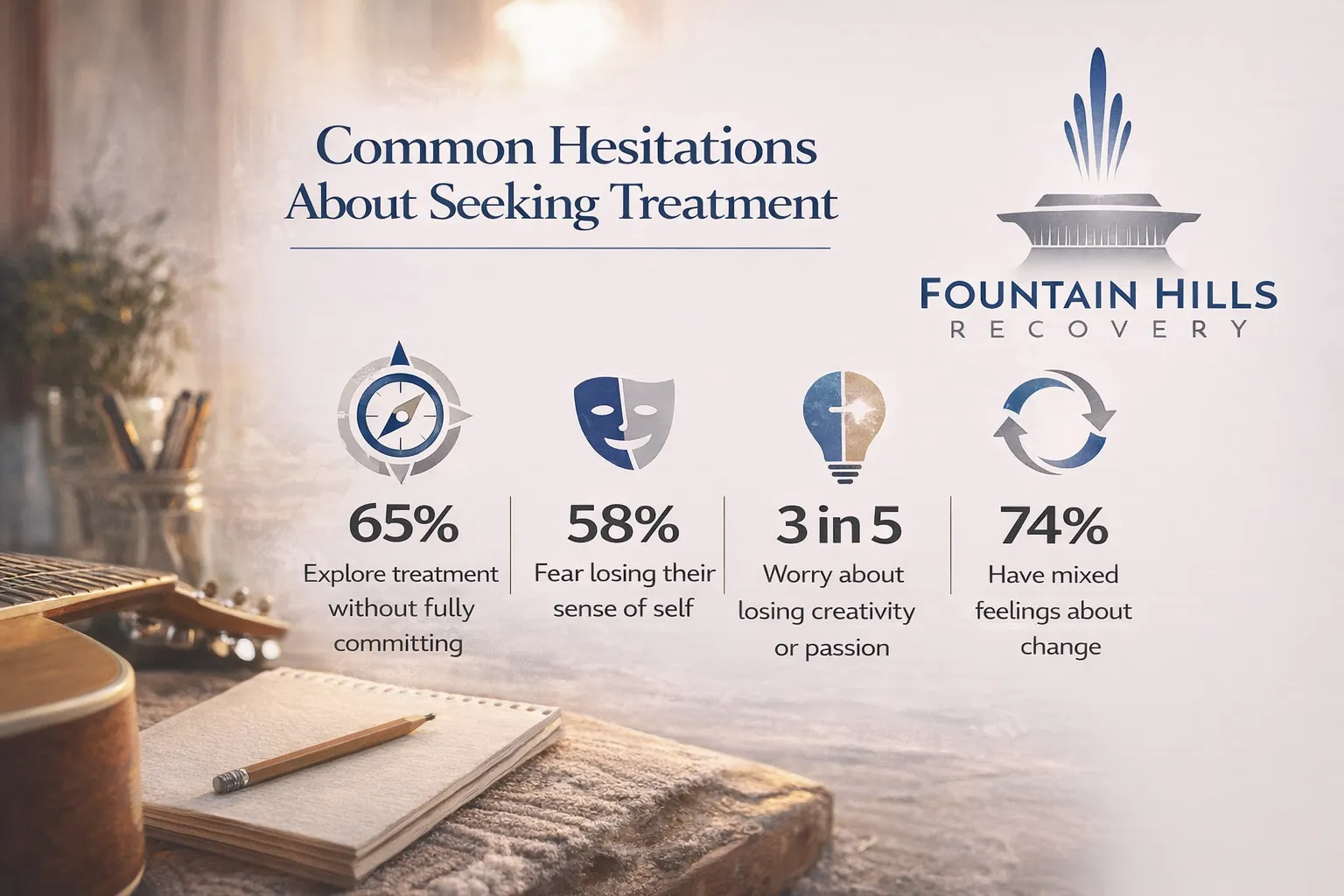
Some people begin by simply exploring a live-in treatment option without making any promises to themselves. Just looking. Just wondering.
That hesitation isn’t a flaw.
It’s your mind trying to protect something important.
The Fear Isn’t About Treatment—It’s About Who You Are
When we sit with people at the beginning of this process, we often hear a version of the same concern:
“I don’t want to become someone I don’t recognize.”
And that makes sense.
Because for many people, their identity isn’t separate from their struggle—it’s intertwined with it.
Maybe substances have helped you:
- Feel more open in social spaces
- Access emotions that feel hard to reach otherwise
- Quiet your thoughts just enough to create or function
Or maybe you’ve built an identity around being intense, expressive, or different.
So the fear isn’t just about stopping something.
It’s about unraveling something.
And wondering what’s left underneath.
You’re Not Afraid of Healing—You’re Afraid of Losing Your Depth
A lot of people don’t say this part out loud—but it’s there.
“What if I stop feeling things as deeply?”
“What if I lose my creativity?”
“What if I become… flat?”
These are real fears, especially for people who feel like their emotions are tied to their identity.
But here’s what we often see, over time—not in a forced way, but gradually:
Your depth doesn’t disappear.
It becomes more usable.
Instead of being overwhelmed by everything you feel, you begin to hold it.
There’s a difference between drowning in emotion and being able to swim in it.
Recovery doesn’t take away the water.
It just teaches your body how to stay afloat.
What Actually Changes (And What Doesn’t)
There’s a common assumption that healing means becoming a completely different person.
In reality, the changes are more subtle—and often more relieving than expected.
What usually stays:
- Your sense of humor
- Your way of thinking
- Your creative instincts
- Your emotional range
What often shifts:
- The intensity that leaves you exhausted
- The chaos that makes everything feel unstable
- The constant mental noise that’s hard to escape
One person shared this after a few weeks of care:
“I thought I’d lose my edge. But I didn’t lose it—I just stopped hurting all the time.”
That distinction matters.
Because what people often call their “edge” is sometimes just unmanaged pain.
And pain doesn’t have to be the price of being yourself.
The Version of You That’s Been Buried Under Survival
Sometimes, the version of you that feels most familiar… isn’t actually your full self.
It’s the version that learned how to cope.
The one who:
- Pushes through exhaustion
- Keeps everything moving, no matter what
- Uses whatever works in the moment to get by
That version deserves compassion. It got you here.
But it’s not the only version of you.
Underneath that, there’s often something quieter.
Not less interesting.
Not less creative.
Just less overwhelmed.
Recovery doesn’t erase your identity.
It creates space for more of it to exist.
Real Stories of People Who Had the Same Fear
This fear is more common than you think—and so is what happens next.
We’ve seen people come in convinced that healing would take everything from them.
And then, slowly, something shifts.
A musician who hadn’t picked up his guitar in months—not because he didn’t love it, but because everything felt too heavy—starts playing again. Not to escape, but because he wants to.
A writer who was afraid medication would “numb her out” later says,
“I still feel everything. I just don’t feel like I’m unraveling every time I do.”
An artist who thought her creativity depended on chaos realizes her ideas are actually clearer—more intentional, more focused.
None of this happens overnight.
It happens in small, steady moments.
And most people don’t feel like they’ve become someone new.
They feel like they’ve come back to themselves.
The Role of a Safe, Structured Environment
One of the reasons this shift can happen is because of the environment.
Not in a rigid or controlling way—but in a way that reduces pressure.
In a supportive, live-in setting, you don’t have to:
- Manage everything alone
- Pretend you’re okay when you’re not
- Figure out every answer right away
Instead, there’s a rhythm to your day. A steadiness.
And that steadiness gives your mind space to settle.
When your system isn’t constantly overwhelmed, something important happens:
You start to hear yourself again.
Not the anxious voice. Not the critical one.
The real one.
You Don’t Have to Decide Who You’ll Become
One of the biggest misconceptions is that starting treatment means committing to a new identity.
It doesn’t.
You’re not being asked to decide who you’ll be for the rest of your life.
You’re just being invited to explore what it feels like to have support.
That’s it.
You’re allowed to:
- Be unsure
- Ask questions
- Change your mind
- Move slowly
Some people begin by looking into treatment options in Scottsdale Addiction Rehab and Mental Health because it feels accessible.
Others choose something quieter, finding support in Fountain Hills Drug where they can step away from noise and reconnect privately.
There’s no right version of starting.
Only the version that feels possible.
You’re Not Becoming Someone Else—You’re Coming Back to Yourself
This is the part that’s hardest to trust at first.
That you won’t lose what makes you different.
That you won’t become less.
That you won’t disappear.
Instead, what many people experience is this:
They still feel deeply—but with less overwhelm.
They still create—but with more clarity.
They still care—but without burning out.
It’s not a loss.
It’s a return.
Like finding a version of yourself that’s been there all along—but harder to access.
What If You’re Still Not Sure?
That’s okay.
You don’t have to feel ready to take a step.
You don’t have to believe this will work.
You don’t have to feel confident.
You just have to be a little curious about the possibility that things could feel different.
That maybe you don’t have to keep carrying everything the way you have been.
That maybe there’s room for relief—without losing yourself.
That’s where it begins.
Frequently Asked Questions
Will I lose my creativity if I get help?
This is one of the most common fears—and it’s valid. What most people experience isn’t a loss of creativity, but a shift. Your ideas are still there. Often, they feel clearer and easier to access without the weight of overwhelm.
What if I feel like my personality is tied to my struggles?
That feeling is more common than people realize. Over time, many discover that their personality is still intact—it’s just not defined by stress, chaos, or coping patterns anymore.
Will I feel like a different person?
You may feel different—but not in the way you’re imagining. Most people describe it as feeling more like themselves, not less.
What if I’m not ready to fully commit?
You don’t have to be. Exploring your options, asking questions, and taking small steps is completely okay.
Can I still make my own decisions in treatment?
Yes. Your voice matters. Good care includes collaboration, not control.
What if I’ve used substances to help me connect socially?
This is something we talk about openly. Social connection doesn’t disappear—it just becomes more genuine, without needing something external to access it.
Is it normal to feel afraid of change, even if I want it?
Yes. Wanting change and fearing it can exist at the same time. That doesn’t mean you’re not ready—it means you’re human.
The First Step Can Be Quiet
Taking the first step doesn’t have to be dramatic.
It can be as simple as:
- Reading something like this
- Asking a question
- Looking into what support might feel like
You don’t need certainty.
You don’t need confidence.
You just need a small openness to the idea that you don’t have to lose yourself to feel better.
If you’re curious about what that next step could look like, we’re here to talk—without pressure, and without trying to change who you are.
Call (800) 715-2004 to learn more about our residential treatment program in Scottsdale, Arizona.