


You got them there.
Whether it took months of conversations, one explosive night, or a crisis that forced everyone’s hand — they’re finally inside a safe place.
And now your mind is racing.
Are they scared?
Are they angry?
Are they detoxing alone in a room?
Did I do the right thing?
If you’re researching alcohol addiction treatment for your young adult, the first 72 hours can feel like the most terrifying stretch of time. You’ve lived in chaos for so long that even calm feels suspicious.
Let’s walk through what really happens.
Not the brochure version. The real one.
The First 24 Hours: Containment, Not Confrontation
The first day is about safety.
Not lectures. Not breakthroughs. Not digging into childhood trauma.
Safety.
Your child is welcomed in. Their physical health is assessed. We gather a full picture — substance use patterns, sleep, appetite, mood changes, medical history, risk factors.
If withdrawal is a concern, medical monitoring begins immediately. Alcohol withdrawal can be serious, and careful stabilization matters. That’s handled with steadiness and oversight — not panic.
There is no shaming. No “How could you do this to your family?”
What most young adults experience in the first 24 hours is something unfamiliar: a nervous system that’s finally being held by structure.
For many parents, this is the first real exhale in months.
You are not the only one watching them anymore.
Expect Emotional Swings — They’re Normal
Early stabilization can look messy emotionally.
Your child may cycle through:
- Relief
- Anger
- Fear
- Numbness
- Tears
- Defensiveness
They might say, “I don’t need this.”
They might say nothing at all.
Both are normal.
Alcohol numbs emotion. When it’s removed, feelings don’t reappear neatly. They surge. They wobble. They fluctuate.
When families look into treatment in Fountain Hills, they often imagine emotional escalation. In reality, our role is to reduce volatility — to contain the storm, not amplify it.
Emotional turbulence in the first 72 hours does not mean it’s failing.
It means the system is recalibrating.
The Second Day: Routine Begins to Do Its Work
By day two, something subtle happens.
Rhythm.
Wake-up times. Meals. Check-ins. Rest periods. Introductions to staff. Gentle exposure to group settings.
Routine may sound basic. It’s not.
Addiction thrives in unpredictability. It feeds off disrupted sleep, irregular meals, isolation, secrecy.
Routine interrupts that cycle.
Your child may not say, “I feel better.”
But you may hear less chaos in their voice. Less frantic energy. Slightly slower speech.
That’s stabilization beginning.
It’s quiet work — but it’s powerful.
The Whole Picture Gets Assessed
Alcohol misuse rarely exists in a vacuum.
Often, underneath it, we see depression. Anxiety. Trauma. ADHD. Sometimes when mental health and substance use collide, it’s difficult to tell which came first.
In those first 72 hours, we’re looking carefully at:
- Mood stability
- Suicidal thoughts or self-harm risk
- Sleep disruption
- Co-occurring mental health conditions
- Trauma history
- Family dynamics
This is not about labeling your child.
It’s about understanding what we’re actually treating.
If you’re also exploring support in Scottsdale or nearby communities, this whole-person assessment is critical. You can’t build a stable plan on incomplete information.
Parents sometimes feel impatient during this phase.
But clarity now prevents relapse later.
You May See Vulnerability You Haven’t Seen in Years
This part can be emotionally intense.
When alcohol is removed, the coping shield comes down.
Your child may appear softer. Younger. More overwhelmed than you expected.
You might hear:
“I don’t know how I got here.”
“I feel ashamed.”
“I’m scared.”
That vulnerability can be hard to witness. It can make you question everything.
But here’s the truth: pain is workable.
Chaos is not.
When the pain becomes visible, it means the masking has stopped.
And that’s the beginning of real work.
Sleep and Nutrition Start to Reset the Nervous System
Many young adults entering care are severely sleep-deprived. Their eating patterns are inconsistent. Their bodies are inflamed, dehydrated, depleted.
The first 72 hours prioritize:
- Rest
- Hydration
- Balanced meals
- Gentle medical oversight
Sleep alone can dramatically reduce agitation and impulsivity.
Parents are often surprised how much shifts when the body stabilizes. It doesn’t fix everything — but it lowers the emotional temperature enough for therapy to begin meaningfully.
The brain cannot process trauma or accountability when it’s exhausted.
Stabilization isn’t cosmetic. It’s foundational.
You’re Not Shut Out of the Process
Parents often ask, “Will I know what’s happening?”
Yes — within appropriate privacy boundaries.
You’ll receive guidance on:
- What emotional shifts are normal
- How to communicate supportively
- What boundaries look like moving forward
- When family involvement begins
We understand that you’ve been living in hypervigilance. The early days are also about helping you step out of crisis mode.
You may feel guilt. Relief. Anger. Exhaustion.
All of that is valid.
This isn’t just your child entering stabilization. It’s your nervous system beginning to regulate too.
It’s Not About Insight Yet
Parents often expect immediate breakthroughs.
Apologies. Realizations. Promises.
The first 72 hours are not about insight.
They are about regulation.
Trying to force deep reflection in the middle of withdrawal or acute stabilization is like asking someone to solve algebra during an earthquake.
First we calm the ground.
Then we build.
Insight comes when the nervous system is steady enough to hold it.
The Energy Changes — Even If the Words Don’t
Here’s something families notice.
By the third day, even if your child hasn’t declared gratitude or transformation, something feels different.
The energy softens.
The edge dulls.
The constant sense of emergency eases.
That shift matters.
Addiction creates urgency and chaos. Early care creates containment and structure.
Containment is the beginning of safety.
Safety is the beginning of trust.
Trust is the beginning of recovery.
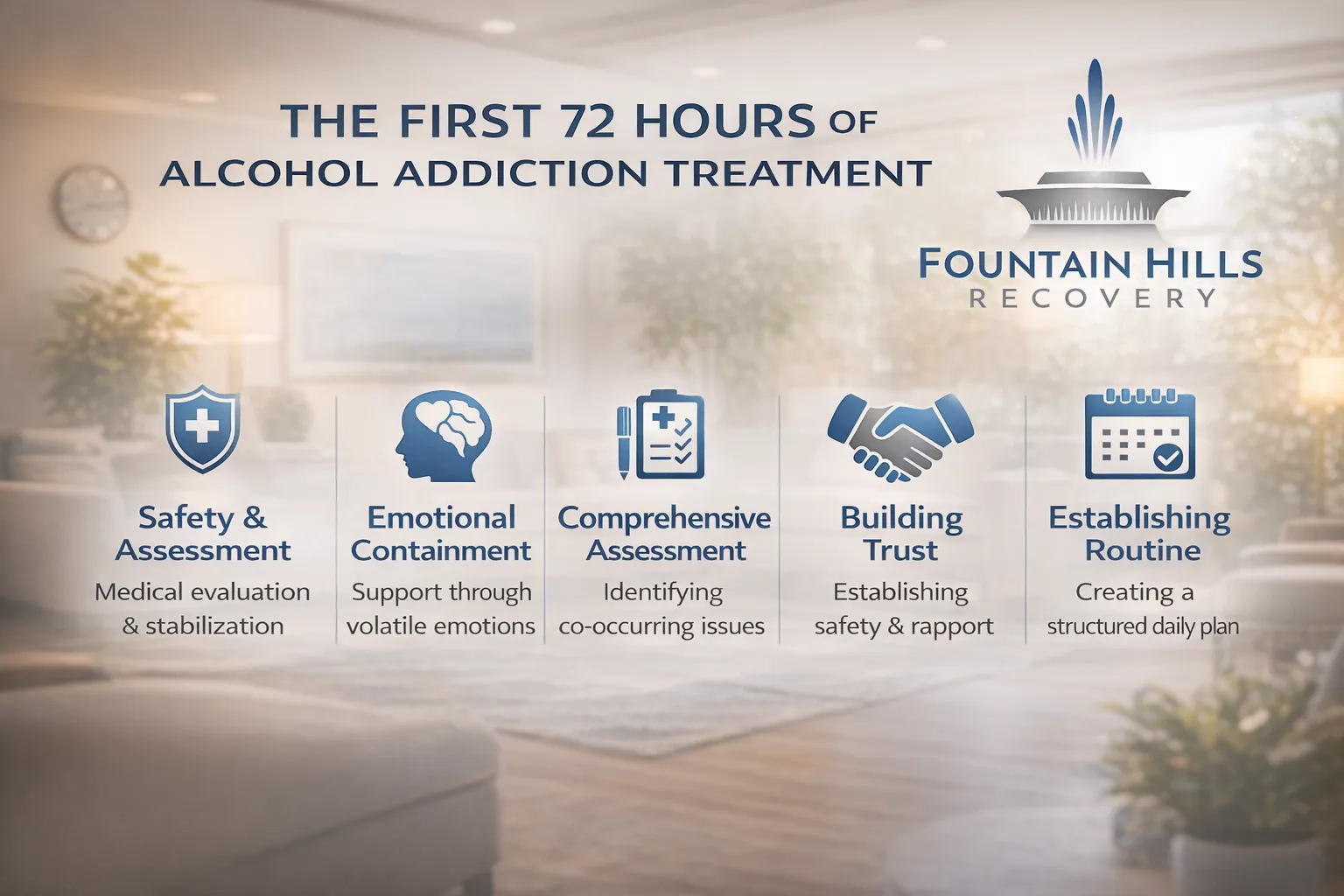
What the First 72 Hours Are Really For
Let’s be clear.
The first 72 hours are not about curing addiction.
They are about:
- Physical stabilization
- Emotional containment
- Comprehensive assessment
- Establishing trust
- Beginning routine
It’s the moment when the free fall slows down.
For parents who have been bracing for disaster every day, that slowdown can feel almost surreal.
Not because everything is fixed.
But because it’s finally being held.
FAQs: What Crisis Parents Often Ask
Is my child going to hate me for bringing them here?
They might be angry at first. That’s common. But anger in early stabilization is usually about fear and loss of control. As safety increases, perspective often shifts. Short-term anger does not equal long-term resentment.
What if they try to leave?
Policies differ by age and circumstance, but early stabilization includes clear expectations and boundaries. We focus on engagement and safety, not confrontation. Many young adults feel relief once the initial shock settles.
How will I know if it’s working?
Look for subtle signs:
- More consistent sleep
- Slightly steadier mood
- Reduced reactivity
- Willingness to attend groups
Early progress is often quiet, not dramatic.
What if they relapse after this?
Relapse is a risk in recovery, but stabilization reduces immediate danger and creates a structured plan. The first 72 hours are about building a foundation that supports longer-term change.
Should I call them constantly?
Early boundaries matter. Too much contact can heighten emotion. Too little can feel abandoning. We help families find a balanced, clinically appropriate communication plan.
What if I feel relief?
Relief is normal.
You’ve likely been in crisis mode for months or years. When someone else steps in, your body may finally unclench.
Relief doesn’t mean you don’t love them.
It means you’ve been carrying too much for too long.
You didn’t cause this.
You are not failing your child.
And getting them through the door — even if it was messy, painful, or forced — is not betrayal. It’s protection.
The first 72 hours are about slowing the spiral and creating safety.
From there, real healing begins.
Call 800-715-2004 or visit our alcohol addiction treatment services to learn more about what the next steady step could look like for your family.