


I remember thinking, “This is it? This is what better feels like?”
Not out loud.
Not in a dramatic way.
Just quietly… in the middle of a normal day that should’ve felt good.
I had done the hard part. Or at least the part everyone talks about.
I got sober.
I followed the plan.
I did the work people could see.
And to be fair—things were better.
No chaos. No constant damage control. No waking up wondering what I said or did the night before.
But something else had taken its place.
Not pain. Not even struggle.
Just… distance.
Like I was finally out of the storm—but standing in a kind of silence I didn’t know how to fill.
If you’ve felt that, even for a moment, you’re not alone in it.
Some of us got here after real, meaningful support—like support for both mental health and substance use—but staying connected to ourselves afterward? That turned out to be a different kind of work.
Getting Better Doesn’t Automatically Feel Better
This is the part no one really prepares you for.
You expect relief.
Maybe even a sense of arrival.
And sometimes you do feel that—at first.
But then life settles.
And without the chaos, without the intensity, without the constant push and pull… things can feel unfamiliar in a different way.
You’re no longer in crisis.
But you’re not fully connected either.
It’s like stepping out of a loud room and into complete silence.
At first, it’s peaceful.
Then, after a while, it’s unsettling.
The Identity You Built Doesn’t Just Fade Away
For a long time, everything revolved around the struggle.
Your routines.
Your relationships.
Even the way you saw yourself.
You adapted to it. You learned how to function inside it.
So when that’s gone—or even just quieter—you’re left with something that feels surprisingly uncomfortable:
Space.
And with that space comes a question that doesn’t have a quick answer:
“Who am I without all of that?”
That question isn’t a setback.
It’s a turning point.
Because now, instead of reacting to your life, you’re being asked to create it.
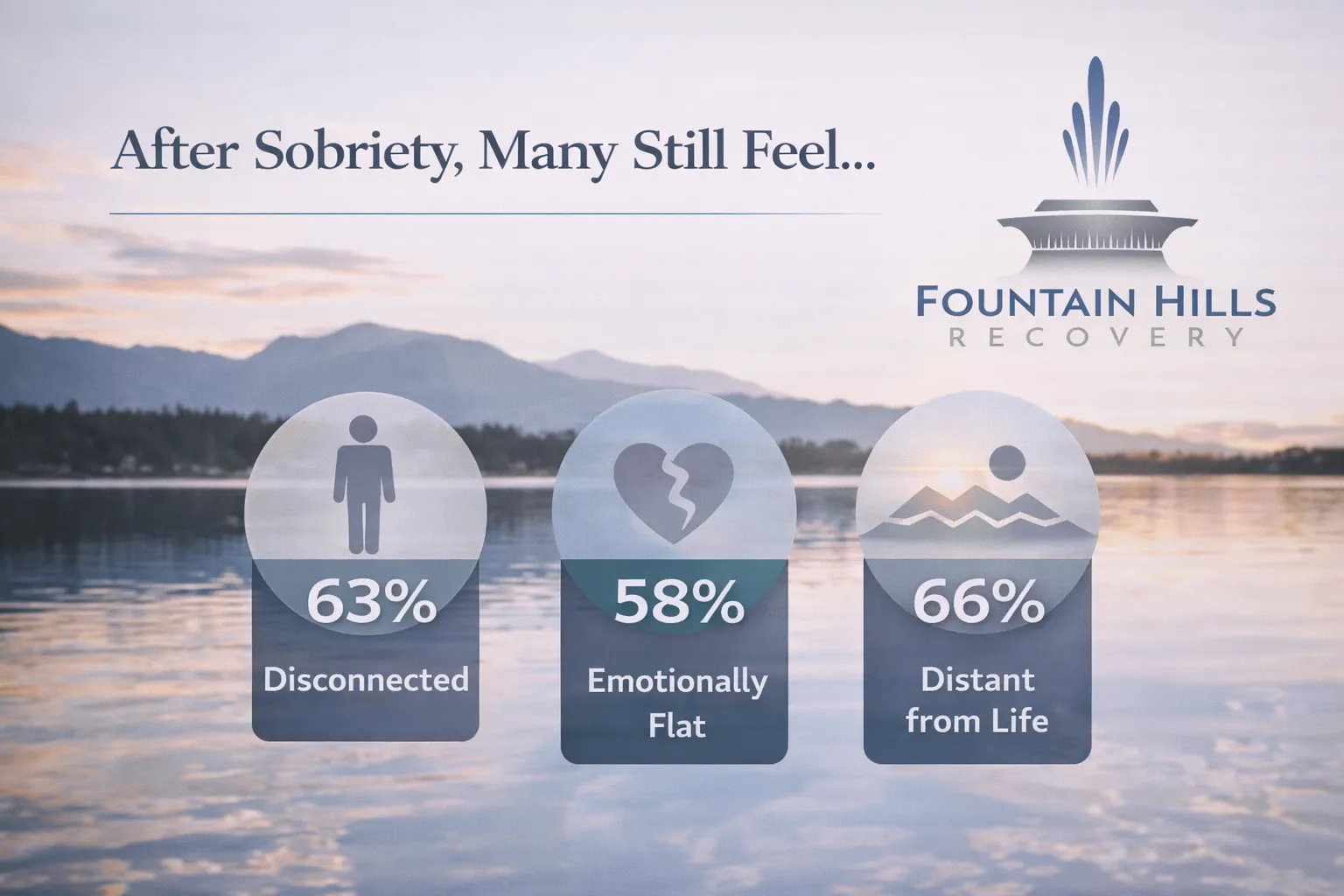
Why Disconnection Shows Up Later—Not Sooner
Early recovery has structure.
There’s momentum. A sense of direction.
You know what you’re working toward.
But over time, that structure loosens.
The urgency fades. The next steps become less clear.
And that’s often when disconnection starts to show up.
You might notice:
- Going through your day without really feeling part of it
- Doing things that used to matter, but now feel flat
- Feeling like you’re “fine”… but not fulfilled
It’s subtle.
And because it’s not dramatic, it’s easy to ignore.
But ignoring it doesn’t make it go away.
The Part That’s Hard to Admit
There’s something many people feel—but don’t say:
You don’t miss the chaos.
But you miss the intensity.
Not the consequences. Not the damage.
Just the feeling of being fully in something—even if it wasn’t good for you.
Life now feels steadier.
But also… quieter.
And sometimes, that quiet can feel like emptiness.
That doesn’t mean something is wrong.
It means your system is adjusting.
Learning how to feel without extremes.
Connection Isn’t Something That Just Comes Back
This is where things shift.
Getting sober creates space.
But connection doesn’t automatically fill that space.
It has to be built.
And not in a forced way—in a real way.
It might look like:
- Trying things that feel unfamiliar at first
- Letting yourself be bad at something new
- Building relationships that aren’t based on old patterns
- Sitting with yourself without immediately reaching for distraction
It’s slower.
Less obvious.
But it’s where things start to feel real again.
The Work That Comes After “The Work”
A lot of people think the hardest part is stopping.
And in many ways, it is.
But there’s another kind of work that comes after:
Learning how to stay connected.
Not just to other people—but to yourself.
That means:
- Not checking out when things feel flat
- Not chasing intensity just to feel something
- Being honest about where you actually are—not where you think you should be
It’s not about doing more.
It’s about being more present with what’s already there.
What Helped Me Start Feeling Again
It didn’t happen all at once.
There wasn’t a breakthrough moment.
It was gradual.
Almost easy to miss at first.
I had to:
- Stop pretending I was “fine” just because I was sober
- Admit that something still felt off
- Pay attention to what actually made me feel present—even if it was small
Some days, that looked like nothing more than noticing a moment.
A real one.
Not forced. Not dramatic.
Just… genuine.
And over time, those moments started to connect.
You’re Not Broken—You’re in a Different Phase
This part matters.
Because it’s easy to think:
“I did all that work… why do I still feel like this?”
But this isn’t failure.
It’s depth.
You’ve moved past survival.
Now you’re learning how to live.
And living isn’t something you figure out once.
It’s something you keep building.
When It Makes Sense to Reach for Support Again
There’s a misconception that going back for support means something went wrong.
It doesn’t.
Sometimes it just means you’ve reached a new layer.
A different kind of challenge.
Some people revisit support because they want more—not because things are falling apart.
You might explore support in Scottsdale Addiction Rehab and Mental Health if you want to reconnect while staying engaged in your day-to-day life.
Or look into help in Fountain Hills Drug if stepping away for a reset feels like what you need.
There’s no rule that says support is only for crisis.
Sometimes it’s for growth.
The Version of You That’s Still Unfolding
This stage isn’t about fixing something.
It’s about discovering something.
What actually matters to you now.
What feels meaningful—not just familiar.
What makes you feel connected—not just occupied.
And that version of you?
It’s not missing.
It’s just still unfolding.
Without the noise that used to define everything.
Frequently Asked Questions
Is it normal to feel disconnected after long-term sobriety?
Yes. Many people experience this after the initial intensity of recovery fades. It’s a common but rarely talked about phase.
Does this mean something is wrong with my recovery?
No. It usually means you’re moving into a deeper stage—where it’s less about stopping and more about living.
Why do I feel flat even though my life is stable?
Because stability removes chaos—but it doesn’t automatically create connection. That part takes time and intention.
Will this feeling go away on its own?
Sometimes it softens over time, but engaging with it—rather than ignoring it—usually helps more.
Should I go back to treatment?
Not necessarily in the same way—but additional support can help you reconnect and move through this phase more intentionally.
What helps with feeling connected again?
Honesty, consistency, and small moments of real engagement—rather than trying to force big changes all at once.
What if I feel guilty for not feeling “better”?
That’s common. But recovery isn’t about constant improvement—it’s about staying engaged with where you are.
The Quiet Truth About Staying Connected
Getting sober changes your life.
But staying connected to it?
That’s something you build.
Not quickly. Not perfectly.
But honestly.
And if you’re in that space where things feel distant, flat, or a little out of reach—it doesn’t mean you’ve lost anything.
It means you’re ready for something deeper.
If you’re feeling disconnected and want to explore what deeper support could look like, you don’t have to figure it out alone.
Call (800) 715-2004 to learn more about our dual diagnosis treatment in Scottsdale, Arizona.