


There’s a conversation that happens quietly in your head.
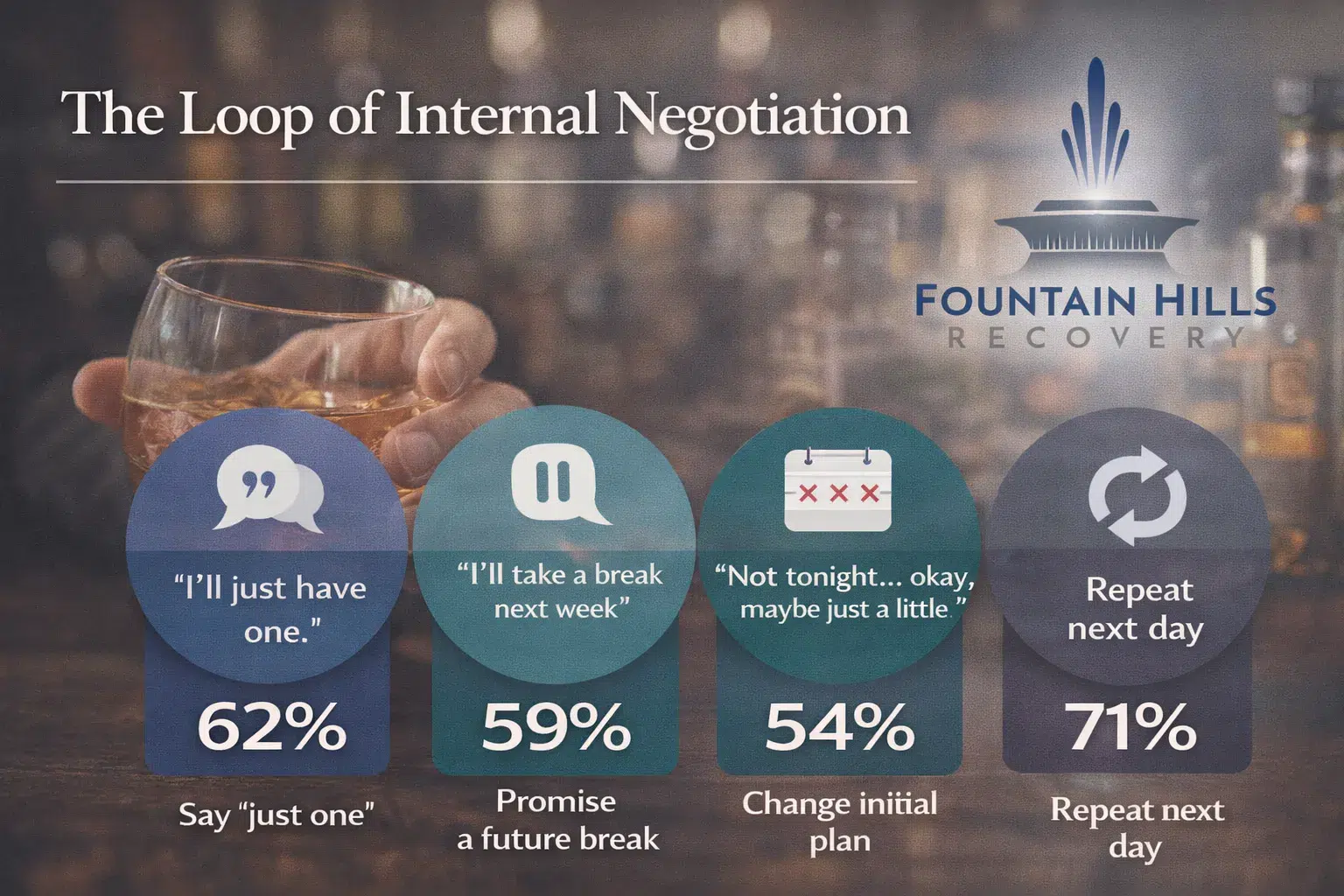
“I’ll just have one.”
“Not tonight… okay, maybe just a little.”
“I’ll take a break next week.”
And then the next day, it starts again.
Not loud. Not dramatic.
Just constant.
If you’re here, you probably recognize that pattern.
You’re not in denial—you’re aware.
But you’re also stuck in the middle of it.
A lot of people reach this point before they ever say anything out loud. They start by exploring something like help for alcohol use and recovery—not because they’ve made a decision, but because they’re tired of negotiating with themselves every day.
This guide isn’t about forcing a decision.
It’s about helping you step out of that loop—gently, honestly, and in a way that actually feels possible.
Step 1: Notice the Pattern—Not Just the Behavior
Most people focus on the drinking itself.
How much. How often. When.
But the real exhaustion usually isn’t just the behavior—it’s the thinking around it.
The rules you make.
The exceptions you allow.
The constant adjusting.
You might notice:
- Promising yourself “just weekends”… then redefining what counts
- Saying “just one”… then negotiating a second
- Thinking about drinking long before you actually do
That mental loop can be more draining than the drinking itself.
And the goal here isn’t to judge it.
It’s to see it clearly.
Because once you see the pattern—not just the behavior—you start to understand what you’re actually dealing with.
Step 2: Stop Trying to Win the Argument in Your Head
There are usually two voices in this loop.
One says:
“I need to stop this.”
The other says:
“I just need a break.”
Both are real.
Both are trying to help you in different ways.
But when you try to “win” that argument through willpower, you often stay stuck.
Because it’s not really a discipline problem.
It’s a needs problem.
Instead of asking, “How do I control this better?”
Try asking, “What am I actually trying to get from this?”
Relief?
Quiet?
Connection?
Escape?
That question changes the direction.
Step 3: Get Honest About the Daily Cost
Not the extreme version. Not the worst-case scenario.
Just the everyday reality.
Ask yourself:
- How much space does this take up in my mind?
- How often do I plan around it?
- How do I feel afterward—physically and mentally?
You don’t need a dramatic story to justify change.
You just need an honest one.
Because the cost often shows up quietly:
- In your energy
- In your focus
- In how present you feel in your own life
And over time, that adds up.
Step 4: Let Go of the “I’m Not That Bad” Filter
This one keeps a lot of people stuck for years.
“I’m still functioning.”
“Other people have it worse.”
“It’s not affecting my life that much.”
But here’s the thing:
You don’t have to be falling apart for something to matter.
You don’t have to hit a breaking point to deserve support.
You just have to recognize:
“This isn’t working the way I want it to.”
That’s enough.
Step 5: Interrupt the Loop—Even Briefly
You don’t have to solve everything right away.
But you can create small interruptions.
Moments where the pattern doesn’t automatically continue.
That might look like:
- Pausing when the urge shows up instead of acting immediately
- Letting yourself sit with the thought instead of negotiating it
- Choosing one different response—even once
Not to prove anything.
Just to experience something different.
Because even a small interruption can show you that the loop isn’t as fixed as it feels.
Step 6: Get Curious Instead of Critical
A lot of people approach this with self-judgment.
“Why can’t I just stop?”
“What’s wrong with me?”
But that kind of thinking usually keeps the loop going.
Instead, try curiosity:
“What’s happening right before I want to drink?”
“What am I trying not to feel?”
“What would actually help in this moment?”
Curiosity creates space.
And space is what allows change to happen.
Step 7: Explore Support Without Pressure
This is where things often shift.
Because many people assume getting help means:
- Making a huge commitment
- Changing everything overnight
- Giving up control
But for most people, the first step is much simpler.
It’s just… learning.
Understanding what support looks like.
Having a conversation.
Some start by exploring support in Scottsdale Addiction Rehab and Mental Health—something that feels accessible and grounded in their daily life.
Others look into care in Fountain Hills Drug, where they can step away from the noise and focus more fully on themselves.
There’s no pressure to decide everything.
Just an opportunity to understand your options.
Step 8: Decide What “Enough” Means for You
At some point, the question becomes:
“How long do I want to keep doing this?”
Not in a harsh way.
In an honest way.
Because staying in the loop has a cost.
And stepping out of it—even partially—creates something different.
You don’t have to define your future.
You just have to decide what you’re ready for right now.
Maybe that’s:
- More clarity
- More support
- Less mental back-and-forth
That’s enough.
What Changes When You Step Out of the Loop
It’s not instant transformation.
It’s not everything becoming easy.
It’s something quieter.
Relief.
Relief from:
- Constant decision-making
- Internal arguments
- The pressure of managing it alone
One person said:
“I didn’t realize how loud my head was until it got quieter.”
That quiet matters.
More than people expect.
The Part Most People Don’t Expect
You don’t lose control by getting help.
You actually gain it.
Because instead of reacting automatically, you start responding intentionally.
Instead of negotiating every day, you start making clearer choices.
And instead of carrying everything alone, you have support.
Not pressure.
Support.
Frequently Asked Questions
Is it normal to feel stuck in this cycle?
Yes. Many people experience this exact back-and-forth before making any change.
What if I don’t want to stop completely?
That’s okay. You don’t have to decide everything upfront. You can start by exploring your options.
Do I need to hit a breaking point first?
No. You can take this seriously long before things fall apart.
What if I’ve tried to cut back before and couldn’t?
That’s common. It usually means you need more support—not more willpower.
What if I’m scared to take the next step?
That’s completely normal. You don’t have to feel ready—you just have to be willing.
What if I don’t know what I need yet?
You don’t have to know. Exploring support can help you figure that out.
The Step That Actually Changes Things
You don’t need certainty.
You don’t need confidence.
You don’t need a perfect plan.
You just need to stop negotiating long enough to take one clear step.
Because staying in the loop?
That’s exhausting.
And you don’t have to keep doing it.
If you’re ready to explore what that next step could look like, we’re here to help—without pressure, and at your pace.
Call (800) 715-2004 to learn more about our alcohol addiction treatment in Scottsdale, Arizona.