






You’ve done everything you were told would help.
You found a therapist.
You made sure they went.
You kept showing up—even on the hard days.
And maybe, for a while, it felt like something was shifting.
But now… something doesn’t feel right.
Not worse in a loud, obvious way.
Worse in a quiet, unsettling way.
Like you’re watching your child slip just out of reach—and you can’t quite explain why.
If you’ve had the thought, “This should be helping more than it is,” you’re not wrong for noticing that.
Some families reach this point and begin exploring support for both mental health and substance use not because they’ve lost faith in therapy—but because they’re realizing their child may need more than one layer of care.
The Moment Things Stop Making Sense
Most parents can point to a moment when things stopped adding up.
It’s not always dramatic.
Sometimes it looks like:
- Your child saying the “right” things in therapy—but not living them at home
- Progress that shows up briefly, then disappears
- Emotional reactions that feel bigger than the situation in front of them
- A growing distance between who they used to be and who they are now
You start to feel like you’re watching two different realities.
One inside the therapy room.
One outside of it.
And you’re left trying to reconcile the gap.
That gap is often where deeper complexity lives.
When It’s Not Just One Struggle Anymore
Another alum’s story — I thought I could handle it alone until I couldn’t anymore — captures that same shame.
Early on, things can look like one clear issue.
Anxiety. Depression. Behavioral changes.
But over time, those experiences can start to layer.
They interact in ways that are hard to separate:
- Emotional pain increases coping behaviors
- Coping behaviors create more consequences
- Those consequences deepen the emotional distress
It becomes a loop.
And that loop can’t always be broken by addressing just one piece of it.
This is often the point where parents realize:
“We’re not dealing with one thing anymore.”
Why Therapy Alone Can Start to Feel Like It’s Falling Short
Therapy is powerful. It creates space for understanding, expression, and healing.
But therapy usually exists within a limited window—an hour at a time, once or twice a week.
And for some young adults in crisis, what they’re dealing with doesn’t stay contained in that hour.
It shows up:
- Late at night
- In moments of overwhelm
- In impulsive decisions
- In ways that feel unpredictable
So even if therapy is helping in conversation, it may not be enough to stabilize what’s happening in real time.
That doesn’t mean therapy failed.
It means the situation has grown beyond what that level of support can hold.
The Back-and-Forth That Wears You Down
One of the most exhausting parts for parents is the cycle.
Things seem better…
Then suddenly, they’re not.
You start to question everything:
“Did we push too hard?”
“Are we expecting too much?”
“Is this just how it’s going to be?”
That emotional whiplash is real.
And over time, it can leave you feeling:
- Drained
- Confused
- Afraid to hope for improvement
But this pattern isn’t random.
It’s often a sign that something underneath hasn’t been fully addressed yet.
The Signs That It’s Time to Look at More Support
No parent wants to escalate care unnecessarily.
But there are moments where staying at the same level of support quietly allows things to get more unstable.
You might notice:
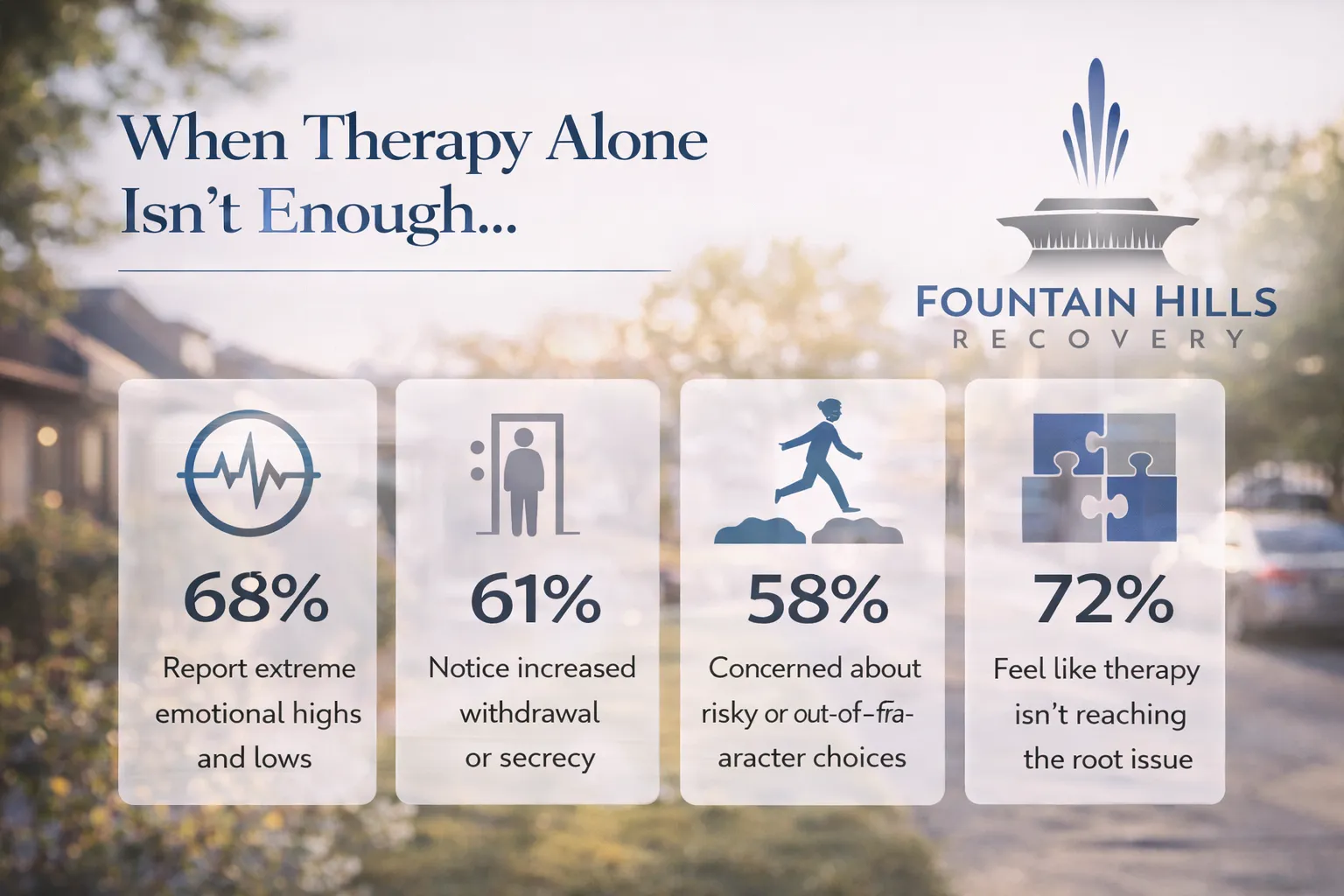
- Emotional highs and lows that feel extreme or unpredictable
- Increased withdrawal, isolation, or secrecy
- Risk-taking behavior or choices that feel out of character
- Therapy insights that don’t translate into daily life
- A growing sense that your child is overwhelmed in ways they can’t articulate
And maybe the hardest one to say out loud:
You feel like you’re losing them—even while you’re right there.
That feeling deserves attention.
What Changes When Care Expands to Meet the Full Picture
When support grows to match the complexity of what’s happening, something important shifts.
Instead of trying to manage separate pieces, care begins to look at how everything connects.
Not just what your child is doing—but why.
Not just what they’re feeling—but what’s driving it.
And when that happens:
- Patterns start to make sense instead of feeling chaotic
- Conversations go deeper, not just surface-level
- Progress becomes more stable—not perfect, but more consistent
It’s not about doing “more” for the sake of it.
It’s about doing what actually fits what your child is experiencing.
The Emotional Weight Parents Carry (And Don’t Always Share)
There’s something parents often carry quietly in this stage.
Guilt.
“Did we miss something?”
“Should we have acted sooner?”
“Did we do something wrong?”
These thoughts can be heavy.
But most families don’t start here.
They start with the least intensive support—because that’s what makes sense.
You didn’t fail by starting with therapy.
You responded with care, intention, and hope.
And now, you’re responding again—based on what you’re seeing.
That’s not failure.
That’s parenting.
You Don’t Have to Solve This Alone
At a certain point, trying to manage everything within the family can become overwhelming.
You’re not just a parent—you’ve become:
- A constant support system
- A monitor of behaviors and moods
- A decision-maker in situations that feel urgent and unclear
That’s a lot for one person—or even one family—to carry.
Some parents begin by exploring support in Scottsdale Addiction Rehab and Mental Health to understand what expanded care might look like in a familiar setting.
Others look into support in Fountain Hills Drug, where a more structured and focused environment can help stabilize what’s been feeling unpredictable.
You don’t have to decide everything today.
You just have to take one step toward understanding your options.
What Parents Often Notice After Taking That Step
There’s a moment that many parents describe—not relief exactly, but something close to it.
It sounds like:
“Someone finally understood what we’ve been seeing.”
“We weren’t overreacting.”
“There was a plan that actually made sense.”
That doesn’t mean everything is instantly okay.
But it means you’re no longer trying to piece this together on your own.
And that shift—from isolation to support—can be powerful.
When It Feels Urgent (But You’re Still Unsure)
Sometimes, there’s a sense of urgency that’s hard to ignore.
Not panic—but a quiet awareness that things could escalate.
And at the same time, you might feel frozen:
“What if we overdo it?”
“What if this makes things worse?”
Those fears are valid.
But here’s something to hold onto:
Taking a step toward more support doesn’t lock you into anything permanent.
It opens the door to understanding what your child actually needs.
And understanding is what leads to better decisions.
Frequently Asked Questions
How do I know if therapy isn’t enough anymore?
If progress feels inconsistent, fragile, or disconnected from daily life, it may be a sign that more comprehensive support is needed.
Does this mean therapy didn’t work?
No. Therapy is often an important first step. It just may not be enough on its own for more complex situations.
What if my child resists getting more help?
That’s very common. Resistance often comes from fear, confusion, or overwhelm—not unwillingness to feel better.
Am I overreacting as a parent?
If something feels off, it’s worth paying attention. Many parents sense shifts before they’re fully visible.
Will more structured support make things harder for them?
The goal is the opposite—to create stability and reduce overwhelm, not increase it.
What if I’m scared to take the next step?
That’s completely normal. You don’t have to feel certain—you just have to be open to learning more.
How quickly should we act?
Every situation is different. But if things feel like they’re escalating, it’s worth exploring options sooner rather than later.
The Moment You Choose to Lean Toward Support
There’s rarely a clear, perfect moment.
No sign that says, “Now is the exact right time.”
It’s usually quieter than that.
A realization.
A pattern you can’t ignore anymore.
A feeling that something needs to change.
That moment matters.
Because it’s not about giving up on what you’ve tried.
It’s about recognizing that your child may need something more—and being willing to move toward it.
If you’re starting to feel like therapy alone isn’t enough, you don’t have to figure out the next step by yourself.
Call (800) 715-2004 to learn more about our dual diagnosis treatment in Scottsdale, Arizona.