




If you’ve ever said, “I tried treatment and it didn’t work,” you’re not wrong.
You’re not negative. You’re not resistant. You’re not making excuses.
You’re someone who showed up—probably scared, probably uncertain—hoping something would finally help. And when it didn’t, it left a deeper kind of pain: the kind that makes you question if anything will.
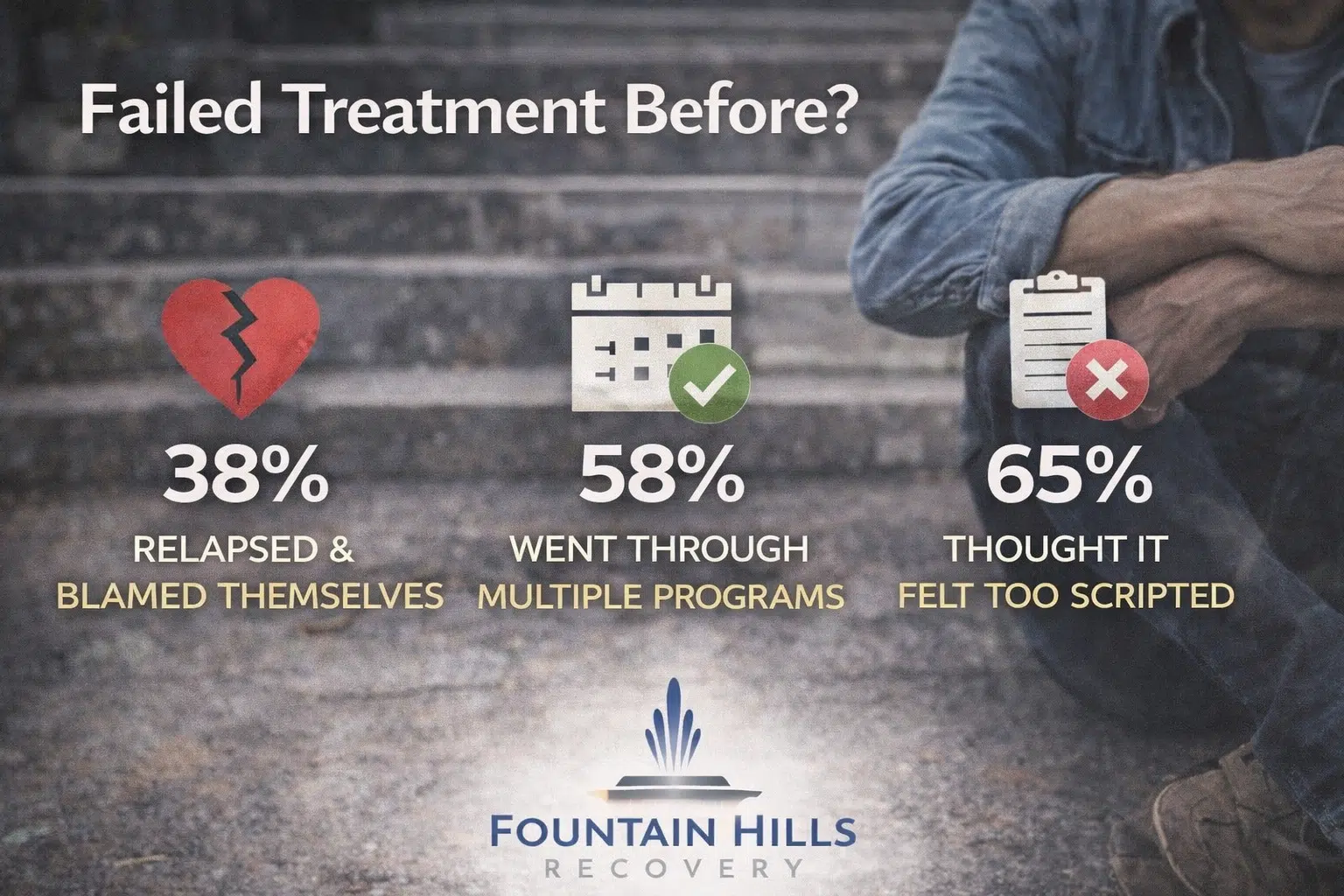
I’ve worked with a lot of people like you. Some came through our doors after three or four programs that left them cold. Some stayed sober for a while, then relapsed and blamed themselves. Others never got past the first week because something about the whole thing felt fake.
I’m not here to sugarcoat. I’m here to tell you this: treatment can feel different when it’s done with honesty. Not with performance. Not with pressure. With honesty.
Most People Don’t Fail Treatment—Treatment Fails Them
Let’s start here. A lot of people assume if someone relapses or doesn’t finish a program, they didn’t try hard enough.
That’s not always true.
Sometimes treatment didn’t get deep enough. Sometimes it was built around someone else’s checklist—not your real life. And sometimes the people running it were more concerned with discharge dates than your actual needs.
It’s okay to name that.
It’s not bitterness. It’s truth.
Real alcohol addiction treatment should begin with asking: “What didn’t work before?” If no one asks you that, they’re not really building care around you—they’re fitting you into a system that’s already set.
At Fountain Hills, that’s not how we operate.
You Don’t Have to Be the “Good Client” Anymore
If you’ve done this before, you’ve probably picked up on the expectations—whether anyone said them out loud or not:
• Say the right things in group.
• Talk about your “tools.”
• Be grateful.
• Don’t challenge the process.
• Keep your doubts to yourself.
But what if your doubts are the most honest thing you have? What if the most courageous thing you can say is, “I’m here, but I’m not sure this will help.”
Honest treatment welcomes that.
You don’t need to perform recovery. You need space to question it—without getting labeled “resistant” or “noncompliant.”
What Real Honesty Looks Like in Treatment
Let me get specific.
Honest treatment doesn’t just mean “be open in group.” It means the entire structure of care respects your reality.
It means we start by listening—to what hurt you, what you’re afraid of, what burned you last time. It means we’re upfront about what we can and can’t promise. It means you can tell us, “I don’t know if I want to be sober forever,” and we won’t flinch.
It’s not just about flexibility—it’s about respect.
That might sound small, but for people who’ve been through programs that felt generic or dismissive, it changes everything.
Treatment Isn’t a Script—And Recovery Isn’t a Straight Line
You know those diagrams where recovery is shown as a nice upward arrow?
Here’s the truth: real recovery is more like a scribble. Messy. Loopy. Up and down. Hopeful one day, numb the next.
If you tried treatment before and didn’t stay sober, it doesn’t mean it didn’t do something. Maybe it planted a seed. Maybe it gave you a glimpse of peace. Maybe it taught you what kind of care you don’t want.
That matters.
At Fountain Hills Recovery, we honor every chapter—even the ones you think don’t count.
You’re Allowed to Be Skeptical—and Still Show Up
I’ll be blunt: some of the people who’ve grown the most in our care walked in practically daring us to help them.
Not because they were rude or manipulative—but because they’d been let down. They were sick of being told what to do by people who didn’t ask what they’d already tried.
If that’s you? You’re welcome here.
You don’t have to trust us right away. You don’t have to believe everything will work. You just have to show up willing to have a real conversation—not a performance.
And if you’re looking for treatment options in Scottsdale or nearby that don’t treat you like a case file, you’ll find them here.
We Build Care Around You—Not Just the Diagnosis
Let’s talk about structure.
In most programs, you get a diagnosis and then a schedule. It’s not built around your trauma history. Or your grief. Or the fact that you’re working full time. Or your creative blocks. Or the religious trauma that makes “higher power” talk a no-go.
But honest treatment makes room for all that.
We ask questions that don’t have checkboxes. We tailor your therapy, your goals, and your support system to your actual life.
That’s why people who felt unseen elsewhere often find solid footing in our programs.
Fountain Hills Recovery offers the kind of individualized, relational care that meets you where you are—not where a chart says you “should” be.
You Can Be Angry. You Can Be Numb. You Can Be Real.
Treatment is not about feeling hopeful all the time.
Sometimes healing looks like crying in a group session you didn’t want to be in. Sometimes it’s walking out mid-sentence and coming back because someone actually checked on you. Sometimes it’s sitting in silence while someone says, “I get it.”
You can be disappointed. You can be pissed off. You can be disconnected.
And still—you belong.
We’re not looking for perfect clients. We’re showing up for real people.
Frequently Asked Questions
What if I’ve already been to rehab more than once?
That doesn’t disqualify you. In fact, it gives us a deeper place to start. We’ll talk honestly about what didn’t work—and what you need now.
I don’t want to stop drinking forever. Can I still come?
Yes. Honesty includes ambivalence. You’re not required to declare lifelong sobriety on day one. We’ll explore your relationship with alcohol together—without pressure.
What’s different about honest treatment?
It’s rooted in consent, curiosity, and flexibility. We don’t force scripts or punish skepticism. We work with who you are—not just the label you carry.
How do I know this won’t be another waste of time?
You don’t. That’s part of the risk. But we’ll never ask you to fake hope. We’ll earn your trust over time—by being consistent, transparent, and human.
Do you offer local support in Arizona?
Yes. We have help in Fountain Hills and throughout Arizona, with programs designed for people who need something more real, more nuanced, and more supportive.
You’re not broken. You’re just tired of being disappointed.
Call (800) 715-2004 to learn more about our alcohol addiction treatment services in Arizona.